Encyclopedia of Life · EOL (see source)
Sclerodermataceae
Sign in to saveAlso known as pestřecovité
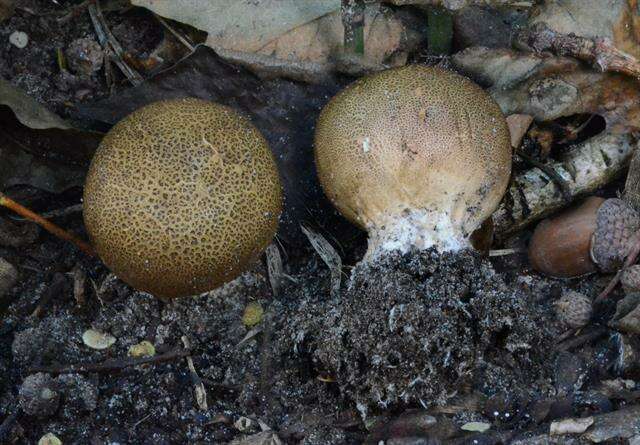
The Sclerodermataceae are a family of fungi in the order Boletales, containing several genera of unusual fungi that little resemble boletes. Taxa, which include species commonly known as the ‘hard-skinned puffballs’, ‘earthballs’, or 'earthstars', are widespread in both temperate and tropical regions. The best known members include the earthball Scleroderma citrinum, the dye fungus Pisolithus tinctorius and the 'prettymouths' of the genus Calostoma.
Species
FAMILY
- KingdomFungi
- PhylumBasidiomycota
- ClassAgaricomycetes
- OrderBoletales
- FamilySclerodermataceae
ニセショウロ科 Scleroderma citrinum 分類 界 : 菌界 Fungi 門 : 担子菌門 Basidiomycota 綱 : 真正担子菌綱 Hymenomycetes 目 : イグチ目 Boletales 科 : ニセショウロ科 Sclerodermataceae 属 クチベニタケ属 Calostoma Chlorogaster Favillea Horakiella Myriostoma コツブタケ属 Pisolithus ニセショウロ属 Scleroderma ニセショウロ科(Sclerodermataceae)はイグチ目のきのこの分類。ほとんどが有毒なので食べない事が望ましい。また、ショウロ類、セイヨウショウロ(トリュフ)類とは生物学的にはほとんど関係が無い。 地上生で類球形のものが多く、大きさは小型のものから大型のものまで様々である。比較的若い頃から内部は黒く、成熟すると綿葛状の暗色系の胞子塊となる。また、無臭である。 形態が単純であるため、肉眼での同定が難しく多くの未知種があるものと考えられている。 目次 1 下位分類 2 参考文献 3 関連項目 4 外部リンク 下位分類[編集] ニセショウロ属 (Scleroderma) 参考文献[編集] この節の加筆が望まれています。 関連項目[編集] ウィキメディア・コモンズには、ニセショウロ科に関連するカテゴリがあります。 この節の加筆が望まれています。 外部リンク[編集] この節の加筆が望まれています。 この項目は、菌類に関連した書きかけの項目です。この項目を加筆・訂正などしてくださる協力者を求めています(P:生き物と自然/PJ生物)。 「https://ja.wikipedia.org/w/index.php?title=ニセショウロ科&oldid=61454125」から取得 カテゴリ: イグチ目 隠しカテゴリ: 書きかけの節のある項目 菌類関連のスタブ項目
via GBIF
Museum specimens
- Specimen records
- 19
- Family
- Sclerodermataceae
- Collections
- UFPB, FLAS, UFRGS, BPBM, INMA, UFPE
- Recorded in
- Brasil, Chile, United States
Wikidata facts
Show 4 more facts
- Commons category
- Sclerodermataceae
- taxon name
- Sclerodermataceae
- taxon rank
- family
- topic's main category
- Category:Sclerodermataceae
Sources (2)
via Wikidata · CC0
~3 min read
Encyclopedic overview
7 sectionsContents
- Description
- Habitat
- Genera
- Taxonomy
- Gallery
- References
- External links
The Sclerodermataceae are a family of fungi in the order Boletales, containing several genera of unusual fungi that little resemble boletes. Taxa, which include species commonly known as the ‘hard-skinned puffballs’, ‘earthballs’, or 'earthstars', are widespread in both temperate and tropical regions. The best known members include the earthball Scleroderma citrinum, the dye fungus Pisolithus tinctorius and the 'prettymouths' of the genus Calostoma.
==Description== Fruit-bodies are mostly epigenous (above ground), rarely hypogeous (underground), more or less spherical in shape, without a stem or with an irregular root-like stem. The peridium (outer wall) is mostly simple, rarely 2-layered, firm, rarely thin, membranous, breaking open irregularly or in lobes or decaying, revealing the gleba. The gleba typically has sharply defined basidia-bearing sectors, which are partitioned from one another by sterile veins, and in which the basidia are regularly scattered through the tissue. The gleba, which is brown or white in young specimens, turns dark purple to brownish purple in age, and crumbles to a powder of spores and disintegrating tissues at maturity. The basidia are roughly clavate (club-shaped). Spores are brown, roughly spherical in shape, thick-walled, with spines or warts, or with a network-like appearance. Spores are spread by wind, by predators, or are washed into the soil by rainwater.
Excerpted from Wikipedia’s “Sclerodermataceae” article, available under the CC BY-SA 4.0 licence.