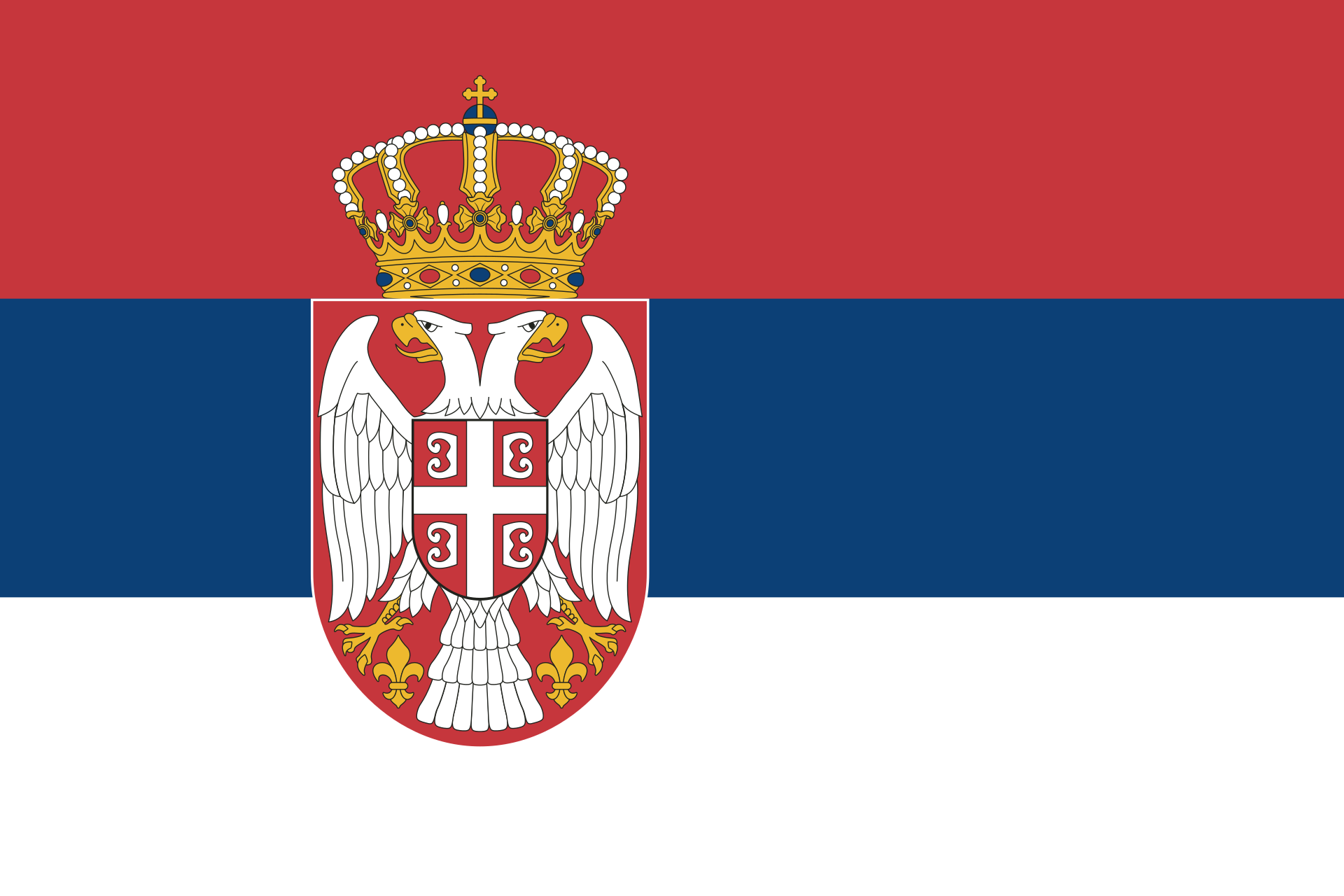
Serbia
Sign in to saveAlso known as Republic of Serbia
I don't have any context provided to base an overview of Serbia on. To write an accurate overview based only on provided information as you've requested, I would need you to supply the context material first.
AI-generated from the Wikipedia summary — may contain errors.
Weather now
cached 146h ago7-day forecast
via Open-Meteo
Country
- Capital
- Belgrade
- Population
- 6,567,783
- Region
- Europe · Southeast Europe
- Demonym
- Serbian
- Currencies
- RSD (дин.)
- Languages
- Serbian
- Calling code
- +381
- Drives on
- Right
- Gini
- 36.2 (2017)
- FIFA code
- SRB
- TLD
- .rs, .срб
- Timezones
- UTC+01:00
- Borders
- BIH, BGR, HRV, HUN, UNK, MKD, MNE, ROU
via REST Countries
Indicators · World Bank
- GDP
- $90.1B(2024)
- Population
- 6,586,476(2024)
- Life expectancy
- 76 yrs(2024)
- Unemployment
- 7.1 %(2025)
- Urban population
- 62.4 %(2024)
- Internet users
- 87.7 %(2024)
- Forest area
- 32.4 %(2023)
- Renewable energy
- 27.2 %(2021)
via World Bank Open Data · CC BY 4.0
Wikipedia views (30d)
189,714 totalvia Wikimedia Pageviews API
Key facts
- Country.coa_size
- 70
- Country.utc_offset
- +1
- Country.conventional_long_name
- Republic of Serbia
- Country.common_name
- Serbia
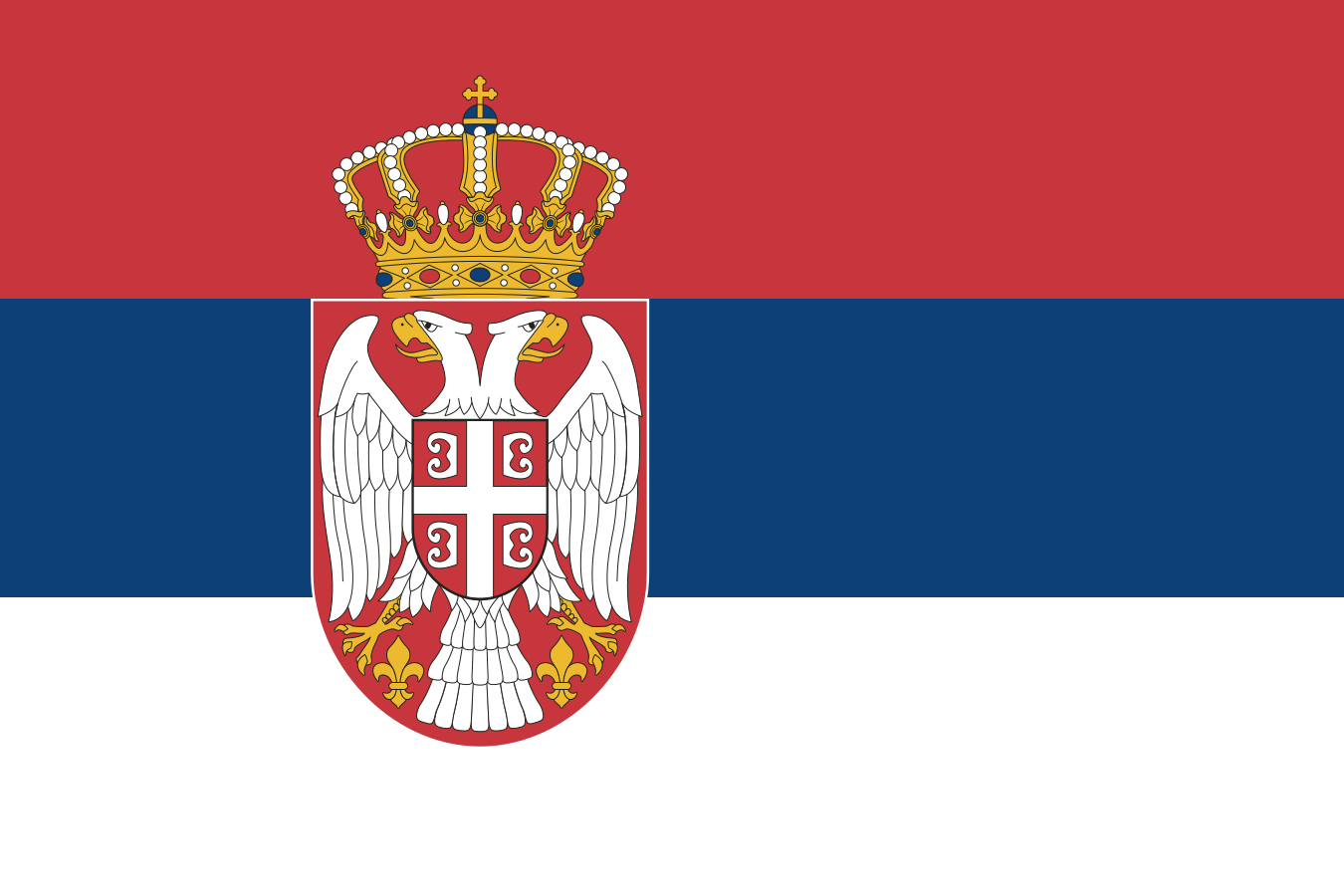
- Country.image_flag
- Flag of Serbia.svg
- Country.date_format
- mm/dd/yyyy (AD)
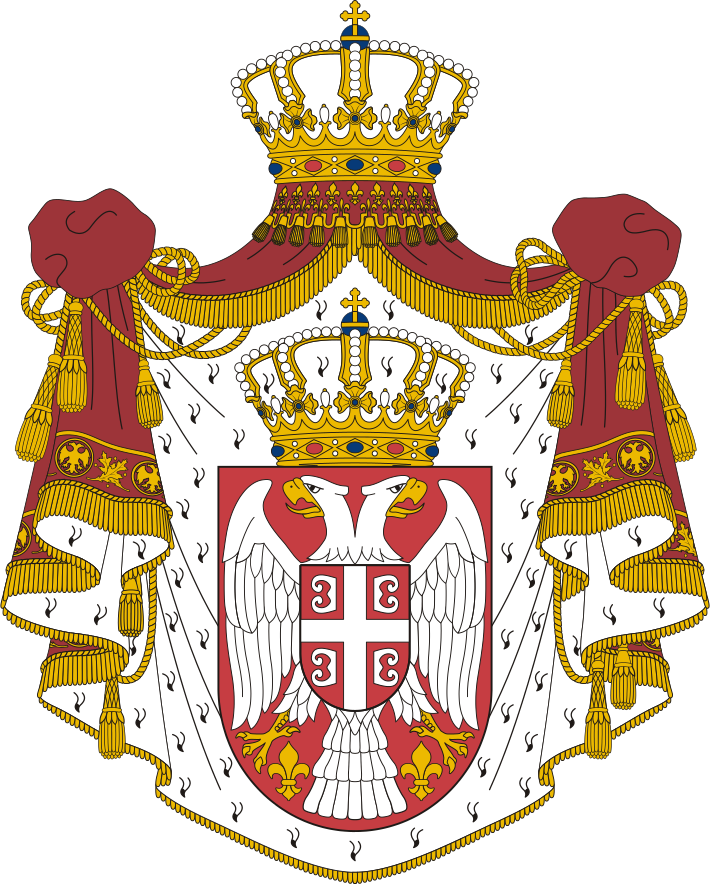
- Country.image_coat
- Coat of arms of Serbia.svg
- Country.national_anthem
- ("God of Justice")
- Country.map_caption
- Location of Serbia (green) and the claimed territory of Kosovo (light green) in Europe (dark grey)
- Country.capital
- Belgrade
- Country.largest_city
- capital
- Country.official_languages
- Serbian
- Country.ethnic_groups_year
- 2022
- Country.religion_year
- 2022
- Country.demonym
- Serbian
- Country.government_type
- Unitary parliamentary republic
- Country.leader_title1
- President
- Country.leader_name1
- Aleksandar Vučić
via Wikipedia infobox
Research
73,243 papers- A Brief History of Peripheral Nerve Surgery in Serbia.ReviewWorld neurosurgery · 2023Rasulić L, Lepić M, Shlobin N et al.DOI: 10.1016/j.wneu.2022.11.086
- Taeniosis and cysticercosis in Serbia, 1990-2018: Significance of standard of living.International journal of infectious diseases : IJID : official publication of the International Society for Infectious Diseases · 2019Stopić M, Bobić B, Dakić Z et al.DOI: 10.1016/j.ijid.2019.07.010
- Suicide in Serbia.Journal of affective disorders · 2016Ilic M, Ilic IDOI: 10.1016/j.jad.2015.12.063
- Discrepancies between preliminary and final COVID-19 mortality data-the case of Serbia.ReviewAnnals of epidemiology · 2023Galjak M, Marinković IDOI: 10.1016/j.annepidem.2023.05.006
- Tularemia in Pregnant Woman, Serbia, 2018.Emerging infectious diseases · 2023Saranovic M, Milic M, Radic I et al.DOI: 10.3201/eid2904.221318
- Echinococcosis in Serbia: an issue for the 21st century?ReviewFoodborne pathogens and disease · 2012Bobić B, Nikolić A, Radivojević SK et al.DOI: 10.1089/fpd.2012.1227
- Serbia faces bleak cancer situation.The Lancet. Oncology · 2021Das MDOI: 10.1016/S1470-2045(21)00397-1
- Epidemiology of cancers in Serbia and possible connection with cyanobacterial blooms.ReviewJournal of environmental science and health. Part C, Environmental carcinogenesis & ecotoxicology reviews · 2014Svirčev Z, Drobac D, Tokodi N et al.DOI: 10.1080/10590501.2014.967053
via PubMed
Travel guide
Understand
thumb|right|250px|Medieval castle in Golubac
Serbs are a warm people and welcoming towards foreigners. Most younger Serbs will speak some English and will be eager to practise it (seniors, however, are more likely to speak German and/or French), so you will be able to find your way around by asking directions. Most tourists come to Serbia in the summer and you can often hear German, Italian, French and English in the streets of Belgrade, while Slovenian tourists pour in for the New Year holidays.
Get around
Public transportation is generally not in very good shape outside of Belgrade. Trams and newer buses are exclusive to the capital, while intercity transport and transport within other smaller cities and towns uses older buses or more expensive minibuses. The coverage, however, is still pretty good in other towns as well. The quality of public transport within Belgrade itself is good and has vastly improved lately as most of the bus fleet was replaced by brand new gas powered buses.
The capital itself has around 120 public transport lines which can get you anywhere within the city you might want to go. A majority of these lines are bus lines, but some are trolleybus, tram and minibus lines.
Minibuses are way more expensive (~€2 per ride) than regular public transport as they are owned by private companies.
For more info check Belgrade#By_public_transport.
See
thumb|right|250px|City of Zrenjanin, Serbia Serbia's many sights include stunning castles, Medieval monasteries, lovely traditional villages and bustling cities with baroque parks and art-deco architecture.
Do
Ada Ciganlija is also an excellent place to kick back and relax during summer. It is as locals call it the sea of Belgrade. A lot of sport fields and courts (soccer, basketball, golf, volleyball, etc.) Cafés serving ice cream and beer abound on the banks of this lake-beach park, although at far higher prices (around 30-40%) compared to other places in Belgrade.
A favourite leisure activity in Belgrade is drinking coffee in numerous bars, bistros and cafés (especially in Strahinjića Bana street, which is known locally as Silicon Valley). It is very strange, but most of places are occupied all day long - i.e., within working hours. You should check: Downtown café, Buka bar, Movie bar, Iron café, Biblioteka café, Monza café-boat, Bibis café-boat, and many more; People who are not in the folk and MTV music, and don't like to drink overpriced coffee, should avoid this street. There are coffee bars on almost every corner in Belgrade, which offer more relaxed atmosphere and are designed with more taste that those in Strahinjića Bana street.
Smederevo is a town about 50 km from Belgrade. There are direct bus lines almost every half an hour and it takes about one hour to get there from Belgrade. It is considered as the unofficial rock 'n' roll capitol of Serbia because of its many rock musicians and bands who live there or were born there. See the largest lowland medieval fortress in Europe (especially at night when its lights give a special romantic and mystical atmosphere) or go t…
Eat
Serbian food is a typical Balkan mix of Central European, Mediterranean, and Middle Eastern dishes. Serbs are very proud of their food, which is heavy on grilled meats and sausages, local cheeses and bread. Serbia is predominantly a meat-loving nation. In all major cities, there are many international restaurants, such as Italian, Chinese, Mexican, Thai, Lebanese. In Belgrade you can even find sushi or kosher food.
There are international fast-food franchises such as McDonald's and KFC. On the whole, prices are cheap compared to Western Europe with main dishes ranging from RSD 600 to 2400 per person.
Drink
thumb|280px|Serbian Slivovitz from Valjevo Region thumb|280px|Serbian beers Rakija (Ракија) – excellent brandy that has many flavours, like plum Slivovitza (Шљивовица - pronounced like SHLYEE-va), quince (Дуњевча - DOO-nyah), apricot (Кајсијевача - KAI-see-yah), Pear (Крушковача), plum-juniper (Клековача - mix between rakija and Gin)... You should know that some prestigious brands of rakija can be extremely expensive like Žuta Osa (ZHOO-tah O-sah), which means Yellow Wasp, or Viljamovka (VEE-lyam-ovka), a kind of poire william which in its most refined and expensive varieties has pear fruit in the bottle. Loza – grape brandy, grappa, a type of rakija Voda – water Slivovitza (Шљивовица) – plum brandy - the national brandy of Serbia, and the most common type of Rakija, very popular, variably strong alcoholic beverage Serbian wine is delicious and comes from many wine regions, including Syrmia (especially town of Sremski Karlovci, also Irig), Oplenac, Župa, Smederevo, Negotin and Metohija. Beer (Пиво) – Jelen (Deer) and Lav (Lion) are the two most popular varieties of Serb beer, although Nikšićko from neighbouring Montenegro also seems very popular. Spring mineral water (Вода) – there are plenty of excellent bottled spring mineral water, from natural resources and protected areas. Mineral water (Минерална Вода) – in Serbia there are plenty of well-known springs (spa) mineral water (slightly sour, with a natural carbon)
Stay safe
upright|thumb|Badge of Serbian police Serbia is generally a safe place to visit. The locals are incredibly polite and helpful in case you require any assistance. (If you need any help finding/reaching a place, it's best to ask a younger person for help, as they are more likely to speak English.) However, you should always be aware of pickpockets, mainly in crowded tourist places and on public transportation. Street robberies, assaults or murders are highly unusual, even in dark or remote parts of a city/town. One should always watch out for drivers, who can be very rude to pedestrians or cyclists. There is also widespread intolerance towards LGBTQ people, even in the most cosmopolitan capital, Belgrade; one should avoid public displays of affection, as such actions are almost always met with glares, verbal and/or physical violence.
Emergency phone numbers are: 192 - police; 193 - fire dept. and 194 - ambulance. Save these as contacts on your phone.
Other international emergency numbers, such as 112 or 911 will route but only to the nearest police service and as such should be avoided for other emergencies. Edit your phone or smartwatch's "Emergency SOS" function accordingly. There are plans to integrate Serbia's emergency services into the EU's 112 system, but no progress has been made as of April 2025.
Following the Yugoslav wars of the 1990s, reports of UXOs (unexploded ordnance) have occurred outside the major cities. Keep an eye out for markings which may signify a p…
Stay healthy
Tap water is generally safe to drink, and mainly of a good quality, too, albeit heavily chlorinated in some areas. Urban areas (especially Belgrade) should be noted for their particularly hard water, which gives the water a cloudy look that dissipates after a couple of seconds. There are also many springs and fountains with excellent-quality drinking water - the most popular ones being the fountain on Knez Mihailova in Belgrade, and the many fountains in the city of Nis.
Pay attention to water in Vojvodina. Some regions (like Kikinda and Zrenjanin) have heavily polluted water that is not even used for cooking, only as industrial water and is not safe to drink. If you aren't sure, asking a local is always a safe bet.
Emergency care is always free. Serbian public healthcare is generally not up to the standards of Western European nations and acquiring care under it is very hard for travelling foreigners, although private clinics exist throughout almost all urban areas and offer an excellent quality of care, albeit at a price. Getting good travel insurance is highly recommended as Serbia is not an EU member state and generally does not recognize the EHIC card, with few exceptions. Some notable private networks offering services in English include MediGroup (english site), Euromedik and Belmedic (Belgrade only).
The Serbian National Health Insurance Fund, responsible for the payment of public healthcare in Serbia, does maintain agreements with several nations (site in Serbia…
Respect
Serbs are a very friendly, polite and hospitable people, especially in the southern parts of the country.
When you are invited into a Serbian home, make sure to bring them a gift if you are coming for the first time. Anything is fine from flowers to chocolate or something representative from your country. When you arrive at a rural house, take off your shoes unless the owner explicitly tells you to keep them on. When inside the house, don't ask for anything, for they will surely offer it. If you are thirsty it is polite to ask for a glass of water. The host probably forgot to offer you a drink and will do so.
In a bus or a tram it is considered polite to offer an elderly person or a pregnant woman a place to sit.
Because many Serbs feel frustrated by the 1990s Yugoslavian Wars or the NATO bombing of Yugoslavia, it is best to avoid discussion of them. If someone brings the topic up, try to avoid giving any strong opinions until you can assess your acquaintance's views. Do not voice support for Kosovo's independence. The U.S.'s vocal support of Kosovar independence and the 1999 air strikes caused some ill will directed towards the West, particularly towards the U.S. (though this is rarely extrapolated to individual American tourists). However, if you share the views of most Serbs, some may be willing to discuss the subject, and many will be happy speaking to a Westerner who shares their views.
On the other hand, talking about Socialist Yugoslavia and Tito will not raise as …
Connect
Serbia is quite well connected, and coverage is very good, even in rural areas. There are three GSM/UMTS/4G LTE mobile phone networks in Serbia: the state telecom provider mts, and the privately-owned Yettel and A1, all of them offering similar quality of service.
Prepaid SIM cards usually cost RSD 200-300 although a new law has introduced mandatory registration for all prepaid SIM cards, and as such, foreigners might face difficulties purchasing them outside of official phone stores. Avoid purchasing prepaid SIMs at regular markets and kiosks. Bring a form of valid ID with you, ideally a passport. 5G service is expected to begin by the end of 2025. For legacy phones, A1 will phase out 3G service by June 2025. Other providers have announced no such similar plans as of April 2025.
In some stores you can buy a simple mobile phone packaged with a prepaid SIM card for RSD 2000–3000.
Serbia has bilateral agreements with Bosnia and Herzegovina, Montenegro, Kosovo, North Macedonia and Albania, similar to the European Union's "Roam like at Home" system, eliminating roaming charges between the nations.
Serbia is not in the EU, so using a SIM card issued outside of the countries listed will cost you a fortune. Check roaming pricing with your home provider beforehand.
Most hotels have internet connections, and plenty of restaurants have Wi-Fi hotspots.
Travel guide from Wikivoyage (CC BY-SA 4.0)
~40 min read
Encyclopedic overview
47 sectionsContents
- Etymology
- History
- Prehistory and antiquity
- Middle Ages
- Ottoman and Habsburg rule
- Revolution and independence
- Balkan Wars and World War I
- Kingdom of Yugoslavia
- World War II
- Socialist Yugoslavia
- Breakup of Yugoslavia and political transition
- Contemporary period
- Geography
- Climate
- Hydrology
- Environment
- Government and politics
- Law and criminal justice
- Foreign relations
- Military
- Administrative divisions
- Economy
- Agriculture
- Industry
- Energy
- Transport
- Telecommunications
- Tourism
- Demographics
- Language
- Religion
- Education
- Health
- Culture
- Art and architecture
- Literature
- Music
- Theatre and cinema
- Media
- Cuisine
- Sports
- See also
- Notes
- References
- Citations
- Sources
- External links
Serbia, officially the Republic of Serbia, is a landlocked country in Southeast and Central Europe. Located in the Balkans, it is bordered by Hungary in the north, Romania in the northeast, Bulgaria in the southeast, North Macedonia in the south, Croatia in the northwest, Bosnia and Herzegovina in the west, and Montenegro in the southwest. Serbia also claims to share a border with Albania through the disputed territory of Kosovo. Serbia has about 6.6 million inhabitants, excluding Kosovo. Belgrade, Serbia's capital, is also its largest city.
Continuously inhabited since the Paleolithic age, the territory of modern-day Serbia, then part of Roman Empire Illyria, Dacia, Moesia, Praevalitana, Dardania, and Pannonia, faced Slavic migrations in the 6th century. Several regional states were founded in the Early Middle Ages and were at times recognised as tributaries to the Byzantine, Frankish and Hungarian kingdoms. The Serbian Kingdom obtained recognition by the Holy See and Constantinople in 1217, reaching its territorial apex in 1346 as the Serbian Empire. By the mid-16th century, the Ottoman Empire annexed the entirety of modern-day Serbia; their rule was at times interrupted by the Habsburg Empire, which began expanding towards Central Serbia from the end of the 17th century while maintaining a foothold in Vojvodina. In the early 19th century, the Serbian Revolution established the nation-state as the region's first constitutional monarchy, which subsequently expanded its territory.
Excerpted from Wikipedia’s “Serbia” article, available under the CC BY-SA 4.0 licence.
Gallery (59)
On the map
6 mapped locations
Available in 282 languages
- Español
- Français
- Deutsch
- 中文
- 日本語
- Русский
- Português
- Italiano
- العربية
- हिन्दी
- Abkhazian
- abstract
- Acehnese
- Adyghe
- Afrikaans
- Akan
- Albanian
- Albanian
Show 263 more
- Amharic
- ami
- Angika
- Aragonese
- Aramaic
- Armenian
- Arpitan
- Asturian
- Avaric
- Aymara
- azb
- Azerbaijani
- Bahasa Indonesia
- Balinese
- Bangla
- Bashkir
- Basque
- bat_smg
- Batak Toba
- Bavarian
- be_x_old
- Belarusian
- Betawi
- Bhojpuri
- Bikol
- Bishnupriya
- Bislama
- blk
- Bosnian
- Breton
- Bulgarian
- Buriat
- Burmese
- Catalan
- cbk_zam
- cdo
- Cebuano
- Central Kurdish
- Chamorro
- Chechen
- Cherokee
- Cheyenne
- Church Slavic
- Chuvash
- Colognian
- Cornish
- Corsican
- Crimean Tatar
- Croatian
- Czech
- Danish
- Divehi
- dty
- Dzongkha
- Egyptian Arabic
- eml
- Erzya
- Esperanto
- Estonian
- Ewe
- Extremaduran
- Faroese
- Fiji Hindi
- Filipino
- Finnish
- fiu_vro
- Friulian
- Fula
- Gagauz
- Galician
- Ganda
- gcr
- Georgian
- Gilaki
- Gothic
- Greek
- Guarani
- Gujarati
- Haitian Creole
- Hakka Chinese
- Hausa
- Hawaiian
- Hebrew
- Hungarian
- hyw
- Icelandic
- Ido
- Igbo
- Iloko
- Inari Sami
- Interlingua
- Interlingue
- Inuktitut
- Irish
- Jamaican Creole English
- Javanese
- Kabardian
- Kabyle
- Kannada
- Kara-Kalpak
- Karachay-Balkar
- Kashubian
- Kazakh
- kbp
- kge
- Khmer
- Kinyarwanda
- Komi
- Komi-Permyak
- Kongo
- Konkani
- Kotava
- Kurdish
- Kyrgyz
- Ladino
- Lao
- Latgalian
- Latin
- Latvian
- Lezghian
- Ligurian
- Limburgish
- Lingala
- Lingua Franca Nova
- Lithuanian
- lld
- Lojban
- Lombard
- Low German
- Lower Sorbian
- Luxembourgish
- Macedonian
- Madurese
- Maithili
- Malagasy
- Malay
- Malayalam
- Maltese
- Manipuri
- Manx
- Māori
- map_bms
- Marathi
- Mari
- Mazanderani
- Minangkabau
- Mingrelian
- Mirandese
- Moksha
- Mongolian
- Moroccan Arabic
- Navajo
- nds_nl
- Neapolitan
- Nederlands
- Nepali
- Newari
- Northern Frisian
- Northern Sami
- Norwegian
- Norwegian Nynorsk
- Novial
- nrm
- nup
- Nyanja
- Obolo
- Occitan
- Odia
- Old English
- olo
- Oromo
- Ossetic
- Pampanga
- Pangasinan
- Papiamento
- Pashto
- Picard
- Piedmontese
- Polski
- Pontic
- Punjabi
- Quechua
- roa_rup
- roa_tara
- Romanian
- Romansh
- rsk
- Rusyn
- Samoan
- Sanskrit
- Santali
- Sardinian
- Saterland Frisian
- Scots
- Scottish Gaelic
- Serbian
- Serbian (Latin)
- Shan
- Shona
- Sicilian
- Silesian
- simple
- Sindhi
- Slovak
- Slovenian
- Somali
- Southern Sotho
- Sranan Tongo
- Standard Moroccan Tamazight
- Sundanese
- Svenska
- Swahili
- Swati
- szy
- Tachelhit
- Tahitian
- Tajik
- Talysh
- Tamil
- Taroko
- Tatar
- tay
- Telugu
- Tetum
- Tibetan
- Tiếng Việt
- Tok Pisin
- Toki Pona
- Tongan
- Tsonga
- Tumbuka
- Türkçe
- Turkmen
- Tyap
- Udmurt
- Ukrainian
- Upper Sorbian
- Urdu
- Uyghur
- Uzbek
- Venetian
- Veps
- Volapük
- Walloon
- Waray
- Welsh
- West Flemish
- Western Frisian
- Western Panjabi
- Wolof
- Wu Chinese
- Yakut
- Yiddish
- Zaza
- Zeelandic
- zh_classical
- zh_min_nan
- zh_yue
- Zhuang
- Zulu
- فارسی
- ไทย
- 한국어
via Wikidata sitelinks · CC0