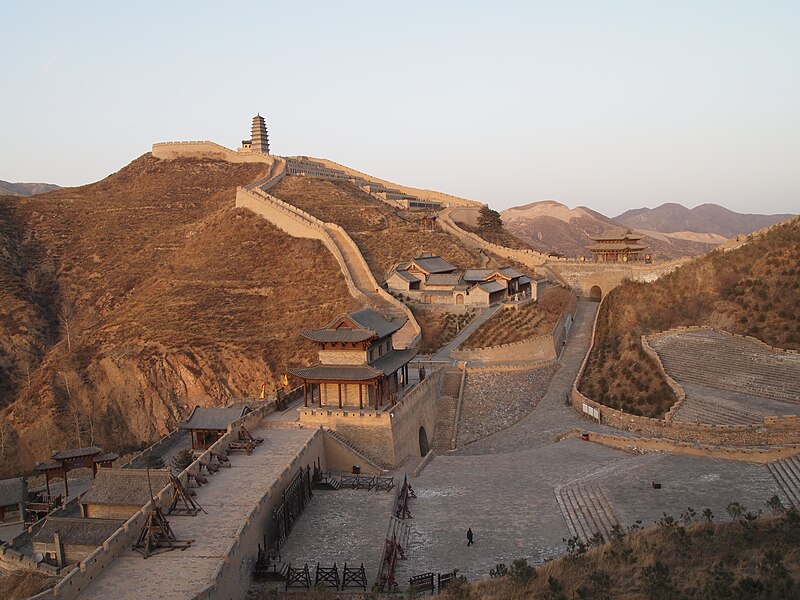
File:Yanmenguan3.JPG · Wikimedia Commons · See Wikimedia Commons
Shanxi
Sign in to saveAlso known as Shanxi Province, Province of Shanxi, Shan-hsi, Shan Hsi, Jin, Shansi, Shan-si, Shanxi Sheng
Shanxi is a province in North China. Its capital and largest city is Taiyuan, while its next most populated prefecture-level cities are Changzhi and Datong. Its one-character abbreviation is (), after the state of Jin that existed there during the Spring and Autumn period (). In later periods, Shanxi also became the political core of the Northern Wei, a Xianbei-founded dynasty whose early capital was located in present-day northern Datong. During the Qing dynasty, Shanxi merchants dominated China's commerce and finance. Their commercial networks extended to Russia, Japan, Korea, Central Asia,
Shanxi is a province in North China with Taiyuan as its capital, notable for its historical significance as the seat of ancient states and dynasties, including the Jin state and the Northern Wei dynasty. During the Qing dynasty, Shanxi merchants became dominant forces in Chinese commerce and finance, establishing trade networks that extended across Russia, Japan, Korea, and Central Asia.
AI-generated from the Wikipedia summary — may contain errors.
Key facts
- Chinese.p
- Shānxī
- Chinese.psp
- Shansi
- Settlement.seat
- Taiyuan
- Settlement.name
- Shanxi
- Settlement.other_name
- Shansi
- Settlement.settlement_type
- Province
- Settlement.translit_lang1
- Name
- Settlement.translit_lang1_info
- ()
- Settlement.translit_lang1_info1
- SX ()
- Settlement.image_map
- Shanxi in China (+all claims hatched).svg
- Settlement.mapsize
- 275px
- Settlement.map_caption
- Location of Shanxi in China
- Settlement.named_for
- "west of the Taihang Mountains"
- Settlement.subdivision_type
- Country
- Settlement.subdivision_name
- China
- Settlement.seat_type
- Capital
- Settlement.parts_type
- Divisions
- Settlement.parts_style
- para
via Wikipedia infobox
Wikidata facts
- Instance of
- province of China
- Official name
- 山西省
- Country
- China
- Located in
- China
- Contains
- Lüliang
- Capital
- Taiyuan
- Population
- 34915616
- Area
- 156000
- Time zone
- UTC+08:00
- Head of government
- Jin Xiangjun
- Shares border with
- Ulanqab
- Highest point
- Mount Wutai
- Official website
- www.shanxi.gov.cn
- Image
- Great Wall of China, Satellite image.jpeg
- Nominal GDP
- 1765190000000
Show 11 more facts
- Commons category
- Shanxi
- topic's main category
- Category:Shanxi
- category for films shot at this location
- Category:Films shot in Shanxi
- Commons gallery
- 山西
- category of associated people
- Category:People of Shanxi
- twinned administrative body
- Saitama Prefecture
- category for people born here
- Category:People from Shanxi
- native label
- 山西
- language used
- Jin
- different from
- Shaanxi
- party chief representative
- Lan Fo'an
via Wikidata · CC0
~73 min read
Encyclopedic overview
47 sectionsContents
- History
- Pre-Imperial China
- Imperial China
- Early Republic of China (1912–1937)
- Second Sino-Japanese War and the Chinese Civil War (1937–1949)
- People's Republic of China (1949–present)
- Geography
- Topography
- Climate
- Ecology
- Politics
- Governor's Mansion
- Xishan Clique
- System of governance
- Economy
- Commerce
- Industry
- Industrial zones
- Tourism
- Transportation
- Road
- Rail
- Aviation
- Demographics
- Language
- Religion
- Administration
- Culture
- Art
- Architecture
- Literature and cinema
- Opera
- Cuisine
- Notable people
- Modern and contemporary
- The Republic of China
- Taiwan-born children of Shanxi parents after 1949
- The People's Republic of China
- Ancient and medieval
- Education
- Health
- See also
- Notes
- References
- Citations
- Sources
- External links
Shanxi is a province in North China. Its capital and largest city is Taiyuan, while its next most populated prefecture-level cities are Changzhi and Datong. Its one-character abbreviation is (), after the state of Jin that existed there during the Spring and Autumn period (). In later periods, Shanxi also became the political core of the Northern Wei, a Xianbei-founded dynasty whose early capital was located in present-day northern Datong. During the Qing dynasty, Shanxi merchants dominated China's commerce and finance. Their commercial networks extended to Russia, Japan, Korea, Central Asia, Southeast Asia, and South Asia. After the collapse of the Qing dynasty, Shanxi was governed for nearly four decades by Yan Xishan and functioned with a high degree of de facto autonomy within the Republic of China, serving as a major Kuomintang political and industrial stronghold in the north and being described as "the model province", before being incorporated into the state system of the People's Republic of China, where its role shifted toward that of a major energy-producing province.
The name Shanxi means 'west of the mountains', a reference to its location west of the Taihang Mountains. Shanxi borders Hebei to the east, Henan to the south, Shaanxi to the west and Inner Mongolia to the north. Shanxi's terrain is characterised by a plateau bounded partly by mountain ranges. Shanxi's culture is largely dominated by the ethnic Han majority, who make up over 99% of its population. Jin Chinese is the only major Sinitic variety in northern China that is not classified within the Mandarin group.
Excerpted from Wikipedia’s “Shanxi” article, available under the CC BY-SA 4.0 licence.
Gallery (52)
On the map
3 mapped locations
Available in 106 languages
- Español
- Français
- Deutsch
- 中文
- 日本語
- Русский
- Português
- Italiano
- العربية
- हिन्दी
- Achinese
- Afrikaans
- Armenian
- Asturian
- Azerbaijani
- Bahasa Indonesia
- Balinese
- Bangla
Show 87 more
- Basque
- be_x_old
- Belarusian
- Breton
- Bulgarian
- Catalan
- cdo
- Cebuano
- Central Kurdish
- Chechen
- Crimean Tatar
- Croatian
- Czech
- Danish
- Esperanto
- Estonian
- Filipino
- Finnish
- Gan Chinese
- Georgian
- Greek
- Hakka Chinese
- Hebrew
- Hungarian
- Icelandic
- Ido
- Interlingua
- Irish
- Kashmiri
- Khmer
- Kongo
- Kurdish
- Latin
- Latvian
- Lingua Franca Nova
- Lithuanian
- Lombard
- Malagasy
- Malay
- Manipuri
- Manx
- Marathi
- Mazanderani
- Mingrelian
- Mongolian
- Nederlands
- Nepali
- Northern Frisian
- Norwegian
- Norwegian Nynorsk
- Novial
- Occitan
- Ossetic
- Pampanga
- Polski
- Punjabi
- Quechua
- Romanian
- Scots
- Serbian
- Serbian (Latin)
- simple
- Slovenian
- Svenska
- Swahili
- Tajik
- Tamil
- Tibetan
- Tiếng Việt
- Türkçe
- Ukrainian
- Urdu
- Uyghur
- Uzbek
- Venetian
- Waray
- Welsh
- Western Panjabi
- Wu Chinese
- Yakut
- zh_classical
- zh_min_nan
- zh_yue
- Zhuang
- فارسی
- ไทย
- 한국어
via Wikidata sitelinks · CC0