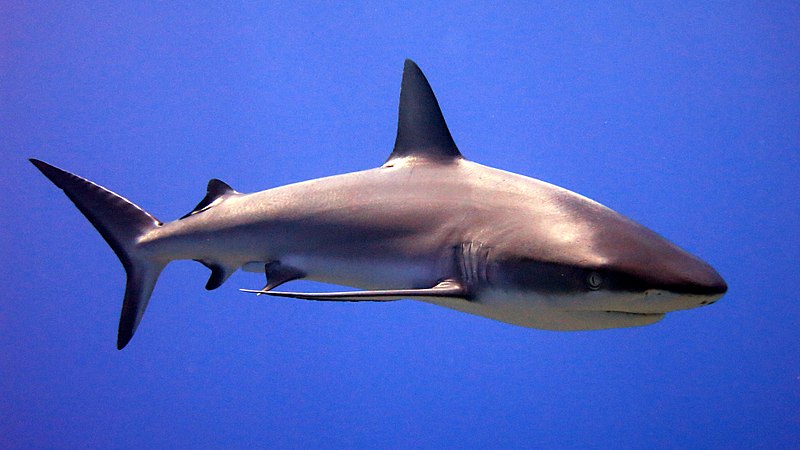
File:Corl0207_(28225976491).jpg · Wikimedia Commons · See Wikimedia Commons
shark
Sign in to saveAlso known as sharks, Selachimorpha, Selachii, Selachian, Selachians
Sharks are a group of elasmobranch cartilaginous fishes characterized by a ribless endoskeleton, dermal denticles, five to seven gill slits on each side, and pectoral fins that are not fused to the head. Modern sharks are classified within the division Selachii and are the sister group to the Batomorphi (rays and skates). Some sources extend the term "shark" as an informal category including extinct members of Chondrichthyes (cartilaginous fish) with a shark-like morphology, such as hybodonts. Shark-like chondrichthyans such as Cladoselache and Doliodus first appeared in the Devonian Period (4
OverviewAI-generated
Sharks, scientifically classified as Selachimorpha, are a superorder of fish within the subclass Neoselachii. They belong to the class Elasmobranchii and phylum Chordata. These organisms inhabit marine, brackish, and freshwater environments. The group has existed since approximately 425 million years ago, with origins dating back about 450 million years. They are a source of shark liver oil.
The taxon is recognized as accepted in the World Register of Marine Species. It is referenced by 3,301 other encyclopedia articles. The Unicode character 🦈 represents the subject. Information about sharks is documented in sources such as the Brockhaus and Efron Encyclopedic Dictionary, Pauly–Wissowa, Gujin Tushu Jicheng, and the Encyclopædia Britannica 11th edition. A list of sharks is available for the group.
Synthesized by Vinony from 31 facts across 5 sources: Wikidata, iNaturalist, PubMed, WoRMS, Vinony graph. Generated from structured data (not the Wikipedia text) and checked against those facts — may still contain errors.
Species
haaien
Infraclass
- PhylumChordata
- ClassElasmobranchii
via
Research
10,186 papers- Characterization of shark skin properties and biomimetic replication.ReviewBioinspiration & biomimetics · 2024R R Baeten S, Kochovski A, Jovanova J et al.DOI: 10.1088/1748-3190/ad5c25
- Shark immune system: A review about their immunoglobulin repertoire.ReviewFish & shellfish immunology · 2025Gargano C, Mauro M, Martino C et al.DOI: 10.1016/j.fsi.2025.110187
- Shark recreational fisheries: Status, challenges, and research needs.ReviewAmbio · 2017Gallagher AJ, Hammerschlag N, Danylchuk AJ et al.DOI: 10.1007/s13280-016-0856-8
- Microbial genetic engineering approach to replace shark livering for squalene.ReviewTrends in biotechnology · 2022Patel A, Bettiga M, Rova U et al.DOI: 10.1016/j.tibtech.2022.03.008
- Relationships in Shark Skin: Mechanical and Morphological Properties Vary between Sexes and among Species.Integrative and comparative biology · 2023Hagood ME, Alexander JRS, Porter MEDOI: 10.1093/icb/icad111
- Assembly and Expression of Shark Ig Genes.ReviewJournal of immunology (Baltimore, Md. : 1950) · 2016Hsu EDOI: 10.4049/jimmunol.1600164
- Light-Designed Shark Skin-Mimetic Surfaces.Nano letters · 2021Jo W, Kang HS, Choi J et al.DOI: 10.1021/acs.nanolett.1c00436
- Armored eyes of the whale shark.PloS one · 2020Tomita T, Murakumo K, Komoto S et al.DOI: 10.1371/journal.pone.0235342
via PubMed
Wikidata facts
- Instance of
- taxon
- Subclass of
- fish as food
- Parent taxon
- Neoselachii
- Image
- Great white shark south africa.jpg
Show 12 more facts
- taxon name
- Selachimorpha
- Commons category
- Selachimorpha
- MCN code
- 0302.81.00
- topic's main category
- Category:Sharks
- Commons gallery
- Shark
- Unicode character
- 🦈
- earliest date
- 450000000-
- on focus list of Wikimedia project
- Wikipedia:Vital articles/Level/4
- start time
- 425000000-
- topic has template
- Template:Selachimorpha
- taxon rank
- superorder
- has list
- list of sharks
via Wikidata · CC0
~57 min read
Encyclopedic overview
59 sectionsContents
- Etymology
- Evolutionary history
- Fossil record
- Taxonomy
- Anatomy
- Teeth
- Skeleton
- Jaw
- Fins
- Dermal denticles
- Tails
- Physiology
- Buoyancy
- Respiration
- Thermoregulation
- Osmoregulation
- Digestion
- Fluorescence
- Senses
- Smell
- Sight
- Hearing
- Electroreception
- Lateral line
- Life history
- Reproduction
- Sexual
- Asexual
- Brooding
- Ovoviviparity
- Oviparity
- Viviparity
- Behavior
- Speed
- Intelligence
- Sleep
- Ecology
- Feeding
- Range and habitat
- Relationship with humans
- Attacks
- In captivity
- In culture
- In culture
- In Hawaii
- In American Samoa
- In popular culture
- Popular misconceptions
- Threats to sharks
- Fishery
- Shark culling
- Other threats
- Conservation
- See also
- References
- Citations
- General and cited references
- Further reading
- External links
Sharks are a group of elasmobranch cartilaginous fishes characterized by a ribless endoskeleton, dermal denticles, five to seven gill slits on each side, and pectoral fins that are not fused to the head. Modern sharks are classified within the division Selachii and are the sister group to the Batomorphi (rays and skates). Some sources extend the term "shark" as an informal category including extinct members of Chondrichthyes (cartilaginous fish) with a shark-like morphology, such as hybodonts. Shark-like chondrichthyans such as Cladoselache and Doliodus first appeared in the Devonian Period (419–359 million years), though some fossilized chondrichthyan-like scales are as old as the Late Ordovician (458–444 million years ago). The earliest confirmed modern sharks (Selachii) are known from the Early Jurassic around , with the oldest known member being Agaleus, though records of true sharks may extend back as far as the Permian.
Sharks range in size from the small dwarf lanternshark (Etmopterus perryi), a deep sea species that is only in length, to the whale shark (Rhincodon typus), the largest fish in the world, which reaches approximately to in length. They are found in all seas and are common to depths up to . They generally do not live in freshwater, although there are a few known exceptions, such as the bull shark and the river sharks, which can be found in both seawater and freshwater, and the Ganges shark, which lives only in freshwater. Sharks have a covering of placoid scales (denticles) that protects the skin from damage and parasites in addition to improving their fluid dynamics. They have numerous sets of replaceable teeth.
Excerpted from Wikipedia’s “shark” article, available under the CC BY-SA 4.0 licence.
Gallery (56)
Available in 157 languages
- Español
- Français
- Deutsch
- 中文
- 日本語
- Русский
- Português
- Italiano
- العربية
- हिन्दी
- abstract
- Achinese
- Afrikaans
- Albanian
- Albanian
- Amharic
- Aragonese
- Armenian
Show 138 more
- Arpitan
- Assamese
- Asturian
- azb
- Azerbaijani
- Bahasa Indonesia
- Balinese
- Bangla
- Bashkir
- Basque
- bat_smg
- be_x_old
- Belarusian
- Betawi
- Bhojpuri
- Bikol
- Bislama
- Bosnian
- Breton
- Bulgarian
- Burmese
- Catalan
- cdo
- Cebuano
- Central Kurdish
- Chechen
- Chuvash
- Cornish
- Croatian
- Czech
- Danish
- Divehi
- Egyptian Arabic
- eml
- Esperanto
- Estonian
- Faroese
- Fiji Hindi
- Fijian
- Filipino
- Finnish
- Fon
- Galician
- Georgian
- Greek
- Guarani
- Haitian Creole
- Hebrew
- Hungarian
- hyw
- Icelandic
- Ido
- Iloko
- Interlingua
- Inupiaq
- Irish
- Javanese
- Kabyle
- Kannada
- Kashmiri
- Kazakh
- kbp
- Kongo
- Kurdish
- Kyrgyz
- Latin
- Latvian
- Lingua Franca Nova
- Lithuanian
- Low German
- Macedonian
- Madurese
- Malagasy
- Malay
- Malayalam
- Marathi
- Mazanderani
- Mongolian
- Moroccan Arabic
- Navajo
- Nederlands
- Newari
- Northern Frisian
- Norwegian
- Norwegian Nynorsk
- nrm
- Occitan
- Odia
- Old English
- Oromo
- Ossetic
- Pampanga
- Pashto
- Piedmontese
- Polski
- Punjabi
- Quechua
- Romanian
- Scots
- Scottish Gaelic
- Serbian
- Serbian (Latin)
- simple
- Sindhi
- Sinhala
- Slovak
- Slovenian
- Somali
- Standard Moroccan Tamazight
- Sundanese
- Svenska
- Swahili
- szy
- Tachelhit
- Tamil
- Tatar
- Telugu
- Tibetan
- Tiếng Việt
- Türkçe
- Ukrainian
- Upper Sorbian
- Urdu
- Uzbek
- Veps
- Waray
- Welsh
- Western Frisian
- Western Panjabi
- Wu Chinese
- Yakut
- Yiddish
- zh_classical
- zh_min_nan
- zh_yue
- فارسی
- ไทย
- 한국어
via Wikidata sitelinks · CC0