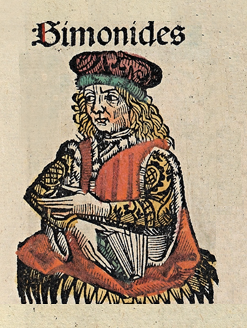
File:Nuremberg_chronicles_f_60r_3.png · Wikimedia Commons · See Wikimedia Commons
Simonides of Ceos
Sign in to saveAlso known as Simonides of Keos, Simonides
Greek lyric poet (c. 556–468 BC)
OverviewAI-generated
Simonides of Ceos was a male poet and writer born in 556 BCE. He wrote in Ancient Greek and is also known by the name Σιμωνίδης ο Κείος. His significant place of association was Kea.
He died in Agrigento, Syracuse. His works have been described by sources including the Nordisk familjebok, Brockhaus and Efron Encyclopedic Dictionary, Encyclopædia Britannica 11th edition, and The Nuttall Encyclopædia. He produced six works.
Synthesized by Vinony from 11 facts across 2 sources: Wikidata, Europeana Sparql. Generated from structured data (not the Wikipedia text) and checked against those facts — may still contain errors.
Wikidata facts
- Instance of
- human
- Gender
- male
- Place of death
- Syracuse
- Languages spoken
- Ancient Greek
- Image
- Nuremberg chronicles f 60r 3.png
Show 8 more facts
- Commons category
- Simonides
- date of birth
- 0556-00-00
- date of death
- 0468-00-00
- writing language
- Ancient Greek
- different from
- Janusz Symonides
- name in native language
- Σιμωνίδης ο Κείος
- P8168
- Bang Gang
- significant place
- Kea
via Wikidata · CC0
Works in European collections
6 objects attributed to Simonides of Ceos, held across European museums, libraries & archives · via Europeana


~27 min read
Encyclopedic overview
Imaginary portrait of Simonides from the Nuremberg Chronicle (1493) Corinthian vase depicting Perseus, Andromeda and Ketos; the names are written in the archaic Greek alphabet.
Simonides of Ceos (/saɪˈmɒnɪˌdiːz/; Ancient Greek: Σιμωνίδης ὁ Κεῖος; c. 556 – 468 BC) was a Greek lyric poet, born in Ioulis on Ceos. The scholars of Hellenistic Alexandria included him in the canonical list of the nine lyric poets esteemed by them as worthy of critical study. Included on this list were Bacchylides, his nephew, and Pindar, reputedly a bitter rival, both of whom benefited from his innovative approach to lyric poetry. Simonides, however, was more involved than either in the major events and with the personalities of their times.
Excerpted from Wikipedia’s “Simonides of Ceos” article, available under the CC BY-SA 4.0 licence.