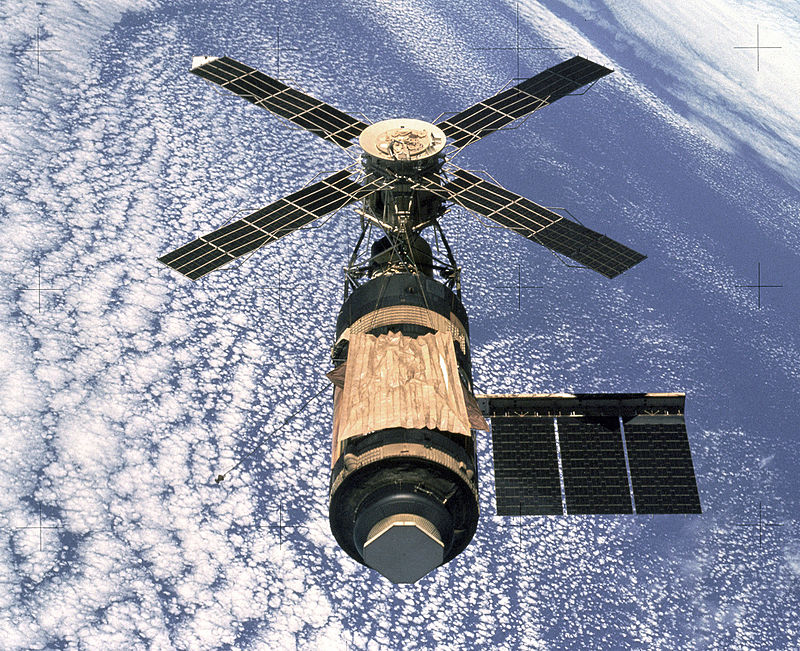
File:Skylab_(SL-4).jpg · Wikimedia Commons · See Wikimedia Commons
Skylab
Sign in to saveSkylab was the United States' first space station, launched by NASA, occupied for about 24 weeks between May 1973 and February 1974. It was operated by three trios of astronaut crews: Skylab 2, Skylab 3, and Skylab 4. Skylab was constructed from a repurposed Saturn V third stage (the S-IVB), and took the place of the stage during launch. Operations included an orbital workshop, a solar observatory, Earth observation and hundreds of experiments. Skylab's orbit eventually decayed and it disintegrated in the atmosphere on July 11, 1979, scattering debris across the Indian Ocean and Western Austra
Skylab was America's first space station, launched by NASA in 1973 and occupied by three rotating crews of astronauts for about six months while conducting hundreds of experiments, solar observations, and Earth studies. The station was built from a repurposed rocket stage and eventually fell back to Earth in 1979, ending its operational life.
AI-generated from the Wikipedia summary — may contain errors.
Key facts
- Space station.COSPAR_ID
- 1973-027A
- Space station.SATCAT
- 6633
- Space station.station
- Skylab
- Space station.station_image
- Skylab (SL-4).jpg
- Space station.station_image_caption
- Skylab as photographed by its departing final crew (Skylab 4).
- Space station.insignia
- Skylab Program Patch.png
- Space station.insignia_caption
- Skylab program insignia
- Space station.sign
- Skylab
- Space station.crew
- 3 per mission (9 total)
- Space station.launch
- May 14, 1973 17:30:00 UTC ( years ago)
- Space station.carrier_rocket
- Saturn VAS-513
- Space station.launch_pad
- Kennedy LC-39A
- Space station.status
- Deorbited
- Space station.reentry
- July 11, 1979 16:37:00 UTC
- Space station.mass
- w/o Apollo CSM
- Space station.length
- w/o Apollo CSM
- Space station.width
- w/ one solar panel
- Space station.height
- w/ telescope mount
via Wikipedia infobox
Wikidata facts
- Instance of
- space station
- Country
- United States
- Operator
- NASA
- Country of origin
- United States
- Parent body
- Earth
- Diameter
- 6.6
- Mass
- 76295
- Orbital period
- 93.4
- Image
- Skylab (SL-4).jpg
- Height
- 11.1
- Width
- 17
- Length
- 25.1
Show 15 more facts
- Commons category
- Skylab (space station)
- time of object orbit decay
- 1979-07-11
- UTC date of spacecraft launch
- 1973-05-14
- space launch vehicle
- Saturn V
- Commons gallery
- Skylab
- type of orbit
- low Earth orbit
- orbits completed
- 34981
- crew members
- William R. Pogue
- start point
- Kennedy Space Center Launch Complex 39A
- maximum capacity
- 3
- call sign
- Skylab
- orbital inclination
- 50
- apoapsis
- 442
- periapsis
- 434
- volume as quantity
- 351.6
Sources (6)
via Wikidata · CC0
~64 min read
Encyclopedic overview
48 sectionsContents
- Overview
- Configuration
- Operations
- Background
- Early studies
- Air Force plans
- Development
- Apollo Applications Program
- Wet workshop
- Dry workshop
- Habitability
- Operational history
- Completion and launch
- Crewed missions
- Orbital operations
- Experiments
- Astronaut maneuvering equipment
- Nobel Prize
- Film vaults and window radiation shield
- Gyroscopes
- Shower
- Cameras and film
- Computers
- Plans for re-use after the last mission
- Shuttle mission plans
- After departure
- Solar activity
- Skylab's fall to Earth
- Launchers, rescue, and cancelled missions
- Launchers
- Skylab Revisit
- Skylab Rescue
- Skylab 5
- Skylab B
- Engineering mock-ups
- Mission designations
- SMEAT
- Program cost
- Gallery
- Depictions in fiction
- See also
- References
- Footnotes
- Works cited
- Further reading
- External links
- NASA
- Third party
Skylab was the United States' first space station, launched by NASA, occupied for about 24 weeks between May 1973 and February 1974. It was operated by three trios of astronaut crews: Skylab 2, Skylab 3, and Skylab 4. Skylab was constructed from a repurposed Saturn V third stage (the S-IVB), and took the place of the stage during launch. Operations included an orbital workshop, a solar observatory, Earth observation and hundreds of experiments. Skylab's orbit eventually decayed and it disintegrated in the atmosphere on July 11, 1979, scattering debris across the Indian Ocean and Western Australia.
== Overview == Skylab had a mass of with a Apollo command and service module (CSM) attached and included a workshop, a solar observatory, and several hundred life science and physical science experiments. It was launched uncrewed into low Earth orbit by a Saturn V rocket modified to be similar to the Saturn INT-21, with the S-IVB, with Skylab itself being the repurposed third stage. This was the final flight for the rocket more commonly known for carrying the crewed Apollo Moon landing missions. Three subsequent missions delivered three-astronaut crews in the Apollo CSM launched by the smaller Saturn IB rocket.
Excerpted from Wikipedia’s “Skylab” article, available under the CC BY-SA 4.0 licence.
Gallery (52)
Available in 68 languages
- Español
- Français
- Deutsch
- 中文
- 日本語
- Русский
- Português
- Italiano
- العربية
- Afrikaans
- Aragonese
- Armenian
- Asturian
- Azerbaijani
- Bahasa Indonesia
- Bangla
- Basque
- Bosnian
Show 49 more
- Bulgarian
- Catalan
- Central Kurdish
- Croatian
- Czech
- Danish
- Egyptian Arabic
- Esperanto
- Estonian
- Finnish
- Galician
- Greek
- Hebrew
- Hungarian
- Ido
- Irish
- Kazakh
- Latvian
- Lithuanian
- Luxembourgish
- Macedonian
- Malay
- Malayalam
- Nederlands
- Norwegian
- Norwegian Nynorsk
- Pashto
- Polski
- Romanian
- Serbian
- Serbian (Latin)
- simple
- Sindhi
- Sinhala
- Slovak
- Slovenian
- Svenska
- Tamil
- Telugu
- Tiếng Việt
- Türkçe
- Ukrainian
- Urdu
- Uzbek
- Welsh
- Wu Chinese
- فارسی
- ไทย
- 한국어
via Wikidata sitelinks · CC0