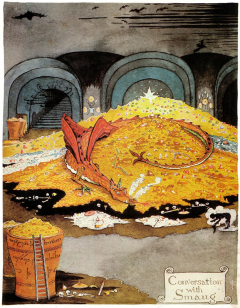
File:Conversation_with_Smaug.png · Wikimedia Commons · See Wikimedia Commons
Smaug
Sign in to saveKey facts
- Character.name
- Smaug
- Character.series
- J.R.R. Tolkien
- Character.image
- Conversation with Smaug.png
- Character.caption
- Tolkien's illustration Conversation with Smaug
- Character.gender
- Male
- Character.species
- Dragon
- Character.lbl24
- Book(s)
via Wikipedia infobox
Wikidata facts
- Has part
- wing
- Gender
- male organism
- Place of death
- Esgaroth
- Languages spoken
- Westron
- Creator
- J. R. R. Tolkien
- Voice actor
- Richard Boone
- Performer
- Richard Boone
- Image
- Air New Zealand, Boeing 777-300ER (Smaug Livery), ZK-OKO - LHR (11344034125).jpg
- Residence
- Lonely Mountain
Show 22 more facts
- enemy
- Gandalf
- color
- gold
- present in work
- Middle-Earth Strategy Battle Game
- from narrative universe
- Tolkien's legendarium
- killed by
- Bard the Bowman
- Commons category
- Smaug (dragon)
- IPA transcription
- smaʊɡ
- owner of
- Arkenstone
- time period
- Third Age
- cause of death
- gunshot wound
- character type
- villain
- personality trait of fictional character
- greed
- inspired by
- The Song of Hiawatha
- superhuman feature or ability
- fire breathing
- first appearance
- The Hobbit
- narrative role
- antagonist
- interested in
- treasure
- means of locomotion
- flight
- significant place
- Dale
- home world
- Middle-earth
- significant person
- Thrór
- main food source
- Middle-earth man
Sources (2)
via Wikidata · CC0
~16 min read
Encyclopedic overview
18 sectionsContents
- Description
- Analysis
- Character
- The ''Beowulf'' dragon
- Fafnir
- ''The Song of Hiawatha''
- Tolkien's choice of the name "Smaug"
- Illustrations
- Adaptations
- Radio
- Animated films
- ''The Hobbit'' (film series)
- Video games
- In popular culture
- See also
- Notes
- References
- Further reading
Smaug () is a dragon and the main antagonist in J. R. R. Tolkien's 1937 novel The Hobbit, his treasure and the mountain he lives in being the goal of the quest. Powerful and fearsome, he invaded the Dwarf kingdom of Erebor 171 years prior to the events described in the novel. A group of thirteen dwarves mounted a quest to take the kingdom back, aided by the wizard Gandalf and the hobbit Bilbo Baggins. In The Hobbit, Thorin describes Smaug as "a most specially greedy, strong and wicked worm".
Critics have identified close parallels with what they presume are sources of Tolkien's inspiration, including the dragon in Beowulf, who is provoked by the stealing of a precious cup, and the speaking dragon Fafnir, who proposes a betrayal to Sigurd. A further source may be Henry Wadsworth Longfellow's 1855 poem The Song of Hiawatha, where Megissogwon, the spirit of wealth, is protected by an armoured shirt, but whose one weak spot is revealed by a talking bird. Commentators have noted Smaug's devious, vain, and proud character, and his aggressively polite way of speaking, like the British upper class.
Excerpted from Wikipedia’s “Smaug” article, available under the CC BY-SA 4.0 licence.