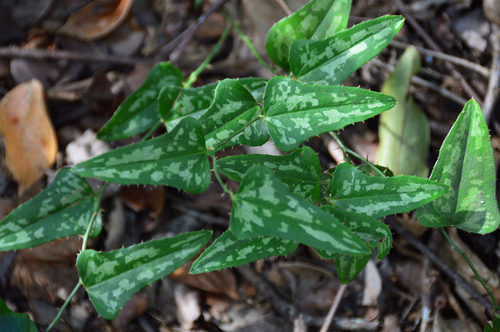
(c) Pablo L Ruiz, all rights reserved, uploaded by Pablo L Ruiz
Smilax
Sign in to saveSmilax is a genus of about 300–350 species, found in the tropics and subtropics worldwide. They are climbing flowering plants, many of which are woody and/or thorny, in the monocotyledon family Smilacaceae, native throughout the tropical and subtropical regions of the world. Common names include catbriers, greenbriers, prickly-ivys and smilaxes. Sarsaparilla (also zarzaparrilla, sarsparilla) is a name used specifically for the Neotropical S. ornata as well as a catch-all term in particular for American species. Occasionally, the non-woody species such as the smooth herbaceous greenbrier (S. h
OverviewAI-generated
Smilax is a genus of climbing shrub plants within the family Smilacaceae. It belongs to the order Liliales, class Magnoliopsida, and phylum Tracheophyta. The genus was described by Linnaeus in 1753 and is currently accepted. It comprises approximately 300 species distributed across tropical and subtropical regions. One species within this group is commonly known as saw greenbrier.
Records for Smilax have been documented in the United States, Turkey, and Mexico. The genus has also been introduced to Romania. Various institutions, including the University of Alberta Museums, UCMP, FMNH, UTC, and UNICACH, hold records related to this plant.
Synthesized by Vinony from 30 facts across 8 sources: Wikidata, iNaturalist, PubMed, Encyclopedia of Life, Plants of the World, WoRMS, iDigBio, Vinony graph. Generated from structured data (not the Wikipedia text) and checked against those facts — may still contain errors.
Species
saw greenbrier
Genus
- PhylumTracheophyta
- ClassMagnoliopsida
- OrderLiliales
- FamilySmilacaceae
菝葜属(学名:Smilax),又名牛尾菜属,是菝葜科下的一个属,为攀援状灌木植物。该属共有约300种,分布于热带和亚热带地区。
via · Kew POWO
Museum specimens
- Specimen records
- 10,500
- With media
- 5,259
- Family
- Smilacaceae
- Collections
- UNIVERSITY OF ALBERTA MUSEUMS, UCMP, FMNH, UTC, UNICACH, INECOL
- Recorded in
- United States, Turkey, Mexico
Research
560 papers- Smilax china L.: A review of its botany, ethnopharmacology, phytochemistry, pharmacological activities, actual and potential applications.Journal of ethnopharmacology · 2024
- Smilax glabra roxb. alleviates cisplatin-induced acute kidney injury in mice by activating the Nrf2/HO-1 Signalling Pathway.Phytomedicine : international journal of phytotherapy and phytopharmacology · 2025
- Combining network pharmacology, RNA-seq, and metabolomics strategies to reveal the mechanism of Cimicifugae Rhizoma - Smilax glabra Roxb herb pair for the treatment of psoriasis.Phytomedicine : international journal of phytotherapy and phytopharmacology · 2022
- Smilax glabra Roxb.: A Review of Its Traditional Usages, Phytochemical Constituents, Pharmacological Properties, and Clinical Applications.Drug design, development and therapy · 2022
- Butyrylated Smilax glabra starch relieves atopic dermatitis through gut-skin axis modulation via colon-targeted delivery.Acta pharmaceutica Sinica. B · 2025
via PubMed
Wikidata facts
- Instance of
- taxon
- Parent taxon
- Smilacaceae
- Image
- Smilax aspera.jpg
Show 11 more facts
- fruit color
- blue
- taxon rank
- genus
- taxon name
- Smilax
- Commons category
- Smilax
- topic's main category
- Category:Smilax
- Commons gallery
- Smilax
- taxon common name
- 菝葜属
- has fruit type
- berry
- taxonomic type
- Smilax aspera
- topic has template
- Template:Rail-interchange
Sources (3)
via Wikidata · CC0
~15 min read
Encyclopedic overview
11 sectionsContents
- Description
- Taxonomy
- {{anchor|List of species}}List of selected species
- Distribution and habitat
- Ecology
- Uses
- Gallery
- Notes
- References
- Bibliography
- External links
Smilax is a genus of about 300–350 species, found in the tropics and subtropics worldwide. They are climbing flowering plants, many of which are woody and/or thorny, in the monocotyledon family Smilacaceae, native throughout the tropical and subtropical regions of the world. Common names include catbriers, greenbriers, prickly-ivys and smilaxes. Sarsaparilla (also zarzaparrilla, sarsparilla) is a name used specifically for the Neotropical S. ornata as well as a catch-all term in particular for American species. Occasionally, the non-woody species such as the smooth herbaceous greenbrier (S. herbacea) are separated as genus Nemexia; they are commonly known by the rather ambiguous name carrion flowers.
Greenbriers get their scientific name from the Greek myth of Crocus and the nymph Smilax. Though this myth has numerous forms, it always centers around the unfulfilled and tragic love of a mortal man who is turned into a flower, and a woodland nymph who is transformed into a brambly vine.
Excerpted from Wikipedia’s “Smilax” article, available under the CC BY-SA 4.0 licence.