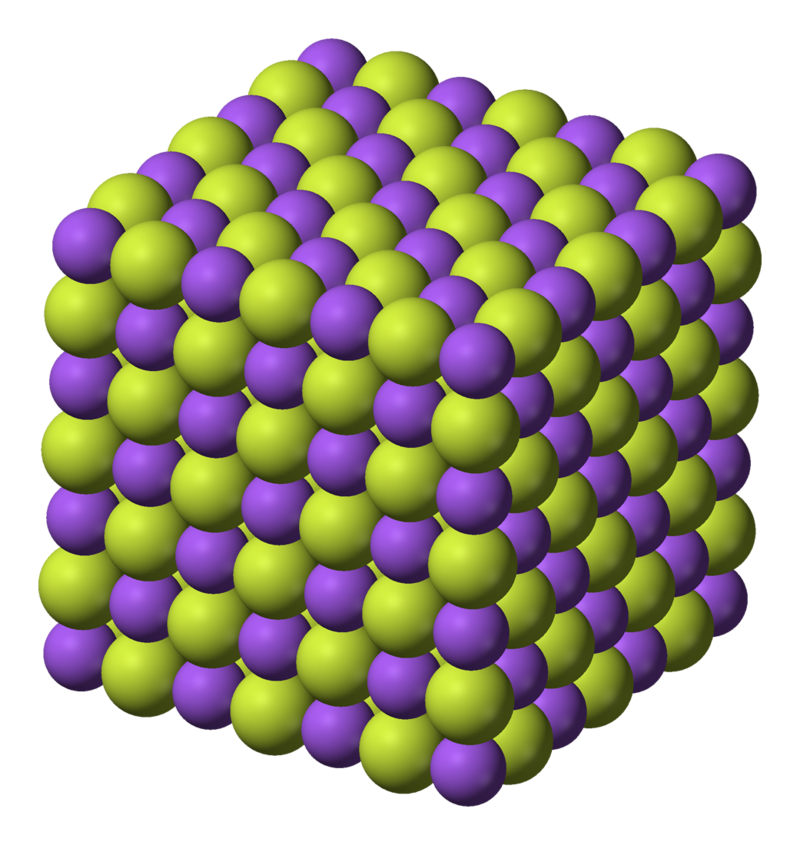
File:Sodium-fluoride-3D-ionic.png · Wikimedia Commons · See Wikimedia Commons
OverviewAI-generated
Sodium fluoride is a chemical compound with the formula NaF. It has a molar mass of 41.988 and a density of 2.78. The substance exhibits a melting point of 1869 and a boiling point of 3099. Its vapor pressure is 0, and it has a solubility of 4. The standard enthalpy of formation is -576.6, while the standard molar entropy is 51.5. The electric dipole moment measures 8.156.
In terms of safety and usage, the defined daily dose is 88. The time-weighted average exposure limit is 2.5, and the level immediately dangerous to life or health is 250. The compound is identified by the NIOSH Pocket Guide ID 0563. It has been referenced by 782 other encyclopedia articles.
Synthesized by Vinony from 28 facts across 4 sources: Wikidata, PubMed, PubChem, Vinony graph. Generated from structured data (not the Wikipedia text) and checked against those facts — may still contain errors.
Chemical data
- Formula
- FNa
- Molecular weight
- 41.9881724 g/mol
- IUPAC name
- sodium fluoride
- SMILES
- [F-].[Na+]
- InChIKey
- PUZPDOWCWNUUKD-UHFFFAOYSA-M
- Polar surface area
- 0 Ų
- H-bond donors
- 0
- H-bond acceptors
- 1
- Formal charge
- 0
via PubChem
Drug data · ChEMBL
- Max clinical phase
- Approved
- Molecule type
- Small molecule
- First approval
- 1972
- Admin. routes
- parenteral, topical
- Indications
- periodontitis, dental caries, dental fluorosis, tooth disease
via ChEMBL · EBI
Research
14,331 papers- Sodium fluoride therapy.The American journal of otology · 1993
- Aortic (18)F-sodium fluoride imaging.Journal of nuclear cardiology : official publication of the American Society of Nuclear Cardiology · 2023
- Sodium fluoride in otosclerosis treatment: review.The Journal of laryngology and otology · 2010
- Sodium fluoride promotes myopia progression via the activation of the ferroptosis pathway by PIEZO1 and pharmacological targeting PIEZO1 represents an innovative approach for myopia treatment.Cell biology and toxicology · 2025
- Sodium fluoride or sodium monofluorophosphate? A critical view of a meta-analysis on their relative effectiveness in dentifrices.American journal of dentistry · 1993
via PubMed
Wikidata facts
Show 15 more facts
- NIOSH Pocket Guide ID
- 0563
- immediately dangerous to life or health
- 250
- Commons category
- Sodium fluoride
- vapor pressure
- 0
- defined daily dose
- 88
- density
- 2.78
- solubility
- 4
- melting point
- 996
- boiling point
- 1704
- time-weighted average exposure limit
- 2.5
- chemical formula
- NaF
- canonical SMILES
- [F-].[Na+]
- standard enthalpy of formation
- -576.6
- standard molar entropy
- 51.5
- electric dipole moment
- 8.156
via Wikidata · CC0
~8 min read
Encyclopedic overview
Sodium fluoride (NaF) is an inorganic compound with the formula NaF. It is a colorless or white solid that is readily soluble in water. It is used in trace amounts in the fluoridation of drinking water to prevent tooth decay, and in toothpastes and topical pharmaceuticals for the same purpose. In 2023, it was the 264th most commonly prescribed medication in the United States, with more than 1 million prescriptions. It is also used in metallurgy and in medical imaging.
Uses
Excerpted from Wikipedia’s “sodium fluoride” article, available under the CC BY-SA 4.0 licence.