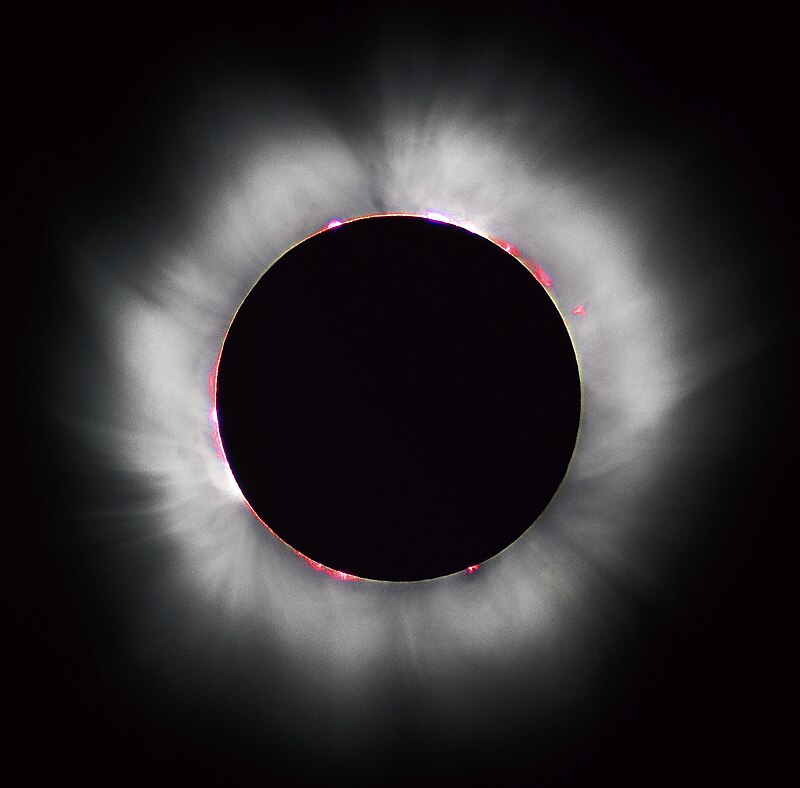
File:Solar_eclipse_1999_4.jpg · Wikimedia Commons · See Wikimedia Commons
solar eclipse
Sign in to savenatural phenomenon wherein the Sun is obscured by the Moon
A solar eclipse occurs when the Moon passes directly between the Earth and the Sun, blocking out the Sun's light and casting a shadow on Earth. This rare astronomical event is significant because it allows scientists to study the Sun's outer atmosphere and provides a spectacular natural phenomenon that captures public interest and wonder.
AI-generated from the Wikipedia summary — may contain errors.
Wikidata facts
- Subclass of
- astronomical phenomenon
- Has part
- annular solar eclipse
- Image
- Solar eclipse 1999 4.jpg
Show 8 more facts
- Commons category
- Solar eclipses
- topic's main category
- Category:Solar eclipses
- different from
- Lunar eclipse
- equivalent class
- dbpedia.org/ontology/SolarEclipse
- topic has template
- Template:Infobox solar eclipse
- described by source
- Pauly–Wissowa
- on focus list of Wikimedia project
- Wikipedia:Vital articles/Level/4
- subject named as
- Sonnenfinsternis
via Wikidata · CC0
~40 min read
Encyclopedic overview
A solar eclipse occurs when the Moon passes between Earth and the Sun, thereby obscuring the view of the Sun from a small part of Earth, totally or partially. Such an alignment occurs approximately every six months, during the eclipse season in its new moon phase, when the Moon's orbital plane is closest to the plane of Earth's orbit. In a total eclipse, the disk of the Sun is fully obscured by the Moon. In partial and annular eclipses, only part of the Sun is obscured. Unlike a lunar eclipse, which may be viewed from anywhere on the night side of Earth, a solar eclipse can only be viewed from a relatively small area of the world. As such, although total solar eclipses occur somewhere on Earth every 18 months on average, they recur at any given place only once every 360 to 410 years.
If the Moon were in a perfectly circular orbit and in the same orbital plane as Earth, there would be total solar eclipses at every new moon. Instead, because the Moon's orbit is tilted at about 5 degrees to Earth's orbit, its shadow usually misses Earth. Solar (and lunar) eclipses therefore happen only during eclipse seasons, resulting in at least two, and up to five, solar eclipses each year, no more than two of which can be total. Total eclipses are rarer because they require a more precise alignment between the centers of the Sun and Moon, and because the Moon's apparent size in the sky is sometimes too small to fully cover the Sun.
Excerpted from Wikipedia’s “solar eclipse” article, available under the CC BY-SA 4.0 licence.
Gallery (12)
Available in 144 languages
- Español
- Français
- Deutsch
- 中文
- 日本語
- Русский
- Português
- Italiano
- العربية
- हिन्दी
- Afrikaans
- Albanian
- Albanian
- Amharic
- Aragonese
- Armenian
- Assamese
- Asturian
Show 125 more
- azb
- Azerbaijani
- Bahasa Indonesia
- Balinese
- Bangla
- Bashkir
- Basque
- be_x_old
- Belarusian
- Bosnian
- Bulgarian
- Catalan
- cbk_zam
- Central Dusun
- Central Kurdish
- Cherokee
- Croatian
- Czech
- Danish
- Esperanto
- Estonian
- Faroese
- Filipino
- Finnish
- Fon
- Fula
- Galician
- Gan Chinese
- Georgian
- Greek
- Guarani
- Gujarati
- Haitian Creole
- Hebrew
- Hungarian
- hyw
- Iban
- Icelandic
- Inari Sami
- Interlingua
- Irish
- Javanese
- Kannada
- Kashmiri
- Kashubian
- Khmer
- Kurdish
- Kyrgyz
- Latin
- Latvian
- Limburgish
- Lithuanian
- Low German
- Luxembourgish
- Macedonian
- Malagasy
- Malay
- Malayalam
- Maltese
- Marathi
- Mazanderani
- Minangkabau
- Mingrelian
- Mongolian
- Moroccan Arabic
- Nederlands
- Nepali
- Northern Frisian
- Northern Sami
- Norwegian
- Norwegian Nynorsk
- Occitan
- Odia
- Oromo
- Pampanga
- Papiamento
- Pashto
- Polski
- Punjabi
- Quechua
- Romanian
- Rusyn
- Santali
- Serbian
- Serbian (Latin)
- Shona
- simple
- Sindhi
- Sinhala
- Slovak
- Slovenian
- Somali
- Sundanese
- Svenska
- Swahili
- Tachelhit
- Tamil
- Tatar
- Telugu
- Tetum
- Tibetan
- Tiếng Việt
- Toki Pona
- Türkçe
- Ukrainian
- Urdu
- Uyghur
- Uzbek
- Venetian
- Waray
- Welsh
- West Flemish
- Western Frisian
- Western Panjabi
- Wu Chinese
- Yiddish
- Yoruba
- Zaza
- zh_classical
- zh_min_nan
- zh_yue
- Zulu
- فارسی
- ไทย
- 한국어
via Wikidata sitelinks · CC0