File:Seminiferous_tubule_and_sperm.jpg · Wikimedia Commons · See Wikimedia Commons
spermatogenesis
Sign in to saveAlso known as GO:0007283, generation of spermatozoa, male gametogenesis
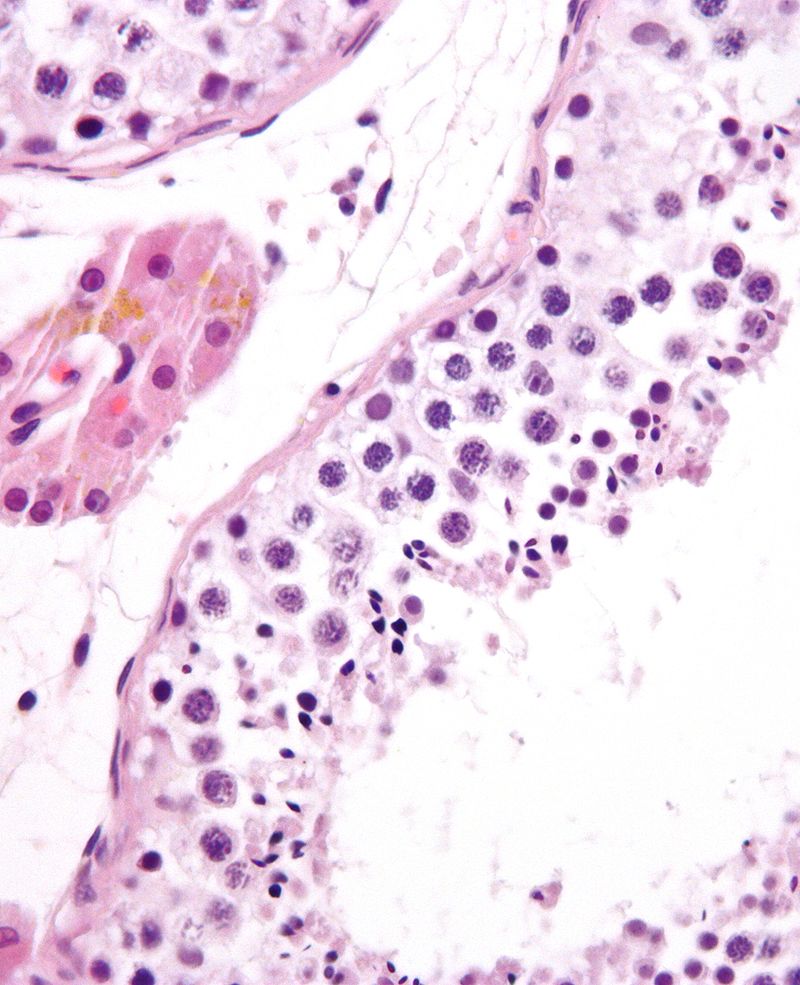
thumb|Normal spermatogenesis, testis biopsy. thumb|High-power view of a seminiferous tubule with normal spermatogenesis. Spermatogenesis is the process by which haploid spermatozoa develop from germ cells in the seminiferous tubules of the testicle. This process starts with the mitotic division of the stem cells located close to the basement membrane of the tubules. These cells are called spermatogonial stem cells. The mitotic division of these produces two types of cells. Type A cells replenish the stem cells, and type B cells differentiate into primary spermatocytes. The primary spermatocyte
Key facts
- Anatomy.Name
- Spermatogenesis
- Anatomy.Image
- Seminiferous tubule and sperm.jpg
- Anatomy.Caption
- Seminiferous tubule with maturing sperm. H&E stain.
- Anatomy.Width
- 250
- Anatomy.Image2
- Simplified spermatozoon diagram.svg
- Anatomy.Caption2
- A mature human Spermatozoon
via Wikipedia infobox
Research
39,289 papersvia PubMed
Wikidata facts
- Instance of
- biological process
Show 2 more facts
- Commons category
- Spermatogenesis
- exact match
- purl.obolibrary.org/obo/GO_0007283
via Wikidata · CC0
~17 min read
Encyclopedic overview
15 sectionsContents
- Purpose
- Location in humans
- Duration
- Stages
- Spermatocytogenesis
- Spermatidogenesis
- Spermiogenesis
- Role of Sertoli cells
- Influencing factors
- Hormonal control
- Disorders
- See also
- References
- Further reading
- External links
thumb|Normal spermatogenesis, testis biopsy. thumb|High-power view of a seminiferous tubule with normal spermatogenesis. Spermatogenesis is the process by which haploid spermatozoa develop from germ cells in the seminiferous tubules of the testicle. This process starts with the mitotic division of the stem cells located close to the basement membrane of the tubules. These cells are called spermatogonial stem cells. The mitotic division of these produces two types of cells. Type A cells replenish the stem cells, and type B cells differentiate into primary spermatocytes. The primary spermatocyte divides meiotically (Meiosis I) into two secondary spermatocytes; each secondary spermatocyte divides into two equal haploid spermatids by Meiosis II. The spermatids are transformed into spermatozoa (sperm) by the process of spermiogenesis. These develop into mature spermatozoa, also known as sperm cells. Thus, the primary spermatocyte gives rise to two cells, the secondary spermatocytes, and the two secondary spermatocytes by their subdivision produce four spermatozoa and four haploid cells.
Spermatozoa are the mature male gametes in many sexually reproducing organisms. Thus, spermatogenesis is the male version of gametogenesis, of which the female equivalent is oogenesis. In mammals it occurs in the seminiferous tubules of the male testes in a stepwise fashion. Spermatogenesis is highly dependent upon optimal conditions for the process to occur correctly, and is essential for sexual reproduction. DNA methylation and histone modification have been implicated in the regulation of this process. It starts during puberty and usually continues uninterrupted until death, although a slight decrease can be discerned in the quantity of produced sperm with increase in age (see Male infertility).
Excerpted from Wikipedia’s “spermatogenesis” article, available under the CC BY-SA 4.0 licence.