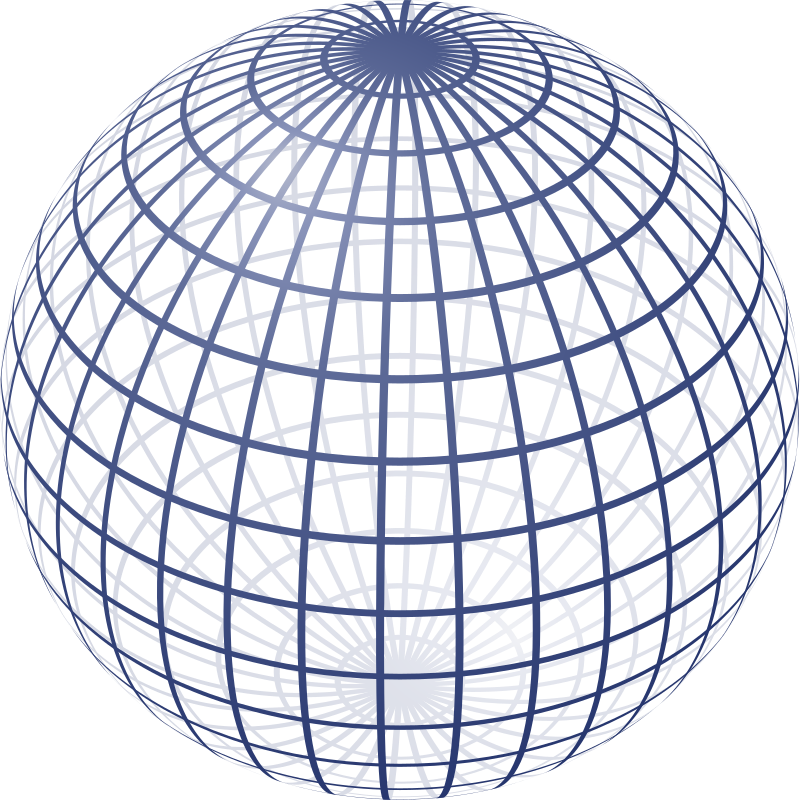
File:Sphere_wireframe_10deg_6r.svg · Wikimedia Commons · See Wikimedia Commons
sphere
Sign in to saveAlso known as 2-sphere, orb
A sphere (from Ancient Greek , ) is a surface analogous to the circle, a curve. In solid geometry, a sphere is the set of points that are all at the same distance from a given point in three-dimensional space. That given point is the center of the sphere, and the distance is the sphere's radius. The earliest known mentions of spheres appear in the work of the ancient Greek mathematicians.
A sphere is a perfectly round three-dimensional shape where every point on its surface sits at an equal distance from a central point, much like how a circle works in two dimensions. Spheres matter because they are a fundamental geometric form that appears throughout mathematics, nature, and everyday objects like planets and balls, making them essential to understanding spatial relationships and physical properties of the world around us.
AI-generated from the Wikipedia summary — may contain errors.
Key facts
- Polyhedron<! Please add only parameters that make sense for a sphere. >.name
- Sphere
- Polyhedron<! Please add only parameters that make sense for a sphere. >.image
- File:Sphere wireframe 10deg 6r.svg
- Polyhedron<! Please add only parameters that make sense for a sphere. >.caption
- A perspective projection of a sphere
- Polyhedron<! Please add only parameters that make sense for a sphere. >.euler
- 2
- Polyhedron<! Please add only parameters that make sense for a sphere. >.symmetry
- Orthogonal group|
- Polyhedron<! Please add only parameters that make sense for a sphere. >.type
- Smooth surfaceAlgebraic surface
via Wikipedia infobox
Wikidata facts
- Subclass of
- geometric primitive
- Followed by
- torus
- Follows
- circle
- Image
- Sphere Quadric.png
- Said to be same as
- Riemann sphere
Show 9 more facts
- Commons category
- Spheres
- Euler characteristic
- 2
- topic's main category
- Category:Spheres
- has characteristic
- genus
- different from
- three-ball
- Commons gallery
- Sphere
- on focus list of Wikimedia project
- Wikipedia:Vital articles/Level/4
- maintained by WikiProject
- WikiProject Mathematics
- described by source
- Encyclopædia Britannica 11th edition
via Wikidata · CC0
~30 min read
Encyclopedic overview
32 sectionsContents
- Basic terminology
- Equations
- Parametric
- Properties
- Enclosed volume{{anchor|Volume}}
- Surface area{{anchor|Area}}
- Other geometric properties
- Pencil of spheres
- Properties of the sphere
- Treatment by area of mathematics
- Spherical geometry
- Differential geometry
- Topology
- Curves on a sphere {{anchor|Curves}}
- Circles
- Loxodrome
- Clelia curves
- Spherical conics
- Intersection of a sphere with a more general surface
- Generalizations
- Ellipsoids
- Dimensionality
- Metric spaces
- History
- Gallery
- Regions
- See also
- Notes and references
- Notes
- References
- Further reading
- External links
A sphere (from Ancient Greek , ) is a surface analogous to the circle, a curve. In solid geometry, a sphere is the set of points that are all at the same distance from a given point in three-dimensional space. That given point is the center of the sphere, and the distance is the sphere's radius. The earliest known mentions of spheres appear in the work of the ancient Greek mathematicians.
The sphere is a fundamental surface in many fields of mathematics. Spheres and nearly-spherical shapes also appear in nature and industry. Bubbles such as soap bubbles take a spherical shape in equilibrium. The Earth is often approximated as a sphere in geography, and the celestial sphere is an important concept in astronomy. Manufactured items including pressure vessels and most curved mirrors and lenses are based on spheres. Spheres roll smoothly in any direction, so most balls used in sports and toys are spherical, as are ball bearings.
Excerpted from Wikipedia’s “sphere” article, available under the CC BY-SA 4.0 licence.
Gallery (30)
Available in 109 languages
- Español
- Français
- Deutsch
- 中文
- 日本語
- Русский
- Português
- Italiano
- العربية
- हिन्दी
- Afrikaans
- Albanian
- Amharic
- Armenian
- Asturian
- azb
- Azerbaijani
- Bahasa Indonesia
Show 90 more
- Bangla
- Bashkir
- Basque
- Belarusian
- Bhojpuri
- Bosnian
- Bulgarian
- Burmese
- Catalan
- Central Kurdish
- Cherokee
- Chuvash
- Croatian
- Czech
- Danish
- Esperanto
- Estonian
- Fijian
- Filipino
- Finnish
- Galician
- Gan Chinese
- gcr
- Georgian
- Greek
- Gujarati
- Haitian Creole
- Hebrew
- Hungarian
- Icelandic
- Ido
- Interlingua
- Irish
- Jamaican Creole English
- Kabyle
- Kannada
- Kazakh
- Latin
- Latvian
- Lithuanian
- Macedonian
- Malagasy
- Malay
- Malayalam
- Moksha
- Mongolian
- Moroccan Arabic
- Nederlands
- Northern Frisian
- Norwegian
- Norwegian Nynorsk
- Occitan
- Oromo
- Piedmontese
- Polski
- Punjabi
- Quechua
- Romanian
- rsk
- Scottish Gaelic
- Serbian
- Serbian (Latin)
- Shona
- Sicilian
- simple
- Sinhala
- Slovak
- Slovenian
- Somali
- Sundanese
- Svenska
- Swahili
- Tamil
- Tatar
- Telugu
- Tiếng Việt
- Toki Pona
- Türkçe
- Ukrainian
- Uzbek
- Waray
- Welsh
- Wu Chinese
- Yakut
- zh_classical
- zh_min_nan
- zh_yue
- فارسی
- ไทย
- 한국어
via Wikidata sitelinks · CC0