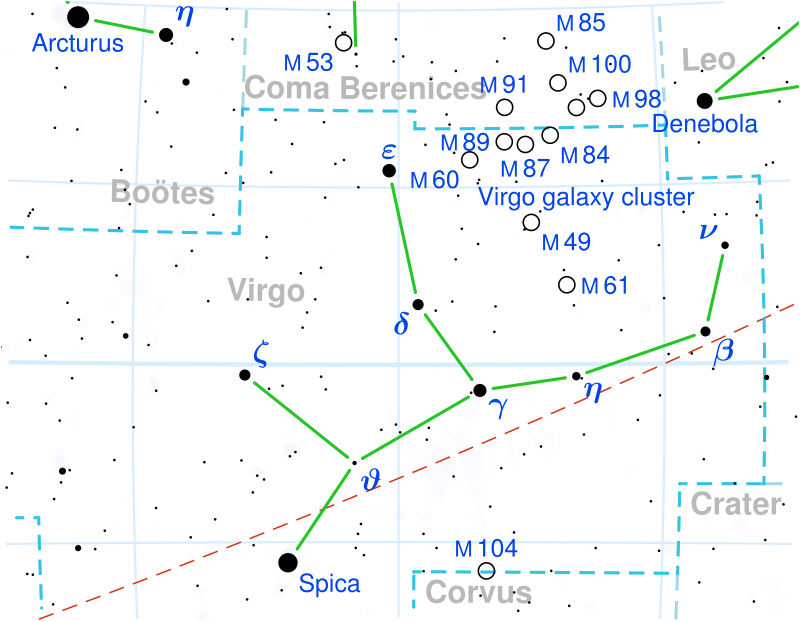
File:Virgo_constellation_map.svg · Wikimedia Commons · See Wikimedia Commons
Spica
Sign in to saveAlso known as Alpha Virginis, 67 Virginis, α Virginis, alf Vir, 67 Vir, α Vir, MCW 553, SACS 290
Spica is the brightest object in the constellation of Virgo and one of the 20 brightest stars in the night sky. It has the Bayer designation α Virginis, which is Latinised to Alpha Virginis and abbreviated Alpha Vir or α Vir. Analysis of its parallax shows that it is located 250 light-years from the Sun. It is a spectroscopic binary star and rotating ellipsoidal variable; a system whose two stars are so close together they are egg-shaped rather than spherical, and can only be separated by their spectra. The primary is a blue giant and a variable star of the Beta Cephei type.
Spica is the brightest star in the constellation Virgo and ranks among the 20 brightest stars visible from Earth, located about 250 light-years away. It's actually a pair of stars so close together that they distort each other into egg shapes and can only be distinguished by analyzing their light spectra, with the primary star being a blue giant that varies in brightness.
AI-generated from the Wikipedia summary — may contain errors.
Wikidata facts
- Instance of
- rotating ellipsoidal variable
- Part of
- Spring Triangle
- Constellation
- Virgo
- Distance from Earth
- 93
- Radius
- 7.4
- Variable-star type
- rotating ellipsoidal variable
- Image
- Virgo constellation map.png
Show 17 more facts
- Commons category
- Spica
- spectral class
- B1IIISB
- catalog code
- BD-10 3672
- described by source
- Armenian Soviet Encyclopedia
- parallax
- 13.06
- apparent magnitude
- 1.64
- right ascension
- 201.298247362
- declination
- -11.161319485
- stellar rotational velocity
- 130
- radial velocity
- -3.31
- epoch
- J2000.0
- effective temperature
- 3
- right ascension component of proper motion
- -40
- declination component of proper motion
- -35
- age estimated by a dating method
- 12.5
- on focus list of Wikimedia project
- Wikipedia:Vital articles/Level/4
- surface gravity
- 3000
via Wikidata · CC0
~9 min read
Encyclopedic overview
6 sectionsContents
- Nomenclature
- Observational history
- Observation
- Physical properties
- See also
- References
Spica is the brightest object in the constellation of Virgo and one of the 20 brightest stars in the night sky. It has the Bayer designation α Virginis, which is Latinised to Alpha Virginis and abbreviated Alpha Vir or α Vir. Analysis of its parallax shows that it is located 250 light-years from the Sun. It is a spectroscopic binary star and rotating ellipsoidal variable; a system whose two stars are so close together they are egg-shaped rather than spherical, and can only be separated by their spectra. The primary is a blue giant and a variable star of the Beta Cephei type.
Spica, along with Arcturus and Denebola—or Regulus, depending on the source—forms the Spring Triangle asterism, and, by extension, is also part of the Great Diamond together with the star Cor Caroli.
Excerpted from Wikipedia’s “Spica” article, available under the CC BY-SA 4.0 licence.
Gallery (13)
Available in 60 languages
- Español
- Français
- Deutsch
- 中文
- 日本語
- Русский
- Português
- Italiano
- العربية
- हिन्दी
- Afrikaans
- Armenian
- Asturian
- Azerbaijani
- Bahasa Indonesia
- Basque
- Belarusian
- Bosnian
Show 41 more
- Bulgarian
- Catalan
- Czech
- Danish
- Esperanto
- Estonian
- Finnish
- Greek
- Hebrew
- Hungarian
- Javanese
- Kurdish
- Latin
- Lithuanian
- Luxembourgish
- Macedonian
- Malayalam
- Nederlands
- Norwegian
- Norwegian Nynorsk
- Polski
- Punjabi
- Romanian
- Serbian
- Serbian (Latin)
- simple
- Slovak
- Slovenian
- Svenska
- Swahili
- Tajik
- Tiếng Việt
- Türkçe
- Ukrainian
- Uzbek
- Waray
- Wu Chinese
- zh_yue
- فارسی
- ไทย
- 한국어
via Wikidata sitelinks · CC0