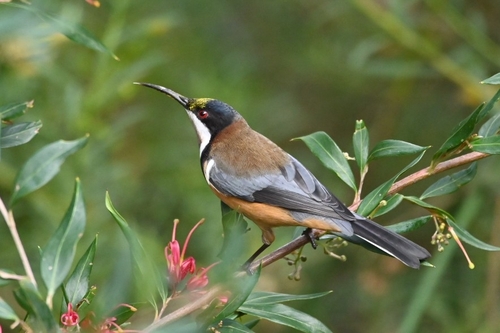
(c) judybarnes, some rights reserved (CC BY-NC), uploaded by judybarnes · cc-by-nc
Spinebill
Sign in to saveAlso known as Acanthorhynchus
Spinebill is the name given to two members of the honeyeater family, both in the genus Acanthorhynchus, which is Latin for "spine bill". They are around 15 centimetres in length, and are coloured black, white and chestnut, with a long, downcurved bill. They are native to Australia, with one species in the east and one in the west. They feed on nectar as well as insects, and live mainly in forests, gardens, and other shrubbery habitats.
Species
Eastern Spinebill
Genus
- PhylumChordata
- ClassAves
- OrderPasseriformes
- FamilyMeliphagidae
via
Wikidata facts
- Instance of
- taxon
- Parent taxon
- Meliphagidae
- Image
- Spinebill3.jpg
Show 4 more facts
- Commons category
- Acanthorhynchus
- taxon rank
- genus
- taxon name
- Acanthorhynchus
- topic's main category
- Category:Acanthorhynchus
Sources (2)
via Wikidata · CC0
~1 min read
Encyclopedic overview
3 sectionsContents
- Species and distribution
- References
- External links
Spinebill is the name given to two members of the honeyeater family, both in the genus Acanthorhynchus, which is Latin for "spine bill". They are around 15 centimetres in length, and are coloured black, white and chestnut, with a long, downcurved bill. They are native to Australia, with one species in the east and one in the west. They feed on nectar as well as insects, and live mainly in forests, gardens, and other shrubbery habitats.
A 2004 molecular study has shown that the two spinebills are a sister grouping to all other honeyeaters, that is, they diverged earlier than all other species.
Excerpted from Wikipedia’s “Spinebill” article, available under the CC BY-SA 4.0 licence.
Gallery (3)
Available in 25 languages
- Español
- Français
- 中文
- Русский
- العربية
- Bahasa Indonesia
- Breton
- Catalan
- Cebuano
- Egyptian Arabic
- Finnish
- Hungarian
- Kurdish
- Lithuanian
- Nederlands
- Norwegian
- Polski
- Svenska
via Wikidata sitelinks · CC0