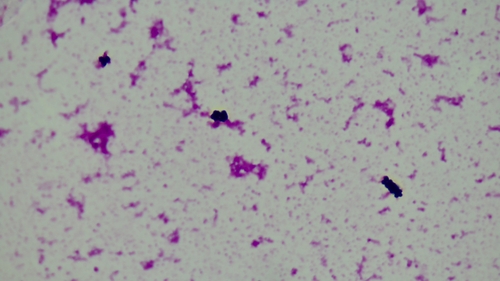
(c) Ansel Oommen, some rights reserved (CC BY-NC), uploaded by Ansel Oommen · cc-by-nc
Staphylococcus hominis
Sign in to savespecies of bacterium
Species
SPECIES
- KingdomBacteria
- PhylumFirmicutes
- ClassBacilli
- OrderStaphylococcales
- FamilyStaphylococcaceae
via GBIF
Described at

Stinky sweat turns out to have a surprising health benefit : Goats and Soda : NPR
So sweat doesn't really smell bad at all. But when bacteria eat the sweat — nostrils, look out! Only it turns out that these sweat-eating critters are responsible for a big health benefit.
npr.org →Stinky sweat turns out to have a surprising health benefit : Goats and Soda So sweat doesn't really smell bad at all. But when bacteria eat the sweat — nostrils, look out! Only it turns out that these sweat-eating critters are responsible for a big health benefit. Tennis great Rafael Nadal of Spain might think twice about shaking off his beads of perspiration. It turns out that sweat leads to a surprising health benefit. Matthew Stockman/Getty Images hide caption Tennis great Rafael Nadal of Spain might think twice about shaking off his beads of perspiration. It turns out that sweat leads to a surprising health benefit. Back in college, I had an embarrassing moment that's forever etched into my memory. A girlfriend borrowed my backpack for a weekend trip. And when she came back, she handed me the backpack and said something I'll never forget: "Michaeleen, you must sweat a lot because your backpack stinks. The armstraps smell like onions. Ew." I stood there in silence, feeling totally ashamed. I'm not sure how I responded. But I remember thinking to myself, "I don't eat many onions. Does my sweat really smell that bad?" To figure out what I'm talking about, we need to step back and look at what actually creates body odor. It's not the sweat itself. "No, I don't think your sweat by itself smells," says microbiologist Gavin Thomas at York University. "It certainly doesn't have these really stinky, odorous molecules." When did human bodies evolve to sweat? We don't know exactly when When did human bodies evolve to sweat? We don't know exactly when Thomas studies how – and why– humans have a particular bouquet of scents. He says that sweat, immediately after it comes out of your pores, is essentially odorless. "So most sweat is salty water," he says. That's the sweat that's secreted pretty much all over your body and cools you down when you're hot. "But that's not what we're interested in," he explains. "We're interested in this other type of sweat, which is produced in our underarms and around the genitals." This other type of sweat isn't just salty water but also contains a cornucopia of compounds, including oils, fats and proteins. No one knows exactly why humans have this second type of sweat. But, Thomas says, one purpose likely has to do with the odors that it ends up emitting. On its own, this second type of sweat isn't smelly. But something living on our skin – tiny creatures – takes that sweat and makes it stinky. Warning: This illustration "grossed out" our visuals editor! It depicts bacteria around a sweat gland pore on the surface of human skin. Sweat pores bring sweat from a sweat gland to the skin's surface. Some of these bacteria enjoy eating the molecules in our sweat. Then they spit out new molecular compounds, some of which can be quite stinky. Juan Gaertner/Science Source hide caption "The human skin has almost 200 different species of bacteria living on it," says biologist Teruaki Nakatsuji at the University of California, San Diego. "And each person has different strains of these bacteria. So the skin microbiota is so diverse." These bacteria are hungry. And some of them really enjoy eating the molecules in our sweat. They munch off a piece of the molecule and then spit out new molecular compounds, some of which are quite aromatic. For example, they can smell like cumin or goats, the American Society for Microbiology asserts . Back in 2020, Thomas and his colleagues found that one critter on the skin, called Staphylococcus hominis, produces an especially pungent odor: "We've had people describe it as kind of an onion smell or a cheesy onion smell," he says. "These types of compounds do smell pretty bad." But wait! This critter – and your stinky sweat – is actually beneficial and even necessary. Which may make you want to go take shower stat. But wait! Before you go grab the antibacterial soap, there's something about this bacteria you need to know. Something that I didn't realize until rece
Excerpt from a page describing this subject · 11,691 chars · not written by Vinony
Wikidata facts
- Instance of
- taxon
- Parent taxon
- Staphylococcus
Show 6 more facts
- taxon name
- Staphylococcus hominis
- taxon rank
- species
- Gram staining
- gram-positive bacteria
- described at URL
- www.npr.org/sections/goatsandsoda/2022/08/25/1119228689/why-stinky-sweat-is-good-for-you
- short name
- S. hominis
Sources (2)
via Wikidata · CC0