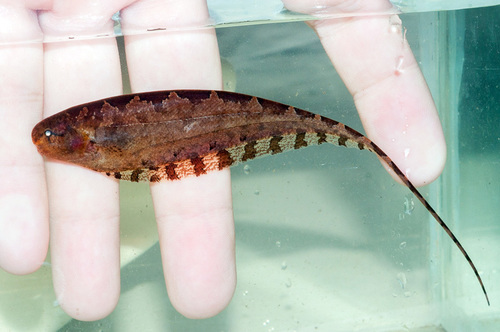
(c) Juan Miguel Artigas Azas, all rights reserved, uploaded by Juan Miguel Artigas Azas
Steatogenys
Sign in to saveSteatogenys is a genus of freshwater ray-finned fishes belonging to the family Rhamphichthyidae, the sand kinifefishes. The fishes in this genus are found in the Amazon, Orinoco and Essequibo river basins in tropical South America. The widespread and common S. elegans is found in a wide range of habitats, from the shallow essentially static waters such as floodplain lakes to fast-flowing rivers as deep as . The two remaining species are less common and widespread, with S. duidae found mainly in small streams running through terra firme forests (forest that does not flood, unlike várzea) and S.
Species
centipede knifefish
GENUS
- KingdomAnimalia
- PhylumChordata
- ClassTeleostei
- OrderGymnotiformes
- FamilyHypopomidae
via GBIF
Museum specimens
- Specimen records
- 35
- Family
- Hypopomidae
- Collections
- ANSP, AUM, INSTITUTO NACIONAL DE PESQUISAS DA AMAZÔNIA (INPA), MPEG
- Recorded in
- Atures, Peru, Guyana, Brasil
Wikidata facts
- Instance of
- taxon
- Parent taxon
- Hypopomidae
- Image
- Hypopomidae Steatogenys elgans.jpg
Show 4 more facts
- Commons category
- Steatogenys
- taxon name
- Steatogenys
- taxon rank
- genus
- topic's main category
- Category:Steatogenys
Sources (1)
via Wikidata · CC0
~2 min read
Encyclopedic overview
2 sectionsContents
- Taxonomy and species
- References
Steatogenys is a genus of freshwater ray-finned fishes belonging to the family Rhamphichthyidae, the sand kinifefishes. The fishes in this genus are found in the Amazon, Orinoco and Essequibo river basins in tropical South America. The widespread and common S. elegans is found in a wide range of habitats, from the shallow essentially static waters such as floodplain lakes to fast-flowing rivers as deep as . The two remaining species are less common and widespread, with S. duidae found mainly in small streams running through terra firme forests (forest that does not flood, unlike várzea) and S. ocellatus among submerged roots and branches in static or slow-flowing blackwater habitats. All three are regularly found among vegetation in floating meadows, a habitat that often contains little oxygen, but they are well-adapted to this.
They are well-camouflaged and brown in color with a barred pattern. They resemble the related Hypopygus, but are larger, reaching up to in total length depending on the exact species of Steatogenys. They feed on invertebrates such as aquatic insect larvae and small shrimp.
Excerpted from Wikipedia’s “Steatogenys” article, available under the CC BY-SA 4.0 licence.