File:Earth_precession.svg · Wikimedia Commons · See Wikimedia Commons
stellar precession
Sign in to saveAlso known as precession of the equinoxes, planetary precession, axial precession
gravity-induced, slow, and continuous change in the orientation of an astronomical body's rotational axis
Wikidata facts
- Instance of
- precession
- Duration
- 26000
- Image
- Precesión.gif
Show 1 more fact
- Commons category
- Precession of the equinoxes
via Wikidata · CC0
~40 min read
Encyclopedic overview
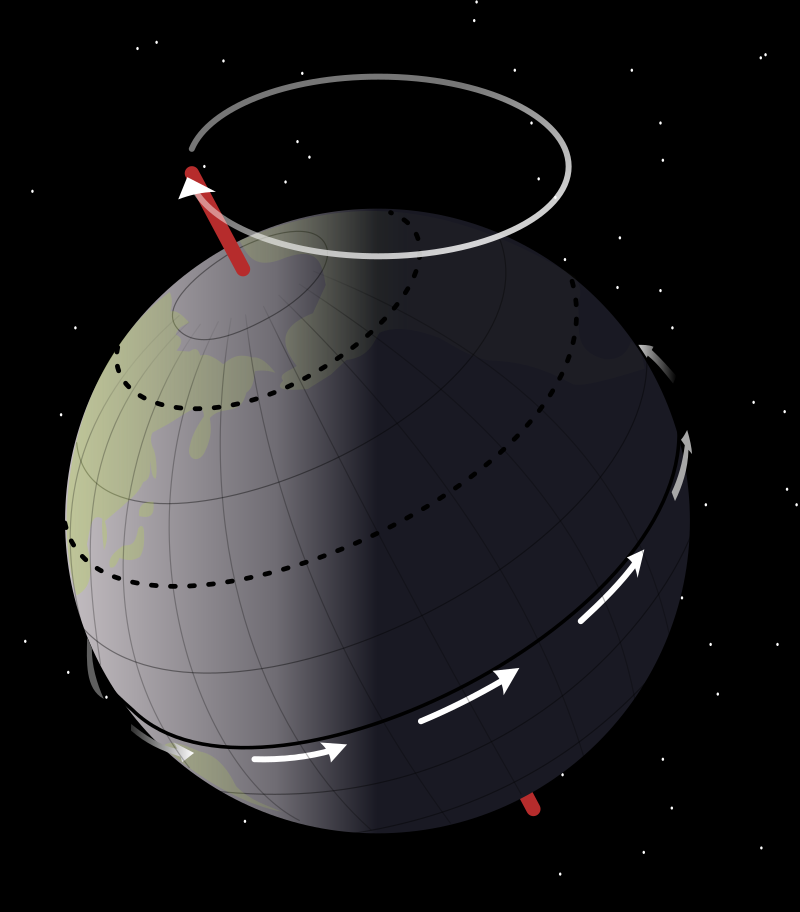
Precessional movement of Earth. Earth rotates (white arrows) about once a day around its rotational axis (red); this axis itself rotates slowly (white circle), completing a rotation in approximately 26,000 years
In astronomy, axial precession is a gravity-induced, slow, and continuous change in the orientation of an astronomical body's rotational axis. In the absence of precession, the astronomical body's orbit would show axial parallelism. In particular, Earth's axial precession is the gradual shift in the orientation of Earth's axis of rotation. It has a cycle of approximately 26,000 years, tracing out a double cone with a half-aperture of about 23.4°, an angle known as the obliquity of the ecliptic. This is similar to the precession of a spinning top. The term "precession" typically refers only to this largest part of the motion; other changes in the alignment of Earth's axis—nutation and polar motion—are much smaller in magnitude.
Excerpted from Wikipedia’s “stellar precession” article, available under the CC BY-SA 4.0 licence.