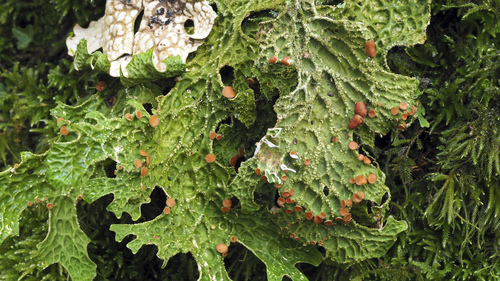
(c) Joaquin Martin, all rights reserved, uploaded by Joaquin Martin
Sticta
Sign in to saveSticta is a genus of lichens in the family Peltigeraceae. The genus has a widespread distribution, especially in tropical areas, and includes about 114 species. These lichens have a leafy appearance, and are colored brown or black. Sticta species with cyanobacteria as photobionts can fix nitrogen from the atmosphere, and due to their relative abundance and high turnover, they contribute appreciably to the rainforest ecosystem. They are commonly called spotted felt lichens.
Species
Tree Lungwort
Genus
- PhylumAscomycota
- ClassLecanoromycetes
- OrderPeltigerales
- FamilyLobariaceae
via
Museum specimens
- Specimen records
- 6,242
- With media
- 3,028
- Family
- Lobariaceae
- Collections
- LSU, COLO, TENN, UCONN, NY
- Recorded in
- United States, Mexico, Australia, Jamaica, Madagascar, Ecuador, Papua New Guinea, Peru
Wikidata facts
- Instance of
- taxon
- Parent taxon
- Lobariaceae
- Image
- Sticta hypochroa.jpg
Show 6 more facts
- taxon common name
- spotted felt lichen
- taxon name
- Sticta
- taxon rank
- genus
- topic's main category
- Category:Sticta
- Commons category
- Sticta
- taxon author citation
- (Schreb.) Ach.
via Wikidata · CC0
~6 min read
Encyclopedic overview
8 sectionsContents
- Description
- Distribution and habitat
- Phylogenetics
- Indicators of ecological continuity
- Bioactive compounds
- Species
- References
- Cited literature
Sticta is a genus of lichens in the family Peltigeraceae. The genus has a widespread distribution, especially in tropical areas, and includes about 114 species. These lichens have a leafy appearance, and are colored brown or black. Sticta species with cyanobacteria as photobionts can fix nitrogen from the atmosphere, and due to their relative abundance and high turnover, they contribute appreciably to the rainforest ecosystem. They are commonly called spotted felt lichens.
==Description== The vegetative bodies of the Sticta, the thalli, are foliose, or leafy in appearance. They typically have dimensions of in diameter, although specimens with diameters of up to have been recorded. The lobes are rounded, and the upper surface is black or brown, while the lower surface has a light to dark brown layer of fine hairs (a ), with a few craters, called . Thalli often smell of shrimp or fish. The vegetative reproductive structures called isidia or soredia are often present on species in this genus; apothecia (cup-shaped spore-bearing structures) are rarely found. Sticta species are usually found growing on bark, wood, or mossy rock.
Excerpted from Wikipedia’s “Sticta” article, available under the CC BY-SA 4.0 licence.