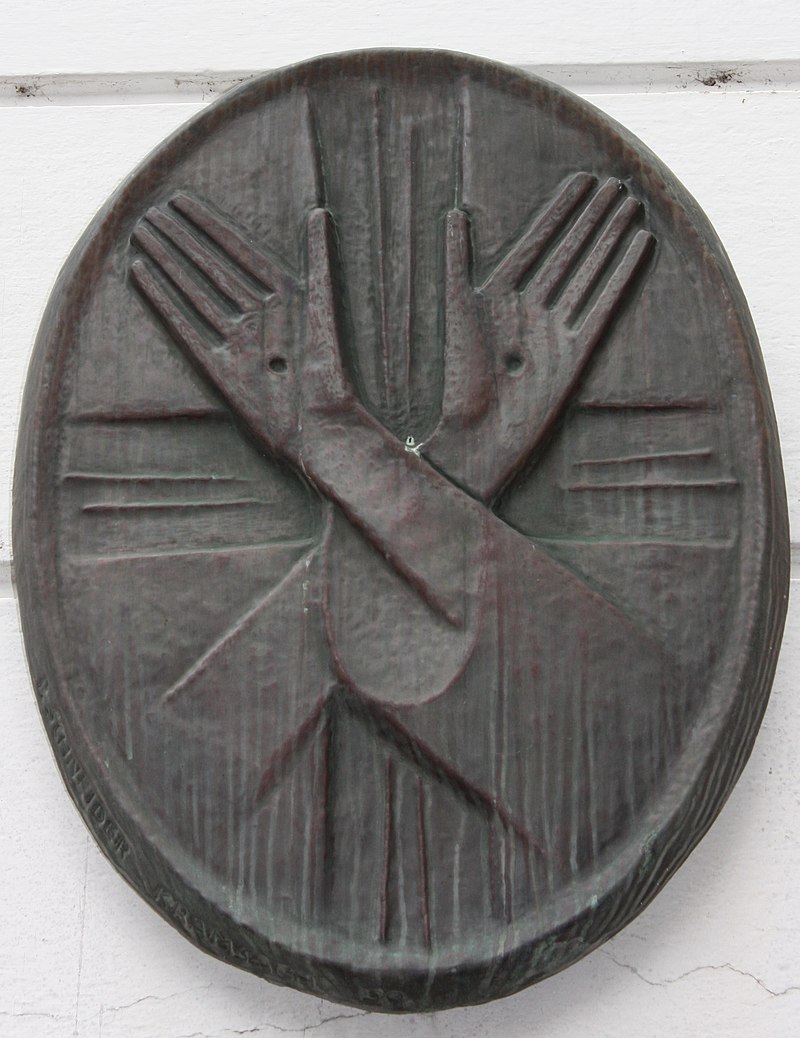
File:Lienz_-_Fanziskanerkirche_-_Außenansicht_-_Hände_mit_Stigmata.jpg · Wikimedia Commons · See Wikimedia Commons
stigmata
Sign in to saveAlso known as crucifixion wounds of Jesus Christ
thumb|Hands with stigmata, depicted on a Order of Saint Francis|Franciscan church in [[Lienz, Austria]] thumb|Catherine of Siena|St Catherine fainting from the stigmata by [[Il Sodoma, Church of Saint Pantaleon, Alsace, France]]
Stigmata refers to the spontaneous appearance of wounds on a person's body that correspond to the wounds of Jesus Christ during his crucifixion, a phenomenon primarily associated with deeply religious Catholic figures throughout history. These occurrences have been considered spiritually significant by believers as signs of divine favor or mystical union with Christ's suffering.
AI-generated from the Wikipedia summary — may contain errors.
Wikidata facts
- Subclass of
- wound
- Image
- Giotto. Stigmatization of St Francis. 1295-1300. 314x162cm. Louvre, Paris.jpg
Show 4 more facts
- Commons category
- Stigmata
- different from
- stigmatism
- described by source
- Wikitólica
- P8168
- Doris Fitschen
via Wikidata · CC0
~17 min read
Encyclopedic overview
12 sectionsContents
- Description
- Specific cases
- Saint Ansbert of Rouen
- Saint Francis of Assisi
- Saint Padre Pio of Pietrelcina
- Mariam Thresia Chiramel
- Stigmata and gender
- Scientific research
- Non-Christian stigmata
- References
- Further reading
- External links
thumb|Hands with stigmata, depicted on a Order of Saint Francis|Franciscan church in [[Lienz, Austria]] thumb|Catherine of Siena|St Catherine fainting from the stigmata by [[Il Sodoma, Church of Saint Pantaleon, Alsace, France]]
Stigmata (, plural of , 'mark, spot, brand'), in Catholicism, are bodily wounds, scars and pain which appear in locations corresponding to the crucifixion wounds of Jesus Christ: the hands, wrists, feet, near the heart, the head (from the crown of thorns), and back (from carrying the cross and scourging).
Excerpted from Wikipedia’s “stigmata” article, available under the CC BY-SA 4.0 licence.