Encyclopedia of Life · EOL (see source)
Streptomycetaceae
Sign in to saveStreptomycetaceae is a family of the order Streptomycetales. It includes the important genus Streptomyces. This was the original source of many antibiotics, namely streptomycin, the first antibiotic against tuberculosis.
Species
ストレプトミセス科
FAMILY
- KingdomBacteria
- PhylumActinobacteriota
- ClassActinomycetia
- OrderStreptomycetales
- FamilyStreptomycetaceae
Streptomycetaceae ist eine Familie der Bakterien-Ordnung Actinomycetales. Sie umfasst drei Gattungen (Stand 2013), die sehr artenreiche Gattung Streptomyces und die weniger Arten enthaltenden Gattungen Kitasatospora und Streptacidophilus.[1] Charakteristisch sind Aerobie, Bildung von stark verzweigtem Myzel mit durch Segmentierung entstehenden Sporen, positives Verhalten in der Gram-Färbung, hoher G+C-Gehalt der Desoxyribonukleinsäure (DNA) und hauptsächliches Vorkommen in Böden. Die Familie Streptomycetaceae wird oft auch als „Streptomyzeten“ oder „Streptomyceten“ bezeichnet. Diese Bezeichnungen sind jedoch nicht eindeutig, weil damit auch die Gattung Streptomyces bezeichnet wird. Inhaltsverzeichnis 1 Gestalt, Zellstruktur 2 Stoffwechsel 3 Vorkommen, Lebensweise 4 Literatur 5 Einzelnachweise Gestalt, Zellstruktur Streptomyceten bilden in der Regel stark verzweigte Myzelien. Der Durchmesser der Myzelfäden (Hyphen) beträgt 0,5 bis 2,0 µm und sie wachsen an ihrer Spitze. In den Hyphen befinden sich zahlreiche Kopien der chromosomalen Desoxyribonukleinsäure (DNA), Querwände sind selten. Selten zerfallen die Hyphen in kleinere Abschnitte. Bei reichlichem Nährstoffangebot entwickelt sic
via GBIF
Research
25,749 papers- Osmotrophy.Current biology : CB · 2018
- Natural Products from Singapore Soil-Derived Streptomycetaceae Family and Evaluation of Their Biological Activities.Molecules (Basel, Switzerland) · 2023
- Study on degradation characteristics of imazamox by Streptomycetaceae.Journal of environmental science and health. Part. B, Pesticides, food contaminants, and agricultural wastes · 2022
- Phylogenetic relationships in the family Streptomycetaceae using multi-locus sequence analysis.Antonie van Leeuwenhoek · 2017
- Recombinant DNA technology.Advances in applied microbiology · 1981
via PubMed
Wikidata facts
- Instance of
- taxon
- Image
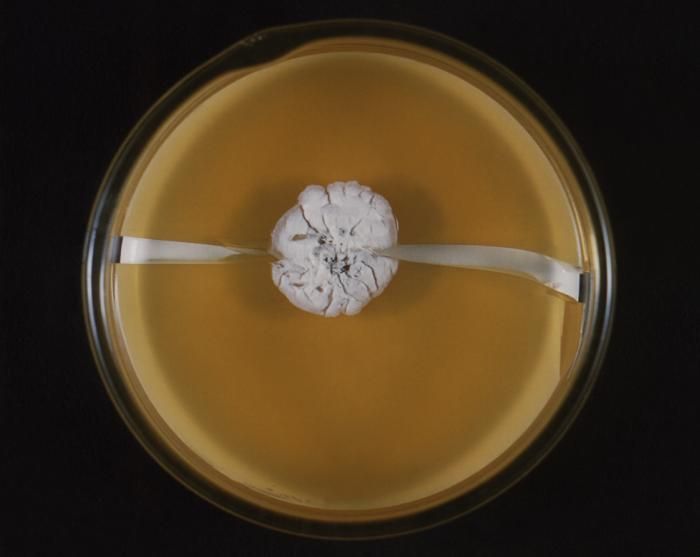
- Streptomyces sp 01.png
Show 7 more facts
- taxon rank
- family
- taxon name
- Streptomycetaceae
- topic's main category
- Category:Streptomycetaceae
- Commons category
- Streptomycetaceae
- Gram staining
- gram-positive bacteria
- taxonomic type
- Streptomyces
Sources (3)
via Wikidata · CC0
~3 min read
Encyclopedic overview
5 sectionsContents
- Genomics
- Phylogeny
- Notes
- See also
- References
Streptomycetaceae is a family of the order Streptomycetales. It includes the important genus Streptomyces. This was the original source of many antibiotics, namely streptomycin, the first antibiotic against tuberculosis.
==Genomics== Sequence alignments of actinomycetotal genomes have led to the identification of three conserved signature indels which are unique to the order Streptomycetales. The enzyme PBGD contains a four-amino-acid insertion which is present in all Streptomyces species and Kitasatospora setae, but not any other Actinomycetota. Similarly, a one- amino-acid insertion is present in a conserved region of adenylate kinase and is found in all Streptomyces species and K. setae, but is not found in any other Actinomycetota. Five conserved signature proteins have also been identified which are present in various sequenced Streptomyces species, but not in K. setae; however, as the complete genome of K. setae has not yet been sequenced, these proteins may be present in K. setae. Additionally, 11 conserved signature proteins have been identified which are found in all sequenced Streptomyces species and K. setae. These proteins are believed to be unique to the Streptomycetales order, thus provide molecular markers which can be used to distinguish this group from the rest of the Actinomycetota. Phylogenetic trees indicate that the order Catenulisporales is closely related to the order Streptomycetales. This inference is supported by a one-amino-acid conserved signature indel which is uniquely found in all Streptomycetales species and Catenulisporales acidiphilia, the only Catenulisporales species whose complete genome has been sequenced. Additionally, three conserved signature proteins have been identified which are found in all Streptomycetales species and C. acidiphilia. Both the conserved signature indel and the conserved signature proteins provide evidence that the orders Streptomycetales and Catenulisporales are closely related.
Excerpted from Wikipedia’s “Streptomycetaceae” article, available under the CC BY-SA 4.0 licence.