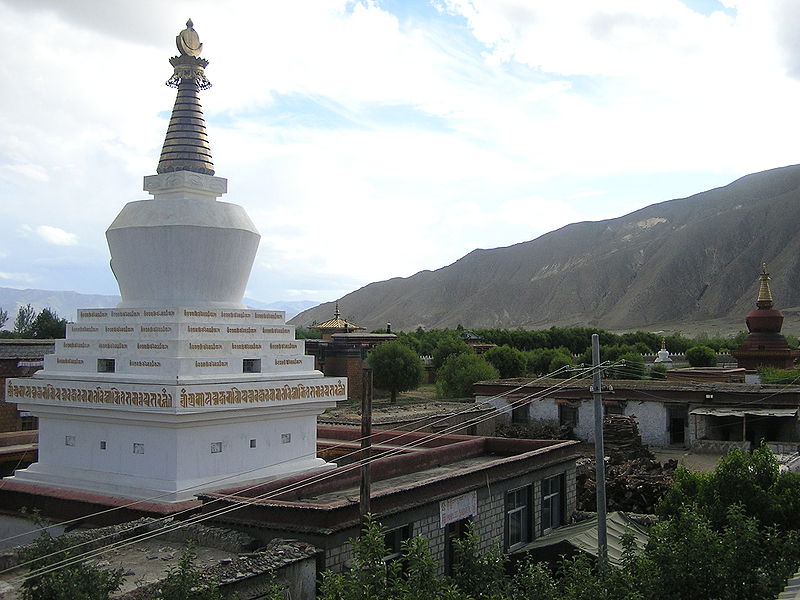
File:Samye32.JPG · Wikimedia Commons · See Wikimedia Commons
stupa
Sign in to saveAlso known as heap, stūpa, dagoba, dhagoba, tope, chorten
In Buddhism, a stupa (, ) is a domed hemispherical structure containing several types of sacred relics, including images, statues, metals, and śarīra—the remains of Buddhist monks or nuns. It is used as a place of pilgrimage and meditation.
A stupa is a dome-shaped Buddhist structure built to house sacred objects like statues, metals, and the remains of Buddhist monks or nuns. Buddhists visit stupas as places of pilgrimage and meditation, making them important spiritual sites in Buddhist practice.
AI-generated from the Wikipedia summary — may contain errors.
Key facts
- Buddhist term.title
- Stupa
- Buddhist term.en
- Stupa
- Buddhist term.pi
- 𑀣𑀼𑀩𑁂 ("thube"), thūpa
- Buddhist term.mr
- स्थूप
- Buddhist term.sa
- स्तूप
- Buddhist term.bn
- স্তূপ
- Buddhist term.bn Latn
- stup
- Buddhist term.or
- ସ୍ତୂପ
- Buddhist term.or Latn
- stupa
- Buddhist term.my
- စေတီ
- Buddhist term.my Latn
- zèdì
- Buddhist term.zh
- 窣堵坡
- Buddhist term.zh Latn
- sūdǔpō
- Buddhist term.ja
- 卒塔婆
- Buddhist term.ja Latn
- sotoba
- Buddhist term.km
- ចេតិយ, ស្តូប
- Buddhist term.km Latn
- chétĕy, stob
- Buddhist term.ko
- 솔도파
via Wikipedia infobox
Wikidata facts
- Subclass of
- religious building
- Part of
- Buddhism
- Image
- Amaravati Stupa.JPG
Show 5 more facts
- Commons category
- Stupas
- topic's main category
- Category:Stupas
- Commons gallery
- Stupa
- different from
- Stupa, Dubrovačko primorje
- OpenStreetMap tag
- tower:type=stupa
Sources (2)
via Wikidata · CC0
~25 min read
Encyclopedic overview
36 sectionsContents
- Description and history
- Mounds for the relics of the Buddha (5th century BCE)
- Expansion under Ashoka (250 BCE)
- Decorated stupas (from 125 BCE)
- Development in Gandhara (3rd century BCE–5th century CE)
- Origin of the pyramidal temple
- Expansion in Asia
- Asian stupas
- Development of the pagoda
- Notable stupas
- European stupas
- Types of stupas
- Symbolism
- Five purified elements
- Construction
- Treasury
- Tree of Life
- Benefits
- Tibetan stupas
- Lotus Blossom Stupa
- Enlightenment Stupa
- Stupa of Many Doors
- Stupa of Descent from the God Realm
- Stupa of Great Miracles
- Stupa of Reconciliation
- Stupa of Complete Victory
- Stupa of Nirvana
- Kalachakra stupa
- Gallery
- Cambodia
- Nepal
- See also
- References
- Works cited
- Further reading
- External links
In Buddhism, a stupa (, ) is a domed hemispherical structure containing several types of sacred relics, including images, statues, metals, and śarīra—the remains of Buddhist monks or nuns. It is used as a place of pilgrimage and meditation.
Walking around a stupa in a clockwise direction, known as pradakhshina, has been an important ritual and devotional practice in Buddhism since the earliest times, and stupas always have a pradakhshina path around them. The original South Asian form is a large solid dome above a tholobate, or drum, with vertical sides, which usually sits on a square base. There is no access to the inside of the structure. In large stupas, there may be walkways for circumambulation on top of the base as well as on the ground below it. Large stupas have, or had, vedikā railings outside the path around the base, often highly decorated with sculpture, especially at the torana gateways, of which there are usually four. At the top of the dome is a thin, vertical element, with one or more horizontal discs spreading from it. These were chatras, symbolic umbrellas, and have not survived, if not restored. The Great Stupa at Sanchi in Madhya Pradesh, is the most famous and best-preserved early stupa in India.
Excerpted from Wikipedia’s “stupa” article, available under the CC BY-SA 4.0 licence.
Gallery (42)
Available in 78 languages
- Español
- Français
- Deutsch
- 中文
- 日本語
- Русский
- Português
- Italiano
- العربية
- हिन्दी
- Afrikaans
- Albanian
- Armenian
- Asturian
- Azerbaijani
- Bahasa Indonesia
- Bangla
- Basque
Show 59 more
- Belarusian
- Bhojpuri
- Bulgarian
- Buriat
- Catalan
- Croatian
- Czech
- Danish
- Esperanto
- Estonian
- Filipino
- Finnish
- Galician
- Georgian
- Greek
- Hebrew
- Hungarian
- Icelandic
- Javanese
- Kalmyk
- Kannada
- Kazakh
- Khmer
- Latin
- Latvian
- Lithuanian
- Malagasy
- Malayalam
- Marathi
- Mongolian
- Nederlands
- Nepali
- Norwegian
- Norwegian Nynorsk
- Polski
- Romanian
- Serbian
- Serbian (Latin)
- simple
- Sindhi
- Sinhala
- Slovenian
- Svenska
- Tamil
- Telugu
- Tiếng Việt
- Türkçe
- Tuvinian
- Ukrainian
- Urdu
- Uzbek
- Waray
- Welsh
- Western Panjabi
- Wu Chinese
- zh_yue
- فارسی
- ไทย
- 한국어
via Wikidata sitelinks · CC0