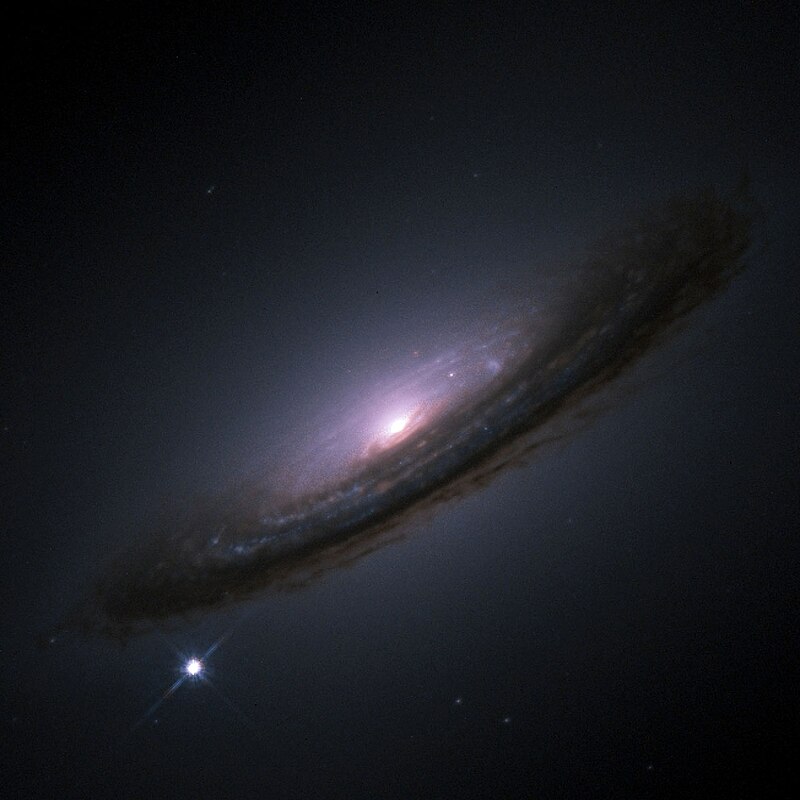
File:SN1994D.jpg · Wikimedia Commons · See Wikimedia Commons
supernova
Sign in to saveAlso known as SN, SNe, supernovae, SNO
thumb|right|upright=1.3|SN 1994D (bright spot on the lower left), a [[Type Ia supernova within its host galaxy, NGC 4526]] A supernova (: supernovae) is a powerful and luminous explosion of a star. A supernova occurs during the last evolutionary stages of a massive star, or when a white dwarf is triggered into runaway nuclear fusion. The original object, called the progenitor, either collapses to a neutron star or black hole, or is completely destroyed to form a diffuse nebula. The peak optical luminosity of a supernova can be comparable to that of an entire galaxy before fading over several w
A supernova is a powerful and luminous explosion of a star that occurs either during the final stages of a massive star's life or when a white dwarf undergoes runaway nuclear fusion. These explosions are so bright that their peak light can rival an entire galaxy, making them important markers for studying the universe, though the original star is either transformed into a neutron star or black hole, or destroyed entirely.
AI-generated from the Wikipedia summary — may contain errors.
Wikidata facts
- Subclass of
- astronomical phenomenon
- Image
- HST SN 1987A 20th anniversary.jpg
Show 6 more facts
- topic has template
- Template:Supernovae
- Commons category
- Supernovae
- topic's main category
- Category:Supernovae
- model item
- SN 1987A
- named by
- Fritz Zwicky
- on focus list of Wikimedia project
- Wikipedia:Vital articles/Level/4
Sources (6)
via Wikidata · CC0
~75 min read
Encyclopedic overview
36 sectionsContents
- Occurrence
- Etymology
- Observation history
- Early observations
- Telescope findings
- Discovery programs
- Naming convention
- Classification
- Type I
- Type II
- Types III, IV and V
- Current models
- Thermal runaway
- Normal Type Ia
- Non-standard Type Ia
- Core collapse
- Detailed process
- Type II
- Type Ib and Ic
- <span class="anchor" id="Electron-capture supernovae"></span> Electron-capture supernovae
- Failed supernovae
- Light curves
- Asymmetry
- Energy output
- Progenitor
- External impact
- Source of heavy elements
- Role in stellar evolution
- Cosmic rays
- Gravitational waves
- Effect on Earth
- Milky Way candidates
- See also
- References
- Further reading
- External links
thumb|right|upright=1.3|SN 1994D (bright spot on the lower left), a [[Type Ia supernova within its host galaxy, NGC 4526]] A supernova (: supernovae) is a powerful and luminous explosion of a star. A supernova occurs during the last evolutionary stages of a massive star, or when a white dwarf is triggered into runaway nuclear fusion. The original object, called the progenitor, either collapses to a neutron star or black hole, or is completely destroyed to form a diffuse nebula. The peak optical luminosity of a supernova can be comparable to that of an entire galaxy before fading over several weeks or months.
It is expected that supernovae in our galaxy occur on average once every 61 years, although the last to be observed was Kepler's Supernova in 1604. SN 1987A occurred in the Large Magellanic Cloud, a satellite of our galaxy, in 1987. Several thousand supernovae are typically seen in distant galaxies every year.
Excerpted from Wikipedia’s “supernova” article, available under the CC BY-SA 4.0 licence.
Gallery (52)
Available in 104 languages
- Español
- Français
- Deutsch
- 中文
- 日本語
- Русский
- Português
- Italiano
- العربية
- हिन्दी
- Afrikaans
- Akan
- Albanian
- Amharic
- Angika
- Aragonese
- Armenian
- Asturian
Show 85 more
- Azerbaijani
- Bahasa Indonesia
- Bangla
- Basque
- Belarusian
- Bhojpuri
- Bosnian
- Bulgarian
- Burmese
- Catalan
- Central Kurdish
- Chuvash
- Croatian
- Czech
- Danish
- Egyptian Arabic
- Esperanto
- Estonian
- Filipino
- Finnish
- Friulian
- Galician
- gcr
- Georgian
- Greek
- Haitian Creole
- Hebrew
- Hungarian
- Icelandic
- Ido
- Interlingua
- Irish
- Jamaican Creole English
- Javanese
- Kannada
- Kazakh
- Latin
- Latvian
- Limburgish
- Lithuanian
- Luxembourgish
- Macedonian
- Malagasy
- Malay
- Malayalam
- Marathi
- Mingrelian
- Mongolian
- Nederlands
- Norwegian
- Norwegian Nynorsk
- Occitan
- Pashto
- Polski
- Punjabi
- Romanian
- Serbian
- Serbian (Latin)
- Sicilian
- simple
- Sindhi
- Sinhala
- Slovak
- Slovenian
- Standard Moroccan Tamazight
- Sundanese
- Svenska
- Tamil
- Tatar
- Telugu
- Tiếng Việt
- Türkçe
- Ukrainian
- Urdu
- Uzbek
- Waray
- Welsh
- Western Frisian
- Western Panjabi
- Wu Chinese
- zh_classical
- zh_yue
- فارسی
- ไทย
- 한국어
via Wikidata sitelinks · CC0