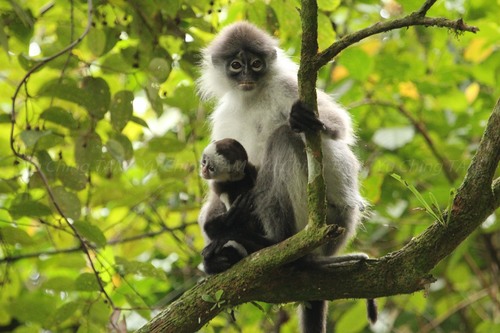
(c) Yu Ching Tam, all rights reserved, uploaded by Yu Ching Tam
Surili
Sign in to saveAlso known as Presbytis
Presbytis is a genus of Old World monkeys also known as langurs, leaf monkeys, or surilis. Members of the genus live in the Thai-Malay Peninsula, on Sumatra, Borneo, Java and smaller nearby islands.
OverviewAI-generated
Presbytis is a taxon classified at the genus rank. It belongs to the subfamily Colobinae. The taxonomic type associated with this group is Presbytis mitrata.
In the iNaturalist database, the rank is listed as species, with the common name White-thighed Surili. This organism is identified as an iconic taxon within the class Mammalia. The record includes 887 observations.
Synthesized by Vinony from 13 facts across 3 sources: Wikidata, iNaturalist, Vinony graph. Generated from structured data (not the Wikipedia text) and checked against those facts — may still contain errors.
Species
White-thighed Surili
species
葉猴屬(學名:Presbytis),猴科的一屬,生活在東南亞的馬來半島南部、蘇門答腊、婆羅洲、爪哇等島嶼上,共有11種。 葉猴一般體型較小,體長在40-60釐米之間,尾長50-85釐米,體重約為5-8公斤。基本居住樹上,白天活動,以樹葉、水果和種子為食。 孕期為5-6個月,每胎一仔。斷奶期約為1年,成熟期為4-5年。平均壽命大約為20年。 维基物种中的分类信息:葉猴屬 取自“https://zh.wikipedia.org/w/index.php?title=葉猴屬&oldid=42675846” 分类: 疣猴亞科 葉猴屬 隐藏分类: 物种微格式条目 含有拉丁語的條目
via
Wikidata facts
Show 5 more facts
- taxon name
- Presbytis
- Commons category
- Presbytis
- taxon rank
- genus
- topic's main category
- Category:Presbytis
- taxonomic type
- Presbytis mitrata
Sources (1)
via Wikidata · CC0
~3 min read
Encyclopedic overview
9 sectionsContents
- Description
- Behaviour
- Diet
- Breeding
- Conservation
- Taxonomy
- References
- Sources
- External links
Presbytis is a genus of Old World monkeys also known as langurs, leaf monkeys, or surilis. Members of the genus live in the Thai-Malay Peninsula, on Sumatra, Borneo, Java and smaller nearby islands.
==Description== Surilis are rather small, slimly built primates. Their fur at the top is brown, grey, black, or orange, and at the lower surface whitish or greyish, sometimes also orange, with some species having fur designs at the head or at the hips. Their German name of Mützenlanguren ("capped langurs") comes from the hair on their head, which forms a tuft. They differ from the other langurs by characteristics in the shape of their head (particularly the poorly developed or absent brow ridges, and the prominent nasal bones), in the teeth, and by the size of their small thumbs. Surilis range in adult length from 40 to 60 cm (with a 50- to 85-cm-long tail) and a weight of 5 to 8 kg.
Excerpted from Wikipedia’s “Surili” article, available under the CC BY-SA 4.0 licence.