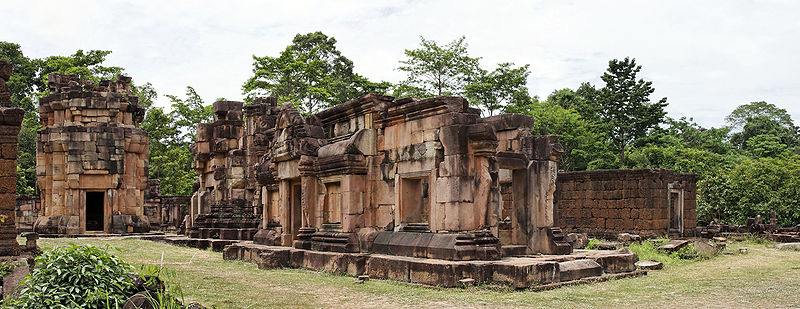
File:Prasat_Ta_Muen_Thom-3-HDC.jpg · Wikimedia Commons · See Wikimedia Commons
Surin
Sign in to saveprovince in northeastern Thailand
Key facts
- Country
- Thailand
- Capital
- Surin
- Governor
- Chamnan Chuenta
- Total
- 8,854 km (3,419 sq mi)
- Rank
- 22nd
- Density
- 154/km (400/sq mi)
- Hai 2022
- 0.5935 "low", Ranked 77th
- Time zone
- UTC+7 ( ICT )
- Postal code
- 32xxx
- Calling code
- 044
- Iso 3166 code
- TH-32
- Website
- surin .go .th
via Wikipedia infobox
Wikidata facts
- Instance of
- province of Thailand
- Official name
- จังหวัดสุรินทร์
- Country
- Thailand
- Located in
- Thailand
- Contains
- Sangkha
- Capital
- Surin
- Population
- 1378221
- Area
- 8124.056
- Shares border with
- Oddar Meanchey Province
- Official website
- www.surin.go.th
- Image
- Mun River Mouth.jpg
- Dialing code
- 038
- Motto
- สุรินทร์ถิ่นช้างใหญ่ ผ้าไหมงาม ประคำสวย ร่ำรวยปราสาท ผักกาดหวาน ข้าวสารหอม งามพร้อมวัฒนธรรม
Show 6 more facts
- postal code
- 32
- native label
- จังหวัดสุรินทร์
- topic's main category
- Category:Surin province
- Commons category
- Surin Province
- category of associated people
- Category:People from Surin province
- language used
- Kuy
via Wikidata · CC0
~14 min read
Encyclopedic overview
Surin (Thai: สุรินทร์, pronounced [sù.rīn]; Northern Khmer: ซเร็น, pronounced [sren]; Kuy: สุลิน) is one of Thailand's seventy-seven provinces (changwat). It lies in lower northeastern Thailand, also called Isan. Neighboring provinces are (from west clockwise) Buriram, Maha Sarakham, Roi Et, and Sisaket. To the south it borders Oddar Meancheay of Cambodia. Surin covers a total area of 8,854 km (3,419 sq mi) from the Mun River in the north to the Dangrek Mountains in the south. The capital, Surin city, in the western central region province is 434 km from Bangkok.
The area of present-day Surin has long history of human settlement which dates back to prehistoric times. Historically the region has been ruled by various powerful kingdoms including the Angkorian Khmer Empire, the Lao kingdom Lan Xang, and the Thai kingdom of Ayutthaya. Reflecting this history as part the greater geo-cultural area of Thailand known as Isan, Surin is ethnically diverse. The primary language is the Isan dialect of Lao. Speakers of Central Thai account for a small minority while nearly 50% of the population are ethnic Khmer. The remainder are speakers of various Lao languages and small tribal groups such as the Kuy and Nyah Kur.
Excerpted from Wikipedia’s “Surin” article, available under the CC BY-SA 4.0 licence.