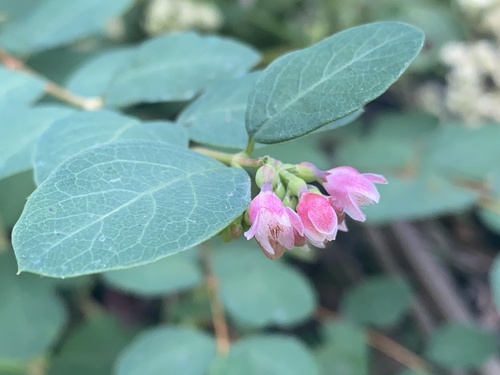
(c) Donna Pomeroy, some rights reserved (CC BY-NC), uploaded by Donna Pomeroy · cc-by-nc
Symphoricarpos
Sign in to saveSymphoricarpos is a small genus of about 15 species of deciduous shrubs in the family Caprifoliaceae. With the exception of the Chinese coralberry, S. sinensis, which is indigenous to western China, all species are native to North and Central America. The name of the genus is derived from the Ancient Greek words (), meaning "to bear together", and (), meaning "fruit". It refers to the closely packed clusters of berries the species produces. Species in the genus are known by several common names, including snowberry, waxberry and ghostberry.
OverviewAI-generated
Symphoricarpos is a genus within the plant kingdom, classified under the phylum Tracheophyta, class Magnoliopsida, and order Dipsacales. It belongs to the family Caprifoliaceae. The genus is associated with the common name Common Snowberry.
Records for this taxon are held by institutions including GH, UCMP, IBUNAM, SJNM, and DERN-IMECBIO-CUCSUR-UDG. These records document occurrences in Mexico and the United States.
Synthesized by Vinony from 27 facts across 8 sources: Wikidata, GBIF, iNaturalist, PubMed, Gbif Occ, Plants of the World, iDigBio, Vinony graph. Generated from structured data (not the Wikipedia text) and checked against those facts — may still contain errors.
Species
Common Snowberry
GENUS
- KingdomPlantae
- PhylumTracheophyta
- ClassMagnoliopsida
- OrderDipsacales
- FamilyCaprifoliaceae
毛核木属(学名:Symphoricarpos)是忍冬科下的一个属,为落叶灌木植物。该属共有18种,分布于北美以及中国西南部和中部等地。[1] 参考文献 ^ 中国种子植物科属词典. 中国数字植物标本馆. (原始内容存档于2012-04-11). 外部链接 維基物種中有關毛核木属的數據 这是一篇與植物相關的小作品。你可以通过编辑或修订扩充其内容。 查 论 编 取自“https://zh.wikipedia.org/w/index.php?title=毛核木属&oldid=45111875” 分类: 忍冬科 毛核木属 隐藏分类: 本地相关图片与维基数据相同 WikispeciesLatinName 全部小作品 植物小作品
via GBIF · Kew POWO
Museum specimens
- Specimen records
- 832
- With media
- 679
- Family
- Caprifoliaceae
- Collections
- GH, UCMP, IBUNAM, SJNM, DERN-IMECBIO-CUCSUR-UDG, DAV
- Recorded in
- Mexico, United States
Research
37 papers- Bioactivity evaluation and active compounds identification of Symphoricarpos orbiculatus as potential botanical herbicide.Journal of the science of food and agriculture · 2024
- Evaluating the Dermatological Benefits of Snowberry (Symphoricarpos albus): A Comparative Analysis of Extracts and Fermented Products from Different Plant Parts.International journal of molecular sciences · 2024
- Snowberry (Symphoricarpos) poisoning in children.JAMA · 1979
- Characteristic of the complete chloroplast genome of Symphoricarpos sinensis, an important ornamental plant endemic to China.Mitochondrial DNA. Part B, Resources · 2020
- Inhibition of GSK_3β by Iridoid Glycosides of Snowberry (Symphoricarpos albus) Effective in the Treatment of Alzheimer's Disease Using Computational Drug Design Methods.Frontiers in chemistry · 2021
via PubMed
Wikidata facts
- Instance of
- taxon
- Parent taxon
- Caprifoliaceae
- Image
- Symphoricarpos albus 7927.jpg
Show 8 more facts
- taxon rank
- genus
- taxon name
- Symphoricarpos
- Commons category
- Symphoricarpos
- topic's main category
- Category:Symphoricarpos
- taxon common name
- 毛核木属
- has fruit type
- drupe
- described by source
- Granat Encyclopedic Dictionary
Sources (3)
via Wikidata · CC0
~6 min read
Encyclopedic overview
7 sectionsContents
- Description
- Ecology
- Cultivation
- Medicinal uses
- Other uses
- References
- External links
Symphoricarpos is a small genus of about 15 species of deciduous shrubs in the family Caprifoliaceae. With the exception of the Chinese coralberry, S. sinensis, which is indigenous to western China, all species are native to North and Central America. The name of the genus is derived from the Ancient Greek words (), meaning "to bear together", and (), meaning "fruit". It refers to the closely packed clusters of berries the species produces. Species in the genus are known by several common names, including snowberry, waxberry and ghostberry.
Snowberry is a resilient plant able to withstand a variety of conditions. Their deep roots allow them to survive dry seasons, and they have been known to grow in a variety of soil types such as light sandy soil, medium loamy soil and heavier clay soil. Snowberry plants are most commonly found low-to mid elevations, in forests, dry or moist openings, rocky hillsides or near riverbanks and streams. Snowberry plants are also able to grow in a wide range of acidic and basic pHs and sunlight conditions.
Excerpted from Wikipedia’s “Symphoricarpos” article, available under the CC BY-SA 4.0 licence.