File:Rea-Menzies_in_studio.jpg · Wikimedia Commons · See Wikimedia Commons
tapestry
Sign in to saveAlso known as gobelin, hanging, woven tapestry
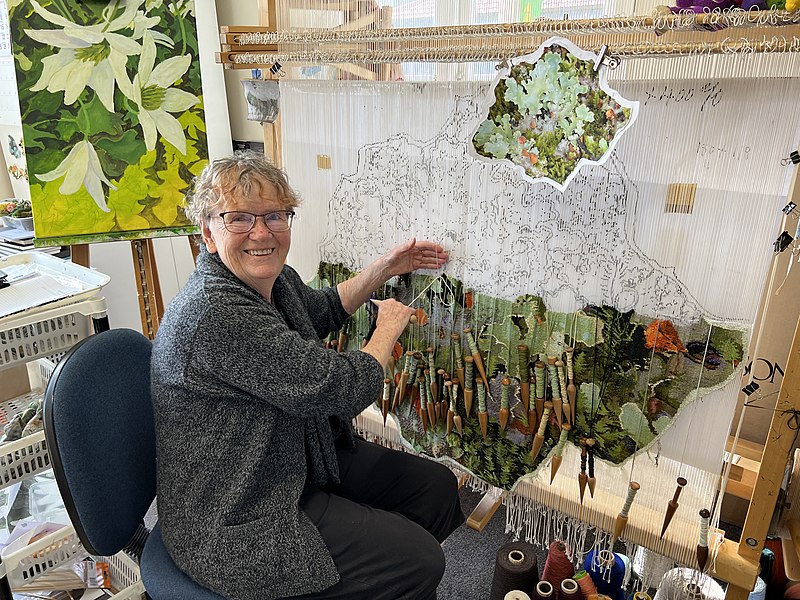
thumb|upright=1.5|Weaving a small tapestry on a high-warp loom, 2022, New Zealand right|thumb|One of the tapestries in the series The Hunt of the Unicorn: The Unicorn is Found, circa 1495–1505, [[The Cloisters, Metropolitan Museum of Art, New York City]]
A tapestry is a textile artwork created by weaving colored threads onto a loom to form an image or design. Tapestries have been valued for centuries as decorative artworks, as evidenced by famous historical examples like the medieval "Hunt of the Unicorn" series now displayed in major museums.
AI-generated from the Wikipedia summary — may contain errors.
Wikidata facts
- Instance of
- art style
- Image
- Wild Men and Moors (Detail 01 of 12).jpg
Show 5 more facts
- Commons category
- Tapestry
- topic's main category
- Category:Tapestries
- described at URL
- tapestries.flandesenhispania.org/index.php/Collectors
- inventory number
- ascs 259
- inception
- 1850-00-00
via Wikidata · CC0
~56 min read
Encyclopedic overview
27 sectionsContents
- Terms and etymology
- Production
- Function
- Early history
- Ancient
- Early and High medieval
- Peak period, after about 1350
- Weaving centres
- Patrons
- Subjects and style
- Hunting
- Military
- Millefleur style
- Landscape
- Arrival of Renaissance style and subjects
- 16th century
- 17th century
- 18th century
- 19th century
- Outside Europe
- Contemporary tapestry
- Jacquard tapestries, colour and the human eye
- List of famous tapestries
- Notes
- References
- Further reading
- External links
thumb|upright=1.5|Weaving a small tapestry on a high-warp loom, 2022, New Zealand right|thumb|One of the tapestries in the series The Hunt of the Unicorn: The Unicorn is Found, circa 1495–1505, [[The Cloisters, Metropolitan Museum of Art, New York City]]
Tapestry is a form of textile art which was traditionally woven by hand on a loom. Normally it is used to create images rather than patterns. Tapestry is relatively fragile, and difficult to make, so most historical pieces are intended to hang vertically on a wall (or sometimes in tents), or sometimes horizontally over a piece of furniture such as a table or bed. Some periods made smaller pieces, often long and narrow and used as borders for other textiles. Most weavers use a natural warp thread, such as wool, linen, or cotton. The weft threads are usually wool or cotton but may include silk, gold, silver, or other alternatives. thumb|Tapestry Room from Croome Court, moved to the [[Metropolitan Museum of Art, hung with made to measure 18th-century Gobelins tapestries, also covering the chairs. 1763–71]]
Excerpted from Wikipedia’s “tapestry” article, available under the CC BY-SA 4.0 licence.
Gallery (52)
Available in 62 languages
- Español
- Français
- Deutsch
- 中文
- 日本語
- Русский
- Português
- Italiano
- العربية
- हिन्दी
- Albanian
- Albanian
- Armenian
- Azerbaijani
- Bahasa Indonesia
- Bangla
- Bashkir
- Basque
Show 43 more
- be_x_old
- Belarusian
- Breton
- Bulgarian
- Catalan
- Chechen
- Chuvash
- Croatian
- Czech
- Danish
- Esperanto
- Estonian
- Finnish
- Georgian
- Greek
- Hebrew
- Hungarian
- Ido
- Kazakh
- Kyrgyz
- Lithuanian
- Macedonian
- Malay
- Marathi
- Nederlands
- Norwegian
- Norwegian Nynorsk
- Polski
- Romanian
- Serbian
- Serbian (Latin)
- simple
- Slovenian
- Svenska
- Tajik
- Ukrainian
- Uzbek
- Welsh
- Wu Chinese
- zh_yue
- فارسی
- ไทย
- 한국어
via Wikidata sitelinks · CC0