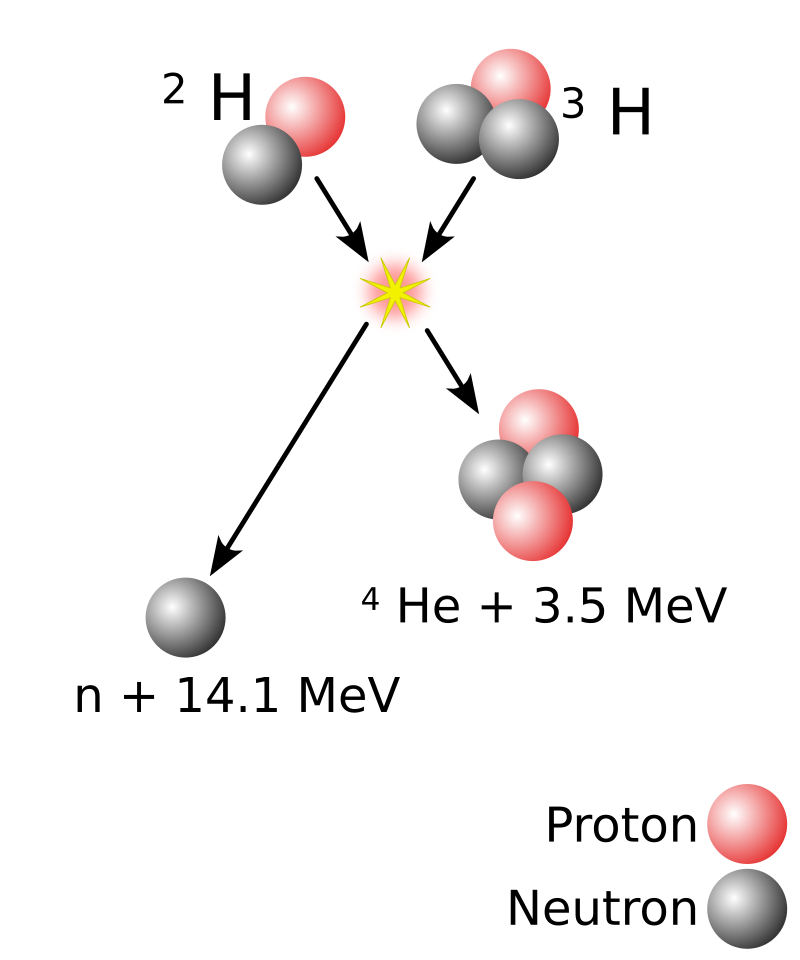
File:Deuterium-tritium_fusion.svg · Wikimedia Commons · See Wikimedia Commons
tennessine
Sign in to saveAlso known as Uus, eka-astatine, element 117, Ts, ununseptium
Tennessine is a synthetic element; it has symbol Ts and atomic number 117. It has the second-highest atomic number, the joint-highest atomic mass of all known elements, and is the penultimate element of the 7th period of the periodic table. It is named after the U.S. state of Tennessee, where key research institutions involved in its discovery are located (however, the IUPAC says that the element is named after the "region of Tennessee").
Tennessine is a human-made chemical element with the symbol Ts and atomic number 117, making it one of the heaviest and most recently discovered elements on the periodic table. It was named after Tennessee, the U.S. state where important research institutions that contributed to its discovery are located.
AI-generated from the Wikipedia summary — may contain errors.
Wikidata facts
- Instance of
- chemical element
- Subclass of
- halogens
- Part of
- halogens
- Named after
- Tennessee
Show 10 more facts
- atomic number
- 117
- time of discovery or invention
- 2010-00-00
- element symbol
- Uus
- Commons category
- Tennessine
- topic's main category
- Category:Tennessine
- location of discovery
- Joint Institute for Nuclear Research
- discoverer or inventor
- Yuri Oganessian
- different from
- Tennessee
- Unicode character
- 鿬
- on focus list of Wikimedia project
- Wikipedia:Vital articles/Level/4
via Wikidata · CC0
~30 min read
Encyclopedic overview
13 sectionsContents
- Introduction
- History
- Pre-discovery
- Discovery
- Confirmation
- Naming
- Predicted properties
- Nuclear stability and isotopes
- Atomic and physical
- Chemical
- Notes
- References
- Bibliography
Tennessine is a synthetic element; it has symbol Ts and atomic number 117. It has the second-highest atomic number, the joint-highest atomic mass of all known elements, and is the penultimate element of the 7th period of the periodic table. It is named after the U.S. state of Tennessee, where key research institutions involved in its discovery are located (however, the IUPAC says that the element is named after the "region of Tennessee").
The discovery of tennessine was officially announced in Dubna, Russia, by a Russian–American collaboration in April 2010, which makes it the most recently discovered element. One of its daughter isotopes was created directly in 2011, partially confirming the experiment's results. The experiment was successfully repeated by the same collaboration in 2012 and by a joint German–American team in May 2014. In December 2015, the Joint Working Party of the International Union of Pure and Applied Chemistry (IUPAC) and the International Union of Pure and Applied Physics (IUPAP), which evaluates claims of discovery of new elements, recognized the element and assigned the priority to the Russian–American team. In June 2016, the IUPAC published a declaration stating that the discoverers had suggested the name tennessine, a name which was officially adopted in November 2016.
Excerpted from Wikipedia’s “tennessine” article, available under the CC BY-SA 4.0 licence.
Gallery (19)
Available in 121 languages
- Español
- Français
- Deutsch
- 中文
- 日本語
- Русский
- Português
- Italiano
- العربية
- हिन्दी
- Afrikaans
- Albanian
- Amharic
- Angika
- Aragonese
- Armenian
- Asturian
- Azerbaijani
Show 102 more
- Bahasa Indonesia
- Balinese
- Bangla
- Basque
- be_x_old
- Belarusian
- Bhojpuri
- Bosnian
- Breton
- Bulgarian
- Burmese
- Catalan
- cdo
- Cebuano
- Central Kurdish
- Chuvash
- Cornish
- Corsican
- Croatian
- Czech
- Danish
- Egyptian Arabic
- Esperanto
- Estonian
- Faroese
- Fiji Hindi
- Finnish
- Friulian
- Galician
- Gan Chinese
- Georgian
- Greek
- Gujarati
- Hakka Chinese
- Hebrew
- Hungarian
- Icelandic
- Interlingua
- Irish
- Kalmyk
- Kazakh
- kbp
- Komi
- Latin
- Latvian
- Ligurian
- Lingua Franca Nova
- Lithuanian
- Low German
- Luxembourgish
- Macedonian
- Malay
- Malayalam
- Manx
- Marathi
- Mongolian
- Nederlands
- Northern Frisian
- Norwegian
- Norwegian Nynorsk
- Novial
- Occitan
- Pashto
- Polski
- Quechua
- roa_rup
- Romanian
- Sardinian
- Scottish Gaelic
- Serbian
- Serbian (Latin)
- Sicilian
- simple
- Slovak
- Slovenian
- Svenska
- Swahili
- Tajik
- Tamil
- Tatar
- Telugu
- Tiếng Việt
- Türkçe
- Ukrainian
- Urdu
- Uyghur
- Uzbek
- Veps
- Volapük
- Waray
- Welsh
- Western Frisian
- Western Mari
- Wu Chinese
- Yoruba
- zh_classical
- zh_min_nan
- zh_yue
- Zulu
- فارسی
- ไทย
- 한국어
via Wikidata sitelinks · CC0