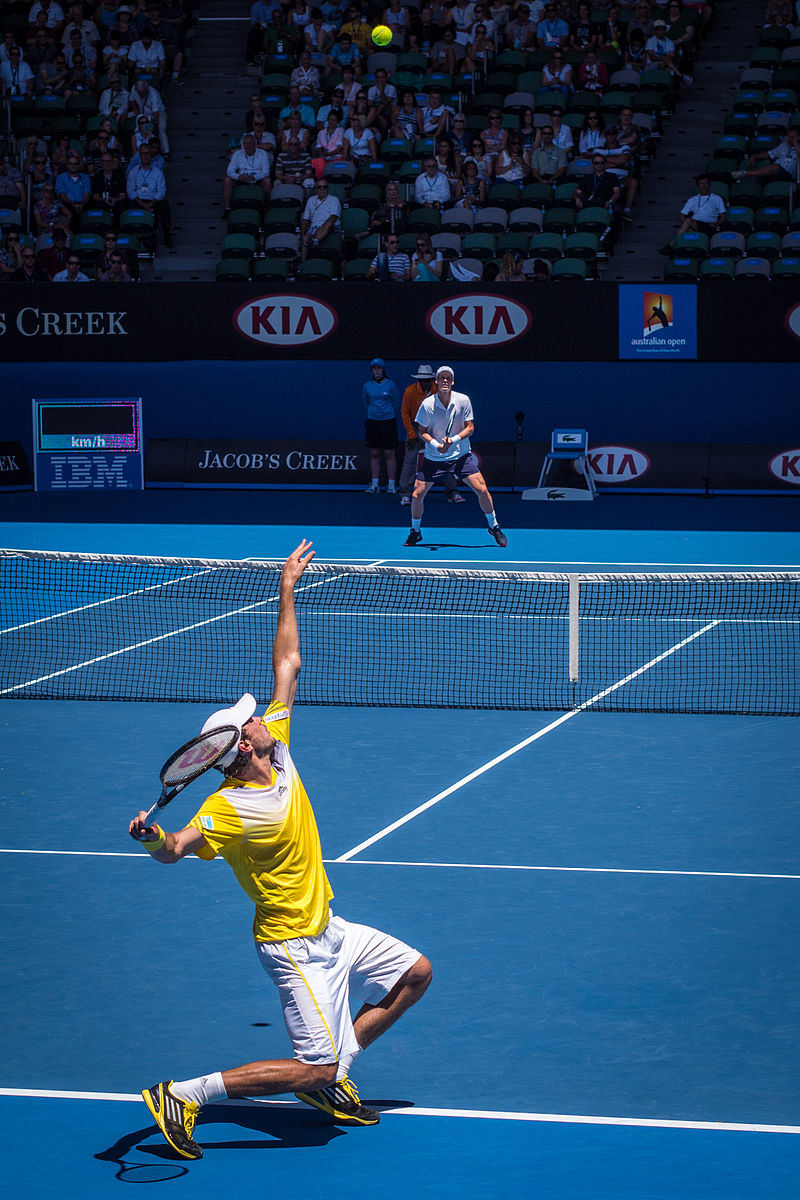
File:2013_Australian_Open_-_Guillaume_Rufin.jpg · Wikimedia Commons · See Wikimedia Commons
tennis
Sign in to saveAlso known as lawn tennis, lawntennis
Tennis is a racket sport that is played either individually against a single opponent (singles) or between two teams of two players each (doubles). Each player uses a tennis racket strung with a cord to strike a hollow rubber ball covered with felt over or around a net and into the opponent's court. The object is to manoeuvre the ball in such a way that the opponent is not able to play a valid return. If a player is unable to return the ball successfully, the opponent scores a point.
OverviewAI-generated
Tennis is a ball game and racket sport that originated in England. It is classified as an Olympic sport and can be practiced as a hobby. The game requires a minimum of two players and a maximum of four. Participants use a tennis court, a tennis racquet, and a tennis ball. The Unicode character 🎾 represents the sport.
The International Tennis Federation serves as the authority for tennis. The subject is described in the Brockhaus and Efron Encyclopedic Dictionary and the Encyclopædia Britannica 11th edition. It is maintained by WikiProject Tennis and appears on the Wikipedia:List of articles all languages should have. The topic has a main Wikimedia portal at Portal:Tennis and is categorized under Category:Tennis.
Tennis is referenced by 31,808 other encyclopedia articles. PubMed lists 11,833 entries for the query tennis. The hashtag for the sport is tennis, or テニス in Japanese. The sport is different from Tenis.
Synthesized by Vinony from 25 facts across 3 sources: Wikidata, PubMed, Vinony graph. Generated from structured data (not the Wikipedia text) and checked against those facts — may still contain errors.
Key facts
- Sport.name
- Tennis
- Sport.image
- 2013 Australian Open - Guillaume Rufin.jpg
- Sport.imagesize
- 200
- Sport.caption
- French singles player Guillaume Rufin serves to Czech player Tomáš Berdych in a tennis match at the 2013 Australian Open.
- Sport.union
- International Tennis Federation
- Sport.first
- 19th century, Birmingham, England, United Kingdom
- Sport.region
- Worldwide
- Sport.contact
- No
- Sport.team
- Singles or doubles
- Sport.mgender
- Yes, separate tours and mixed doubles
- Sport.type
- Outdoor or indoor
- Sport.category
- Racket sport
- Sport.equipment
- Ball, racket, net
- Sport.venue
- Tennis court
- Sport.glossary
- Glossary of tennis terms
- Sport.olympic
- Part of Summer Olympic programme from 1896 to 1924Demonstration sport in the 1968 and 1984 Summer OlympicsPart of Summer Olympic programme since 1988
- Sport.paralympic
- Part of Summer Paralympic programme since 1992
via Wikipedia infobox
Research
11,833 papers- Tennis injuries: occurrence, aetiology, and prevention.ReviewBritish journal of sports medicine · 2006Pluim BM, Staal JB, Windler GE et al.DOI: 10.1136/bjsm.2005.023184
- Tennis physiology: training the competitive athlete.ReviewSports medicine (Auckland, N.Z.) · 2007Kovacs MSDOI: 10.2165/00007256-200737030-00001
- Biomechanics and tennis.ReviewBritish journal of sports medicine · 2006Elliott BDOI: 10.1136/bjsm.2005.023150
- Epidemiology of musculoskeletal injury in the tennis player.ReviewBritish journal of sports medicine · 2012Abrams GD, Renstrom PA, Safran MRDOI: 10.1136/bjsports-2012-091164
- Upper Extremity Injuries in Tennis Players: Diagnosis, Treatment, and Management.ReviewHand clinics · 2017Chung KC, Lark MEDOI: 10.1016/j.hcl.2016.08.009
- Risk Factors for Upper Limb Injury in Tennis Players: A Systematic Review.International journal of environmental research and public health · 2020Kekelekis A, Nikolaidis PT, Moore IS et al.DOI: 10.3390/ijerph17082744
- "Tennis Leg": A State-of-the-Science Review.ReviewWorkplace health & safety · 2021Domeracki SJDOI: 10.1177/2165079920961966
- Epidemiology of musculoskeletal injuries in tennis players: risk factors.The Journal of sports medicine and physical fitness · 2019Minghelli B, Cadete JDOI: 10.23736/S0022-4707.19.09842-6
via PubMed
Wikidata facts
- Instance of
- hobby
- Subclass of
- Olympic sport
- Country of origin
- England
- Image
- Richèl Hogenkamp - Masters de Madrid 2015 - 11.jpg
Show 18 more facts
- topic has template
- Template:Tennis box
- OpenStreetMap tag
- sport=tennis
- topic's main Wikimedia portal
- Portal:Tennis
- Commons category
- Tennis
- topic's main category
- Category:Tennis
- Commons gallery
- Tennis
- minimum number of players
- 2
- maximum number of players
- 4
- Unicode character
- 🎾
- history of topic
- history of tennis
- uses
- tennis ball
- exact match
- imagenet.stanford.edu/synset?wnid=n00482298
- different from
- Tenis
- on focus list of Wikimedia project
- Wikipedia:List of articles all languages should have
- maintained by WikiProject
- WikiProject Tennis
- authority
- International Tennis Federation
- hashtag
- テニス
- inception
- 1873-00-00
Sources (9)
via Wikidata · CC0
~74 min read
Encyclopedic overview
67 sectionsContents
- History
- Predecessors
- Origins of the modern game
- Equipment
- Rackets
- Strings
- Natural gut
- Synthetic
- Hybrid strings
- Balls
- Manner of play
- Court
- Lines
- Play of a single point
- Scoring
- Game, set, match
- Game
- Set
- Match
- Special point terms
- Game point
- Break point
- Rule variations
- Match play
- Continuity
- Ball changes
- On-court coaching
- Stance
- Open stance
- Semi-open stance
- Closed stance
- Neutral stance
- Shots
- Grip
- Serve
- Forehand
- Backhand
- Other shots
- Tournaments
- Grand Slam tournaments
- Men's tournament structure
- ATP 1000
- 500 and 250 series
- Challenger Tour and Futures tournaments
- Women's tournament structure
- WTA 1000
- 500 and 250 Series
- WTA 125
- Players
- Professional players
- Singles and doubles professional careers
- Olympics
- Prize money
- Grand Slam tournament winners
- Greatest male players
- Greatest female players
- Officials
- Junior tennis
- Injuries
- In popular culture
- Literature
- TV and film
- Video games
- See also
- References
- Further reading
- External links
Tennis is a racket sport that is played either individually against a single opponent (singles) or between two teams of two players each (doubles). Each player uses a tennis racket strung with a cord to strike a hollow rubber ball covered with felt over or around a net and into the opponent's court. The object is to manoeuvre the ball in such a way that the opponent is not able to play a valid return. If a player is unable to return the ball successfully, the opponent scores a point.
Tennis can be played by anyone who can hold a racket, including wheelchair users, and is played by people at every level of society and across all ages. The original forms of tennis developed in France during the late Middle Ages. The modern form of tennis originated in Birmingham, England, in the late 19th century as lawn tennis. It had close connections to various field (lawn) games such as croquet and bowls as well as to the older racket sport today called real tennis.
Excerpted from Wikipedia’s “tennis” article, available under the CC BY-SA 4.0 licence.
Gallery (48)
Available in 169 languages
- Español
- Français
- Deutsch
- 中文
- 日本語
- Русский
- Português
- Italiano
- العربية
- हिन्दी
- abstract
- Adyghe
- Afrikaans
- Albanian
- Albanian
- Angika
- Aragonese
- Armenian
Show 150 more
- Assamese
- Asturian
- azb
- Azerbaijani
- Bahasa Indonesia
- Balinese
- Bangla
- Bashkir
- Basque
- bat_smg
- Bavarian
- be_x_old
- Belarusian
- Betawi
- Bhojpuri
- Bosnian
- Breton
- btm
- Bulgarian
- Catalan
- Cebuano
- Central Kurdish
- Chechen
- Chuvash
- Croatian
- Czech
- Danish
- Egyptian Arabic
- Esperanto
- Estonian
- Extremaduran
- Faroese
- Fiji Hindi
- Filipino
- Finnish
- fiu_vro
- Galician
- Gan Chinese
- Georgian
- Greek
- Guarani
- Haitian Creole
- Hakka Chinese
- Hausa
- Hebrew
- Hungarian
- hyw
- Icelandic
- Ido
- Iloko
- Interlingua
- Interlingue
- Irish
- Javanese
- Kannada
- Kara-Kalpak
- Kashmiri
- Kazakh
- kbp
- Kinyarwanda
- Kurdish
- Kyrgyz
- Lao
- Latin
- Latvian
- Lezghian
- Limburgish
- Lingua Franca Nova
- Lithuanian
- lld
- Low German
- Luxembourgish
- Macedonian
- Malagasy
- Malay
- Malayalam
- Maltese
- Manx
- Marathi
- Mingrelian
- Mirandese
- Mongolian
- Moroccan Arabic
- Nederlands
- Newari
- Northern Sotho
- Norwegian
- Norwegian Nynorsk
- nup
- Nyanja
- Occitan
- Old English
- olo
- Pennsylvania German
- Picard
- Piedmontese
- Polski
- Punjabi
- Quechua
- Romanian
- Romansh
- Rusyn
- Samoan
- Sanskrit
- Santali
- Sardinian
- Scots
- Serbian
- Serbian (Latin)
- Sicilian
- Silesian
- simple
- Sindhi
- Sinhala
- Slovak
- Slovenian
- Somali
- Sundanese
- Svenska
- Swahili
- Tajik
- Talysh
- Tamil
- Tatar
- Telugu
- Tibetan
- Tiếng Việt
- Tulu
- Türkçe
- Turkmen
- Ukrainian
- Urdu
- Uzbek
- Walloon
- Waray
- Wayuu
- Welsh
- West Flemish
- Western Frisian
- Western Panjabi
- Wu Chinese
- Yakut
- Yiddish
- Yoruba
- Zaza
- zh_min_nan
- zh_yue
- فارسی
- ไทย
- 한국어
via Wikidata sitelinks · CC0