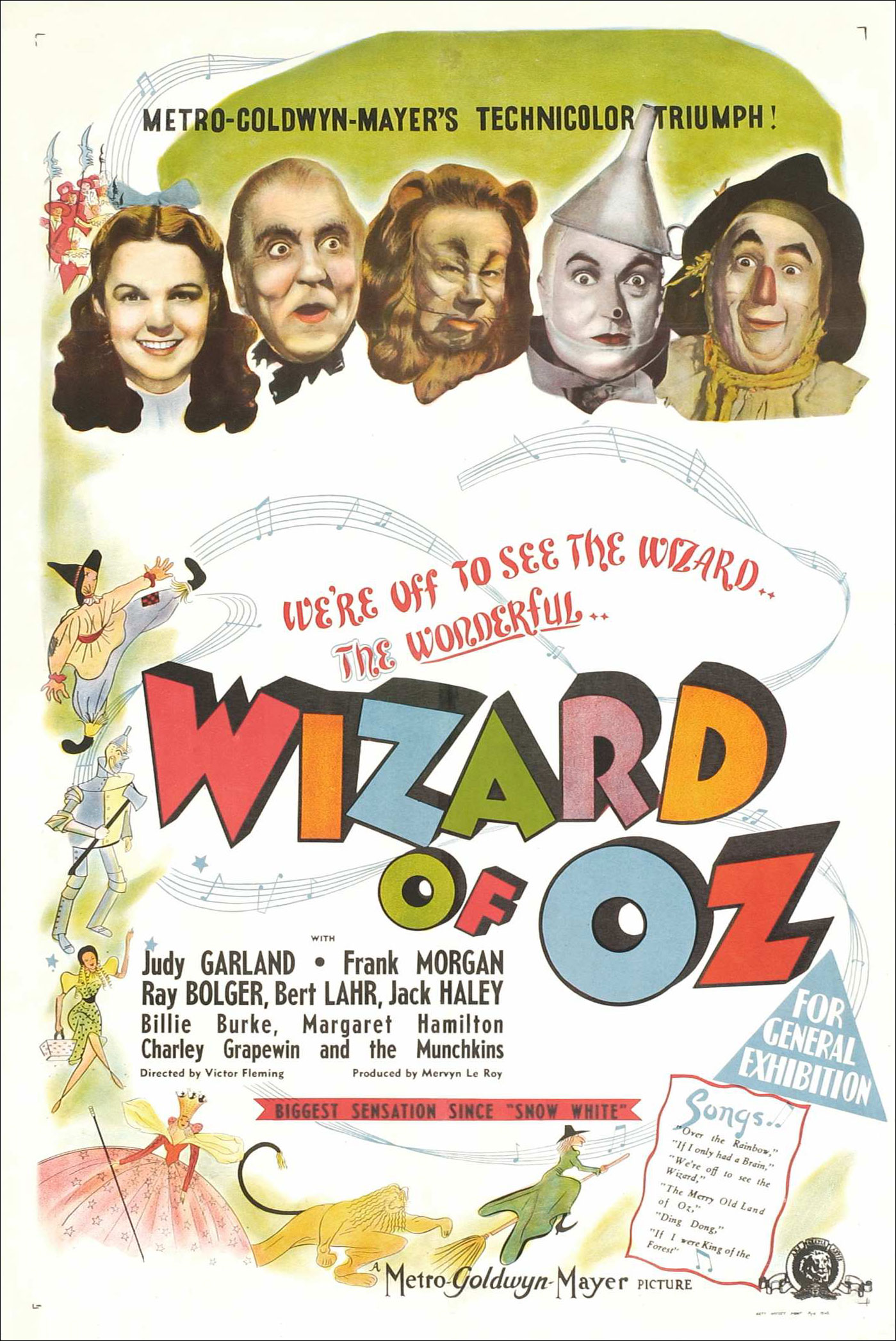
The Wizard of Oz
Also known as Wizard of Oz
The Wizard of Oz is a 1939 American musical fantasy film produced by Metro-Goldwyn-Mayer. Based on the 1900 novel The Wonderful Wizard of Oz by L. Frank Baum, it was primarily directed by Victor Fleming, who left production to take over the troubled Gone with the Wind. The screenplay is credited to Noel Langley, Florence Ryerson, and Edgar Allan Woolf, but includes contributions from other writers. The film stars Judy Garland, Frank Morgan, Ray Bolger, Jack Haley, Bert Lahr, Billie Burke, and Margaret Hamilton. The music was composed by Harold Arlen and adapted by Herbert Stothart, with lyrics by Edgar "Yip" Harburg.
AI overview
The Wizard of Oz is a 1939 musical fantasy film produced by MGM, based on L. Frank Baum's 1900 novel, featuring Judy Garland and directed primarily by Victor Fleming. The film's enduring cultural significance stems from its combination of imaginative storytelling, memorable music by Harold Arlen and Yip Harburg, and acclaimed performances that have made it a classic of American cinema.
AI-generated from the Wikipedia summary — may contain errors.
Film · TMDB
7.6Young Dorothy finds herself in a magical world where she makes friends with a lion, a scarecrow and a tin man as they make their way along the yellow brick road to talk with the Wizard and ask for the things they miss most in their lives. The Wicked Witch of the West is the only thing that could stop them.
Released: 1939-08-15102 minDir: Victor FlemingAdventure, Fantasy, FamilyBudget: $2.8MBox office: $33.8M
Cast
- Judy Garland as Dorothy Gale
- Ray Bolger as "Hunk" / Scarecrow
- Jack Haley as "Hickory" / Tin Man
- Bert Lahr as "Zeke" / Cowardly Lion
- Frank Morgan as Professor Marvel / The Wizard of Oz
- Margaret Hamilton as Miss Gulch / Wicked Witch of the West
~40 min read
Article
The Wizard of Oz is a 1939 American musical fantasy film produced by Metro-Goldwyn-Mayer. Based on the 1900 novel The Wonderful Wizard of Oz by L. Frank Baum, it was primarily directed by Victor Fleming, who left production to take over the troubled Gone with the Wind. The screenplay is credited to Noel Langley, Florence Ryerson, and Edgar Allan Woolf, but includes contributions from other writers. The film stars Judy Garland, Frank Morgan, Ray Bolger, Jack Haley, Bert Lahr, Billie Burke, and Margaret Hamilton. The music was composed by Harold Arlen and adapted by Herbert Stothart, with lyrics by Edgar "Yip" Harburg.
The film is celebrated for its use of three-strip Technicolor, fantasy storytelling, musical score, and memorable characters. It was a critical success and was nominated for five Academy Awards, including Best Picture, winning Best Original Song for "Over the Rainbow" and Best Original Score for Stothart; an Academy Juvenile Award was presented to Judy Garland. It was on a preliminary list of submissions from the studios for an Academy Award for Cinematography (Color) but was not nominated. While it was sufficiently popular at the box office, it failed to make a profit until its 1949 re-release, earning only $3 million on a $2.7 million budget, making it MGM's most expensive production at the time.