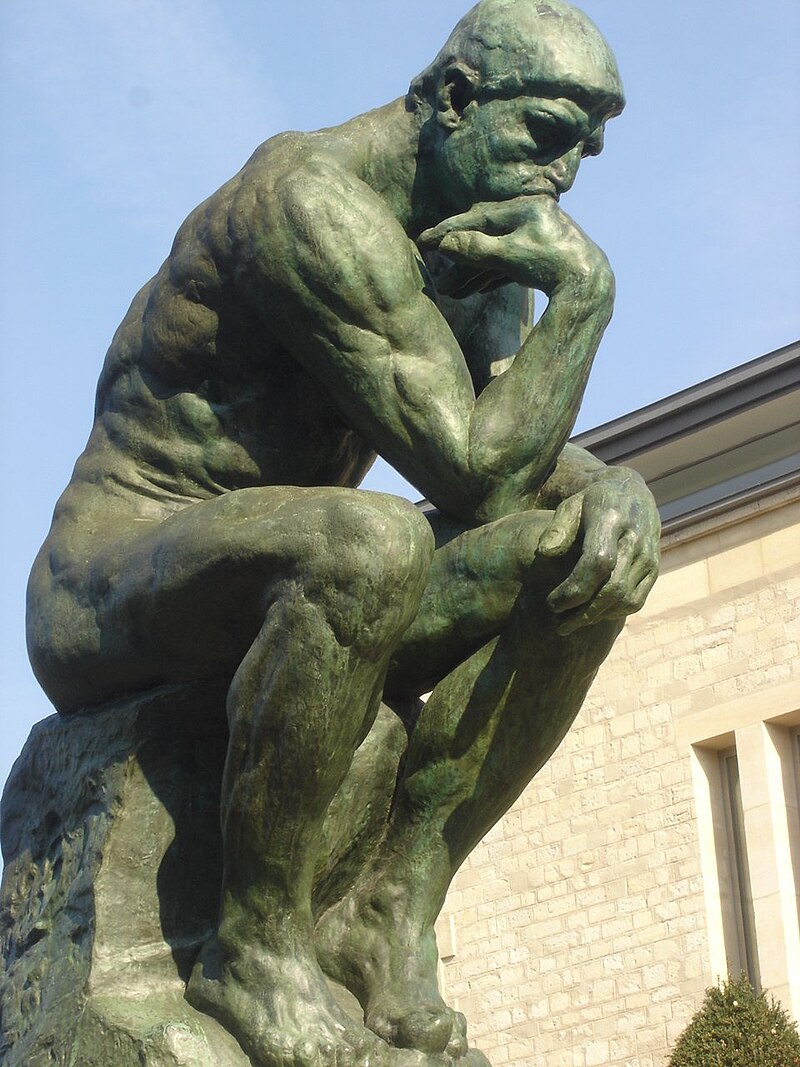
File:Jardin_du_Musee_Rodin_Paris_Le_Penseur_20050402_(02).jpg · Wikimedia Commons · See Wikimedia Commons
AI overview
Thought refers to mental activities like reasoning, problem-solving, and remembering that happen in your mind without requiring direct sensory input from your surroundings. It matters because these cognitive processes allow us to judge situations, form ideas, imagine possibilities, and deliberately work through problems—capabilities that are fundamental to how we understand and navigate the world.
AI-generated from the Wikipedia summary — may contain errors.
Research
724,922 papers- Brain mechanisms underlying the inhibitory control of thought.ReviewNature reviews. Neuroscience · 2025Anderson MC, Crespo-Garcia M, Subbulakshmi SDOI: 10.1038/s41583-025-00929-y
- Thought-Feeling Accuracy in Person Perception and Metaperception: An Integrative Perspective.ReviewAnnual review of psychology · 2025Vorauer JD, Hodges SD, Hall JADOI: 10.1146/annurev-psych-011624-024416
- Thought suppression and psychopathology.ReviewBehaviour research and therapy · 1999Purdon CDOI: 10.1016/s0005-7967(98)00200-9
- The neural ingredients for a language of thought are available.ReviewTrends in cognitive sciences · 2023Kazanina N, Poeppel DDOI: 10.1016/j.tics.2023.07.012
- Clinically relevant aspects of thought across psychological disorders.ReviewCognitive processing · 2025Hammerdahl E, Vazquez N, Alperin BRDOI: 10.1007/s10339-025-01271-y
- On the relationship between unprompted thought and affective well-being: A systematic review and meta-analysis.Psychological bulletin · 2024Kam JWY, Wong AY, Thiemann RF et al.DOI: 10.1037/bul0000428
- Thought contagion? Conspiracy beliefs boost paranoid thoughts.Applied psychology. Health and well-being · 2024Molenda Z, Marchlewska M, Karakula A et al.DOI: 10.1111/aphw.12577
- Language and thought are not the same thing: evidence from neuroimaging and neurological patients.ReviewAnnals of the New York Academy of Sciences · 2016Fedorenko E, Varley RDOI: 10.1111/nyas.13046
via PubMed
Wikidata facts
- Subclass of
- cognitive process
- Has part
- proprioception
- Image
- Herkulaneischer Meister 002.jpg
- Said to be same as
- thought
Show 4 more facts
- Commons category
- Thinking
- topic's main category
- Category:Thought
- on focus list of Wikimedia project
- Wikipedia:Vital articles/Level/4
- studied by
- cognitive science
Sources (5)
via Wikidata · CC0
Gallery (6)
Available in 145 languages
- Español
- Français
- Deutsch
- 中文
- 日本語
- Русский
- Português
- Italiano
- العربية
- हिन्दी
- abstract
- Afrikaans
- Albanian
- Albanian
- Aragonese
- Armenian
- Assamese
- Asturian
Show 126 more
- Avaric
- azb
- Azerbaijani
- Bahasa Indonesia
- Bangla
- Bashkir
- Basque
- bat_smg
- Bavarian
- be_x_old
- Belarusian
- Bikol
- Bosnian
- btm
- Bulgarian
- Burmese
- Catalan
- Central Kurdish
- Chechen
- Cornish
- Crimean Tatar
- Croatian
- Czech
- Danish
- Egyptian Arabic
- Esperanto
- Estonian
- Extremaduran
- Fiji Hindi
- Fijian
- Filipino
- Finnish
- Fula
- Galician
- Gan Chinese
- gcr
- Georgian
- Goan Konkani
- Greek
- Guarani
- Haitian Creole
- Hausa
- Hebrew
- Hungarian
- hyw
- Iban
- Icelandic
- Iloko
- Interlingua
- Jamaican Creole English
- Kabyle
- Kannada
- Kara-Kalpak
- Kazakh
- Khmer
- Kurdish
- Kyrgyz
- Lao
- Latin
- Latvian
- Lithuanian
- Lojban
- Lombard
- Low German
- Macedonian
- Madurese
- Malagasy
- Malay
- Malayalam
- Marathi
- Mingrelian
- Mirandese
- Moroccan Arabic
- Nederlands
- Newari
- Northern Frisian
- Norwegian
- Norwegian Nynorsk
- Occitan
- Pashto
- Piedmontese
- Polski
- Punjabi
- Quechua
- Romanian
- Rusyn
- Samoan
- Scots
- Serbian
- Serbian (Latin)
- Shona
- Sicilian
- simple
- Sindhi
- Slovak
- Slovenian
- Svenska
- Swahili
- Tajik
- Tamil
- Tatar
- Telugu
- Tiếng Việt
- Toki Pona
- Tsonga
- Türkçe
- Ukrainian
- Urdu
- Uzbek
- Venetian
- Waray
- Welsh
- Western Frisian
- Western Panjabi
- Wu Chinese
- Yakut
- Yiddish
- Zaza
- zh_classical
- zh_min_nan
- zh_yue
- Zhuang
- Zulu
- فارسی
- ไทย
- 한국어
via Wikidata sitelinks · CC0