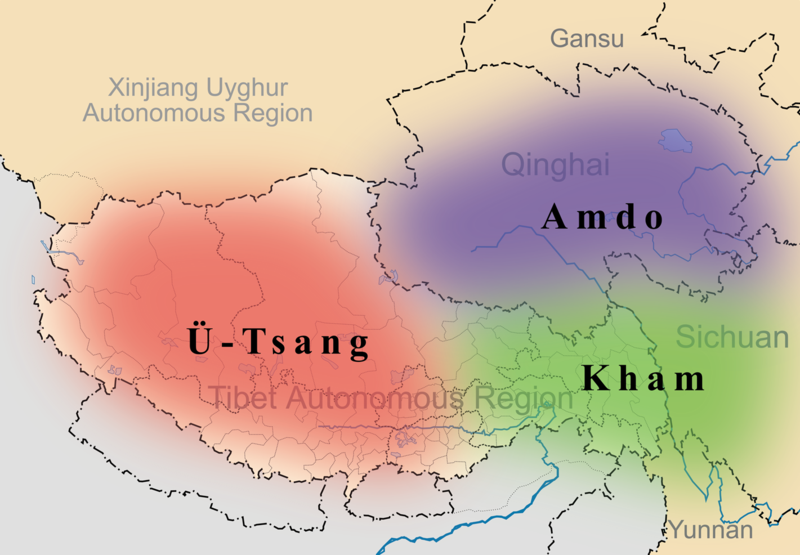
File:Tibet_provinces.png · Wikimedia Commons · See Wikimedia Commons
Tibetic
Sign in to saveAlso known as Tibetan languages, Tibetic languages
group of Bodic languages spoken by Tibetans in the Eastern Tibetan Plateau and in northern areas of the Indian subcontinent
Key facts
- Geographic distribution
- China ( Tibet Autonomous Region , Qinghai , Sichuan , Gansu , Yunnan ); India ( Ladakh , Sikkim , Uttarakhand , Himachal Pradesh , Arunachal Pradesh , Assam ); Pakistan ( Gilgit-Baltistan ); Nepal ; Bhutan ; Myanmar ( Kachin State )
- Ethnicity
- Tibetan people and other Tibetic-speaking peoples
- Native speakers
- 6 million (2014)
- Linguistic classification
- Sino-Tibetan Tibeto-Burman Tibeto-Kanauri (?) Bodish Tibetan
- Early forms
- Old Tibetan Classical Tibetan
- Subdivisions
- Central Tibetan Amdo Khams Dzongkha –Lhokä Ladakhi–Balti Lahuli–Spiti Kyirong–Kagate Sherpa Jirel
- Glottolog
- oldm1245
via Wikipedia infobox
Wikidata facts
- Instance of
- language group
- Subclass of
- Bodish
Show 4 more facts
- topic's main category
- Category:Tibetic languages
- linguistic typology
- agglutinative language
- number of speakers, writers, or signers
- 6000000
- exact match
- data.linguistik.de/bll/bll-ontology#Tibetic
Sources (2)
via Wikidata · CC0
~23 min read
Encyclopedic overview
The Tibetan languages or Tibetic languages are a branch of the Tibeto-Burman languages in the Sino-Tibetan language family. Descending from Old Tibetan, there are 50 recognized Tibetic languages, which branch into more than 200 dialects, which could be grouped into eight dialect continua. These Tibetic languages are spoken in parts of China, Pakistan, Nepal, Bhutan, India and Myanmar. Classical Tibetan is the major literary language, particularly for its use in Tibetan Buddhist scriptures and literature.
Tibetan languages are spoken by some 6 million people, not all of whom are Tibetan. With the worldwide spread of Tibetan Buddhism, the Tibetan language has also spread into the western world and can be found in many Buddhist publications and prayer materials, while western students also learn the language for the translation of Tibetan texts. Outside of Lhasa itself, Lhasa Tibetan is spoken by approximately 200,000 exiled Tibetans who have moved from Tibet to India, Nepal and other countries. Tibetan is also spoken by groups of ethnic minorities in Tibet who have lived in close proximity to Tibetans for centuries, but nevertheless retain their own languages and cultures.
Excerpted from Wikipedia’s “Tibetic” article, available under the CC BY-SA 4.0 licence.