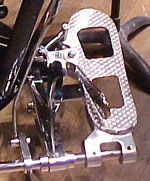
File:Dresden_pedal.jpg · Wikimedia Commons · See Wikimedia Commons
timpani
Sign in to saveAlso known as kettledrums, timps, timpano, tympani, kettledrum, tympany, timpany, kettle drum
The timpani (; ) or kettledrums (also informally called timps) are musical instruments in the percussion family. A type of drum categorised as a hemispherical drum, they consist of a membrane called a head stretched over a large bowl traditionally made of copper. Thus timpani are an example of kettledrums, also known as vessel drums and semispherical drums, whose body is similar to a section of a sphere whose cut conforms the head. Most modern timpani are pedal timpani and can be tuned quickly and accurately to specific pitches by skilled players through the use of a movable foot-pedal. They a
Timpani are large percussion drums with a membrane stretched over a copper bowl that can be tuned to specific pitches by skilled players using a foot pedal. They are important members of the percussion family and are commonly used in orchestral and ensemble music because of their ability to produce precise, adjustable tones.
AI-generated from the Wikipedia summary — may contain errors.
Key facts
- Instrument.name
- Timpani
- Instrument.names
- Kettledrums, Timps, Pauken
- Instrument.image
- USAFE Band timpanist.jpg
- Instrument.image_capt
- A timpanist
- Instrument.background
- percussion
- Instrument.hornbostel_sachs
- 211.11
- Instrument.hornbostel_sachs_desc
- (Separate) kettledrums
- Instrument.developed
- at least 6th century AD
- Instrument.range
- 200px|center|class=skin-invert-image
- Instrument.related
- Kus Naqareh
- Instrument.sound sample
- thumb|Timpani F major triad
via Wikipedia infobox
Wikidata facts
- Image
- Munich - A standard set of timpani Percussion - 5647.jpg
Show 4 more facts
- Hornbostel-Sachs classification
- 211.11-922
- Commons category
- Timpani
- has characteristic
- missing fundamental
- on focus list of Wikimedia project
- Wikipedia:Vital articles/Level/4
Sources (3)
via Wikidata · CC0
~37 min read
Encyclopedic overview
27 sectionsContents
- Etymology and alternative spellings
- Construction
- Basic timpani
- Machine timpani
- Pedal timpani
- Chain timpani
- Other tuning mechanisms
- Heads
- Sticks and mallets
- Popular grips
- In the modern ensemble
- Standard set
- Players
- Concertos
- Performance techniques
- Striking
- Tuning
- Muffling
- Extended techniques
- History
- Pre-orchestral history
- Role in orchestra
- Outside the orchestra
- See also
- References
- Further reading
- External links
The timpani (; ) or kettledrums (also informally called timps) are musical instruments in the percussion family. A type of drum categorised as a hemispherical drum, they consist of a membrane called a head stretched over a large bowl traditionally made of copper. Thus timpani are an example of kettledrums, also known as vessel drums and semispherical drums, whose body is similar to a section of a sphere whose cut conforms the head. Most modern timpani are pedal timpani and can be tuned quickly and accurately to specific pitches by skilled players through the use of a movable foot-pedal. They are played by striking the head with a specialized beater called a timpani stick or timpani mallet. Timpani evolved from military drums to become a staple of the classical orchestra by the last third of the 18thcentury. Today, they are used in many types of ensembles, including concert bands, marching bands, orchestras, and even in some rock bands.
Timpani is an Italian plural, the singular of which is , though the singular may also be referred to as a timpanum. In English the term timpano is only widely in use by practitioners: a single drum is often referred to as a timpani, leading many to incorrectly pluralize the word as timpanis. A musician who plays timpani is a timpanist.
Excerpted from Wikipedia’s “timpani” article, available under the CC BY-SA 4.0 licence.
Gallery (48)
Available in 64 languages
- Español
- Français
- Deutsch
- 中文
- 日本語
- Русский
- Português
- Italiano
- العربية
- Afrikaans
- Armenian
- Azerbaijani
- Bahasa Indonesia
- Basque
- Belarusian
- Bosnian
- Bulgarian
- Catalan
Show 45 more
- Croatian
- Czech
- Danish
- Esperanto
- Estonian
- Filipino
- Finnish
- Galician
- Georgian
- Greek
- Hebrew
- Hungarian
- Icelandic
- Interlingua
- Irish
- Kazakh
- kbp
- Kyrgyz
- Latvian
- Lithuanian
- Macedonian
- Malay
- Malayalam
- Nederlands
- Norwegian
- Norwegian Nynorsk
- Polski
- Romanian
- Serbian
- Serbian (Latin)
- simple
- Sindhi
- Slovak
- Slovenian
- Svenska
- Tiếng Việt
- Türkçe
- Ukrainian
- Uzbek
- Welsh
- Wu Chinese
- zh_yue
- فارسی
- ไทย
- 한국어
via Wikidata sitelinks · CC0