File:Tirpitz-1.jpg · Wikimedia Commons · See Wikimedia Commons
Key facts
- Namesake
- Alfred von Tirpitz
- Builder
- Kriegsmarinewerft Wilhelmshaven
- Laid down
- 2 November 1936
- Launched
- 1 April 1939
- Commissioned
- 25 February 1941
- Fate
- Sunk by Royal Air Force bombers on 12 November 1944
- Class type
- Bismarck -class battleship
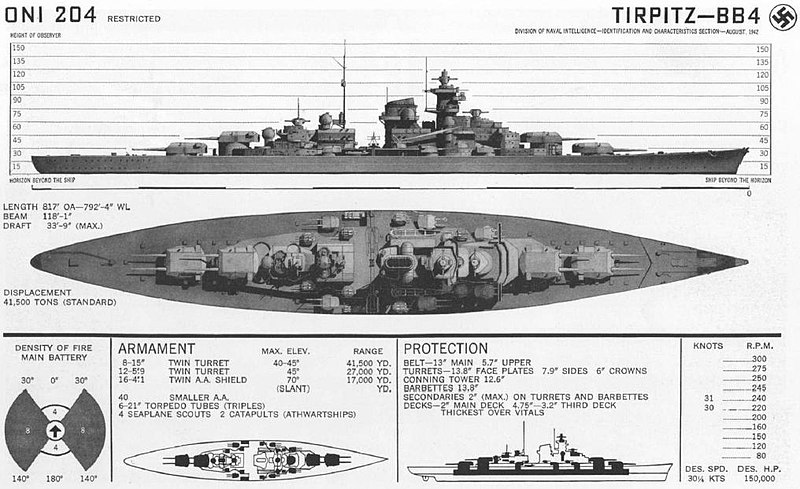
- Displacement
- 42,900 t (42,200 long tons) standard 52,600 t (51,800 long tons) full load
- Length
- 241.60 m (792 ft 8 in) waterline 251 m (823 ft 6 in) overall
- Beam
- 36 m (118 ft 1 in)
- Draft
- 9.30 m (30 ft 6 in) standard
- Installed power
- 12 × Wagner water-tube boilers ; 163,026 PS (160,796 shp ; 119,905 kW )
- Propulsion
- 3 × geared steam turbines ; 3 × screw propellers
- Speed
- 30 knots (56 km/h; 35 mph)
- Range
- 8,870 nmi (16,430 km; 10,210 mi) at 19 knots (35 km/h; 22 mph)
- Complement
- 103 officers 1,962 enlisted men
- Sensors processing systems
- FuMO 23
- Armament
- As built: 8 × 38 cm (15 in) SK C/34 (4 × 2) 12 × 15 cm (5.9 in) L/55 (6 × 2) 16 × 10.5 cm (4.1 in) SK C/33 (8 × 2) 16 × 3.7 cm (1.5 in) SK C/30 (8 × 2) 12 × 2 cm (0.79 in) FlaK 30 (12 × 1) Modifications: 58 × 2 cm FlaK 30 8 × 53.3 cm (21 in) torpedo tubes
via Wikipedia infobox
Wikidata facts
- Instance of
- battleship
- Named after
- Alfred von Tirpitz
- Operator
- Kriegsmarine
- Manufacturer
- Kriegsmarinewerft Wilhelmshaven
- Conflict
- World War II
- Image
- Tirpitz-2.jpg
- Length
- 251.0
- Speed
- 30.8
- Significant event
- ship launching
Show 12 more facts
- draft
- 9.9
- yard number
- 128
- Commons category
- Tirpitz (ship, 1941)
- Commons gallery
- Tirpitz (Schiff, 1941)
- vessel class
- Bismarck-class battleship
- armament
- cannon
- beam
- 36.0
- country of registry
- Nazi Germany
- native label
- Tirpitz
- different from
- Alfred von Tirpitz
- location of creation
- Kriegsmarinewerft Wilhelmshaven
- name
- Tirpitz
Sources (9)
via Wikidata · CC0
~35 min read
Encyclopedic overview
Tirpitz ( German pronunciation: [ˈtɪʁpɪt͡s] ) was the second of two Bismarck-class battleships built for Nazi Germany's Kriegsmarine (navy) prior to and during the Second World War. Named after Grand Admiral Alfred von Tirpitz, the architect of the Kaiserliche Marine (Imperial Navy), the ship was laid down at the Kriegsmarinewerft in Wilhelmshaven in November 1936 and her hull was launched two and a half years later. Work was completed in February 1941, when she was commissioned into the German fleet. Like her sister ship, Bismarck, Tirpitz was armed with a main battery of eight 38-centimetre (15 in) guns in four twin turrets. After a series of wartime modifications she was 2000 tonnes heavier than Bismarck, making her the heaviest battleship ever built by a European navy.
After completing sea trials in early 1941, Tirpitz briefly served as the centrepiece of the Baltic Fleet, which was intended to prevent a possible break-out attempt by the Soviet Baltic Fleet. In early 1942, the ship sailed to Norway to act as a deterrent against an Allied invasion. While stationed in Norway, Tirpitz was also intended to be used to intercept Allied convoys to the Soviet Union, and two such missions were attempted in 1942. This was the only feasible role for her, since the St Nazaire Raid had made operations against the Atlantic convoy lanes too risky. Tirpitz acted as a fleet in being, forcing the British Royal Navy to retain significant naval forces in the area to contain the battleship.
Excerpted from Wikipedia’s “Tirpitz” article, available under the CC BY-SA 4.0 licence.