
Togo
Sign in to saveAlso known as Togolese Republic, tg
Togo, officially the Togolese Republic, is a country in West Africa. It is bordered by Ghana to the west, Benin to the east and Burkina Faso to the north. It is one of the least developed countries in the world. It extends north from the Gulf of Guinea (where its capital, Lomé, is located) to the Burkina Faso-Togo border. It is a small, tropical country, spanning with a population of approximately 8 million, and it has a width of less than between Ghana and its eastern neighbor Benin.
OverviewAI-generated
Togo, officially the Togolese Republic, is a sovereign state and republic located in Western Africa. Its capital is Lomé, and it shares borders with Burkina Faso, Ghana, and Benin. The country is situated on the Atlantic Ocean and includes administrative entities such as the Savanes, Kara, Centrale, and Maritime regions. Its highest point is Mount Agou.
The official language is French, while other languages used include Ginyanga, Yobe, Kusaal, and Konkomba. The currency is the West African CFA franc, and the top-level Internet domain is .tg. Togo is a member of the United Nations, African Union, World Trade Organization, and Organisation of Islamic Cooperation. Its anthem is Terre de nos aïeux, and its head of state is Faure Essozimna Gnassingbé.
The population is recorded at 8,095,498 or 9,515,236 depending on the source, with an area of 56,785 square kilometers. Forest area covers 22.07 percent of the land, and 75.1 percent of energy is renewable. The life expectancy is 62.935 years, and the urban population percentage is 43.8148491605996. The telephone country code is +228.
Synthesized by Vinony from 67 facts across 9 sources: Wikidata, REST Countries, Openweathermap, Open Meteo, World Bank, OpenStreetMap, PubMed, Vinony graph, Geo. Generated from structured data (not the Wikipedia text) and checked against those facts — may still contain errors.
Weather now
7-day forecast
via Open-Meteo
Country
- Capital
- Lomé
- Population
- 8,095,498
- Region
- Africa · Western Africa
- Demonym
- Togolese
- Currencies
- XOF (Fr)
- Languages
- French
- Calling code
- +228
- Drives on
- Right
- Gini
- 43.1 (2015)
- FIFA code
- TOG
- TLD
- .tg
- Timezones
- UTC
- Borders
- BEN, BFA, GHA
via REST Countries
Indicators · World Bank
- GDP
- $10.7B(2024)
- Population
- 9,515,236(2024)
- Life expectancy
- 62.9 yrs(2024)
- Unemployment
- 2 %(2025)
- Urban population
- 43.8 %(2024)
- Internet users
- 39.5 %(2024)
- Forest area
- 22.1 %(2023)
- Renewable energy
- 75.1 %(2021)
via World Bank Open Data · CC BY 4.0
Wikipedia views (30d)
55,710 totalvia Wikimedia Pageviews API
Key facts
- Country.footnote_d
- Estimates for this country explicitly take into account the effects of excess mortality due to AIDS; this can result in lower life expectancy, higher infant mortality and death rates, lower population and growth rates, and changes in the distribution of population by age and sex than would otherwise be expected.
- Country.footnote_e
- Rankings based on 2017 figures (CIA World Factbook – "Togo")
- Country.conventional_long_name
- Togolese Republic
- Country.common_name
- Togo
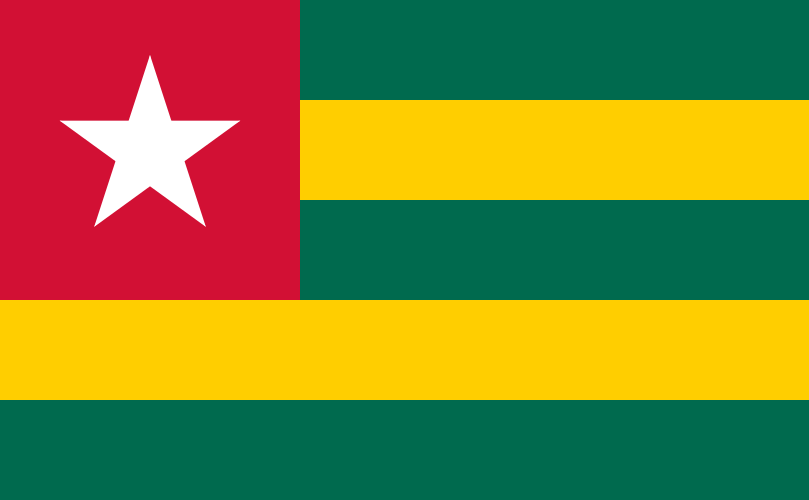
- Country.image_flag
- Flag of Togo.svg
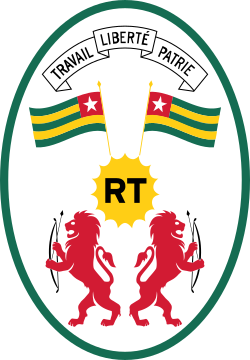
- Country.image_coat
- Emblem of Togo.svg
- Country.coa_size
- 70
- Country.symbol_type
- Coat of arms
- Country.national_motto
- ()
- Country.national_anthem
- ()
- Country.capital
- Lomé
- Country.largest_city
- Lomé
- Country.official_languages
- French
- Country.languages_type
- Spoken languages
- Country.ethnic_groups
- non-African (5.6%)
- Country.religion_year
- 2025
- Country.demonym
- Togolese
- Country.government_type
- Unitary parliamentary republic
via Wikipedia infobox
Research
5,360 papers- Togo.Department of State publication. Background notes series · 1987United States. Department of State. Bureau of Public Affairs
- Natural occurrence of mycotoxins in maize and sorghum in Togo.ReviewMycotoxin research · 2019Hanvi DM, Lawson-Evi P, De Boevre M et al.DOI: 10.1007/s12550-019-00351-1
- [HIV prevention among serodifferent couples: postures and difficulties in Lomé (Togo)].ReviewSante publique (Vandoeuvre-les-Nancy, France) · 2023Djakpa Y, Sawadogo NDOI: 10.3917/spub.231.0087
- Seasonal variations and other changes in the geographical distributions of different cytospecies of the Simulium damnosum complex (Diptera: Simuliidae) in Togo and Benin.ReviewActa tropica · 2023Cheke RA, Post RJ, Boakye DADOI: 10.1016/j.actatropica.2023.106970
- Spinal Cord Compression in Togo: Etiologies and Management.World neurosurgery · 2022Kpelao E, Doleagbenou AK, El Kader Moumouni A et al.DOI: 10.1016/j.wneu.2022.03.063
- [Satisfaction of parents of children hospitalized in pediatrics in Togo].ReviewSoins. Pediatrie, puericulture · 2022Tchagbele OB, Réné Segbedji KA, Douti B et al.DOI: 10.1016/j.spp.2022.06.011
- Effet de l’inclusion financière sur le recours des ménages aux soins de santé au Togo.Sante publique (Vandoeuvre-les-Nancy, France) · 2024Atchi KF, Sy IDOI: 10.3917/spub.246.0121
- [Subsaharan respiratory medicine--the case of Togo: poor relation in the Francophone family].ReviewRevue des maladies respiratoires · 2005Tidjani ODOI: 10.1016/s0761-8425(05)85609-8
via PubMed
Wikidata facts
- Instance of
- country
- Official name
- République togolaise
- Demonym
- Togolais
- Country
- Togo
- Contains
- Plateaux Region
- Continent
- Africa
- Capital
- Lomé
- Official language
- French
- Currency
- West African CFA franc
- Population
- 9515240
- Area
- 56785
- Body of water
- Atlantic Ocean
- Head of government
- Faure Essozimna Gnassingbé
- Head of state
- Faure Essozimna Gnassingbé
- Legislature
- National Assembly
- Anthem
- Terre de nos aïeux
- Shares border with
- Hohoe
- Highest point
- Mount Agou
- Follows
- French Togoland
- Official website
- www.republicoftogo.com
- Image
- Kpalime.jpg
- Life expectancy
- 60.232
- Nominal GDP
- 9930000000
- Unemployment rate
- 1.9
Show 58 more facts
- Calling code
- +228
- Licence plate code
- TG
- Electrical plug type
- Europlug
- Mains voltage
- 220
- Motto
- Arbeit, Freiheit, Vaterland
- Flag
- flag of Togo
- Coat of arms
- Emblem of Togo
- language used
- Lama
- topic's main Wikimedia portal
- Portal:Togo
- top-level Internet domain
- .tg
- Commons category
- Togo
- member of
- African Continental Free Trade Area
- topic's main category
- Category:Togo
- category for people who died here
- Category:Deaths in Togo
- category for people born here
- Category:Births in Togo
- category of associated people
- Category:Togolese people
- Commons gallery
- Togo
- mobile country code
- 615
- lowest point
- Bight of Benin
- diplomatic relation
- Cameroon
- driving side
- right
- geography of topic
- Geography of Togo
- marriageable age
- 17
- office held by head of government
- President of the Council of Ministers of Togo
- office held by head of state
- President of Togo
- number of out-of-school children
- 487535
- located in/on physical feature
- West Africa
- total fertility rate
- 4.584
- maritime identification digits
- 671
- inception
- 1960-04-27
- Unicode character
- 🇹🇬
- native label
- Togo
- history of topic
- history of Togo
- culture
- culture of Togo
- VAT rate
- 18
- BTI Status Index
- 4.79
- BTI Governance Index
- 4.93
- economy of topic
- economy of Togo
- demographics of topic
- demographics of Togo
- different from
- Togo
- Democracy Index
- 2.80
- Human Development Index
- 0.539
- P11012
- Ljubljana
- central bank
- Central Bank of West African States
- hashtag
- Togo
- on focus list of Wikimedia project
- Wikipedia:Vital articles/Level/4
- Happy Planet Index score
- 37.3
- Gini coefficient
- 42.4
- Inequality-adjusted Human Development Index
- 0.372
- P12749
- Indian Ocean
- birth rate
- 31.48
- male population
- 4448225
- death rate
- 8.213
- rural population
- 4962262
- female population
- 4726032
- urban population
- 3886437
- P8168
- transparency
- Commonwealth Sport country code
- TOG
Sources (15)
via Wikidata · CC0
Travel guide
Get in
thumb|375px|Visa policy of Togo
Get around
A taxi-moto (motorcycle taxi) will cost CFA 150-500 to get you around. You can tell who the taxi-moto drivers are: they will honk or hiss at you as they drive by and usually wear baseball caps and sunglasses. A taxi will usually cost about CFA 500 for a one-way short trip inside the city, for trips to the northern parts of the city expect to pay up to CFA 2,500. Taxis will have yellow licence plates and their registration number painted on the car. Always negotiate before you get on/in, the quoted price will include tip.
Sometimes, when you are on a side street, it might be helpful if you ask a security guard to wave down a taxi for you. Tipping CFA 300-600 is expected.
See
thumbnail|The tatas in Nadoba
Lomé's markets, both general and voodoo, are the most popular stop in the country along the road between Ghana and Benin. The smaller towns of Togoville on Lake Togo and Aneho on the ocean are also popular stops for the former's voodoo shrines and historic sights and the latter's beaches.
Lately, the coffee growing region around Kpalimé has become popular with the errant tourist in Togo, with a good number of nice hikes, cooler weather, and pleasant views.
Perhaps the most alluring part of the country is the hardest to get to—the hilly and sparsely populated north. The best known destination is Tamberma Valley — the Koutammakou UNESCO World Heritage site, to the north of Kara. The local Batammariba people (known by colonists as the Tamberma) constructed and live in unique Takienta (a.k.a. Tata) "tower-houses" of mud and straw, which arguably have become the Togolese national symbol. It's a surreal dreamland of a place, and easily a highlight of a trip to Togo, although it is a journey to get there.
Togo's few parks and reserves are relatively rarely visited, but if you manage to make it out there on a safari, Fazao Mafakassa National Park in the center-west of the country is quite beautiful. In the far north of the country is Kéran National Park, with one of the larger elephant populations in West Africa. Aside from Kéran, the north also offers a ton of potential outdoor excursions, with nice hikes up mountains, out to waterfalls, etc. Akloa …
Do
Sports, especially football, are the main entertaining activity in Togo. You can watch the football league games played in the weekends (check listings). Apart from football, there are several night clubs that can keep you awake at night, and the capital is full of them; the Chess BSBG is among the most popular.
TV programs are not the best in the world, with films and sitcoms that have been played for years.
The beach offers another type of fun. Many activities and parties are organized there, with people coming from all over Lomé to enjoy the beautiful weather in the weekends. Despite those great things at the beach, you really have to choose a good spot to avoid stepping or sitting on the unwanted.
Buy
thumb|270px|[[Lome Fetish Market]]
Eat
thumb|Fufu Akume is made from corn flour. The "national" dish of West-Africa is Fufu. In Togo, it consists of white yams pounded into a doughy consistency. You will find plenty of Fufu Restaurants in the cities as well as roadside stands. Akume and Fufu are usually eaten with your hands and come with different sauces (from smoked fish to spicy tomato to peanut).
Plantains can also be found in various forms; grilled, cooked, mashed or fried. In the season, mangos, papayas, and pineapples are for sale everywhere.
There are a lot of local fruits sold on the side of the highways and main country roads - pineapples, oranges, mangoes, etc. You can also sometimes see them selling African fan palm fruits (Borassus aethiopum) which look like orange coconuts. Ripe fruit can be opened by removing the top (cap) and then peeling off the skin (using hands or machete) - then people suck on the bright orange fibres as they are quite sweet and reminiscent of mango. Not for everyone but can be fun if you are into trying out exotic fruits.
Drink
Lemonade and Bissap juice are the most popular drinks. There are many bars almost around all corners in Lomé where you will be able to have a beer.
The most popular drinks you will find in common bars are beers and sodas. Here is a list of the beers you may find based on their popularity: Pils Guinness Castel Flag Eku Lager Cocktail de fruit Coca Cola Fanta Pompom (apple based soda) Limonade Sprite XXL (red-bull-like soda) Schwepp's Tonic Pamplemousse (grapefruit based soda) Sodawater Moka Malta Malta Guinness Don't be surprised if most of the bars do not have what you ask. The Togolese are not renowned for their organisation and tight management, except one small motel called "Auberge London" in the northern suburbs of Lomé called "Agoe" where you will have all the possible drink listed above.
Stay safe
thumb|Aného Beach As a rule, stay away from public beaches, where tourists find themselves mugged any time of day or night. Most of the country has little crime, but Lomé is a clear exception, and is a good deal more dangerous than any city in Ghana or Benin. If going somewhere at night, take a car taxi, and get the numbers of a few trusted taxi drivers if you plan to stay for a while.
Driving is atrocious in Togo, with fatalistic overloaded speed demons chancing it on curves and hills, capital streets swarming with motorcycles throughout the black of night, and worrisome accident scenes along the main roads. The hilly north-south road north of Kara is particularly dangerous. If you are skeptical, take a day trip, and marvel at all the husks of buses and trucks that weren't there on the way out! Traffic is the single biggest danger to travelers in Togo.
Stay healthy
Drink bottled water such as Volta or sachets of "Pure Water". Bissop juice is also fairly safe as it is boiled, and avoid the lemonade "citron" despite its delicious appearance. Stay away from roadside meals if possible. People relieve themselves in the streets in Lomé, so be aware of that.
In rural areas you can sometimes see vendors on the side of the road selling the Ackee fruit, the trees of which are quite abundant throughout Togo. While locals cook this fruit or eat the yellow arils of it, it is recommended to avoid eating it altogether, as black seeds and red fibrous rinds contain hypoglycin A - a toxin which can cause a "Jamaican Vomiting Sickness" (severe hypoglycemia) and can result in coma or death.
Respect
Greetings are a little more elaborate in Togo. Say hello to everyone when coming and going. Handshakes are key. Also, maybe if you try to get to know them, you will fit in. Make sure you make yourself feel like you are at home. Don't make it too homey, though, because you don't want to get on their bad side.
Travel guide from Wikivoyage (CC BY-SA 4.0)
~40 min read
Encyclopedic overview
37 sectionsContents
- Etymology
- History
- Independence
- Joining the Commonwealth
- Government
- 2024 constitutional reform
- Administrative divisions
- Foreign relations
- Military
- Human rights
- Geography
- Wildlife
- Economy
- Transport
- Road
- Challenges and developments
- Urban transportation
- Railways
- Air
- Water
- Demographics
- Ethnic groups
- The Adele people
- The Akebou people
- The Ntrubo people
- The Akposso people
- The Bogo ([[Ahlon language|Ahlon]]) people
- Religion
- Languages
- Health
- Education
- Culture
- See also
- Notes
- References
- Further reading
- External links
Togo, officially the Togolese Republic, is a country in West Africa. It is bordered by Ghana to the west, Benin to the east and Burkina Faso to the north. It is one of the least developed countries in the world. It extends north from the Gulf of Guinea (where its capital, Lomé, is located) to the Burkina Faso-Togo border. It is a small, tropical country, spanning 57,000 square kilometres (22,000 square miles) with a population of approximately 8 million. It has a width of less than 115 km (71 mi) between Ghana and its eastern neighbour Benin.
Various peoples settled the boundaries of present-day Togo between the 11th and 16th centuries. Between the 16th and 18th centuries, the coastal region served primarily as a European slave trading outpost, earning Togo and the surrounding region the name "The Slave Coast". In 1884, during the scramble for Africa, Germany established a protectorate in the region called Togoland. After World War I, Togo was transferred to France with its contemporary borders. Togo gained independence from France in 1960. In 1967, Gnassingbé Eyadéma led a successful military coup d'état and became president of an anti-communist, single-party state. In 1993, Eyadéma faced multiparty elections marred by irregularities, and won the presidency three times. At the time of his death, Eyadéma was the "longest-serving leader in modern African history", having been president for 38 years. In 2005, his son Faure Gnassingbé was elected president.
Excerpted from Wikipedia’s “Togo” article, available under the CC BY-SA 4.0 licence.
Gallery (51)
On the map
6 mapped locations
Available in 253 languages
- Español
- Français
- Deutsch
- 中文
- 日本語
- Русский
- Português
- Italiano
- العربية
- हिन्दी
- Abkhazian
- Achinese
- Adyghe
- Afrikaans
- Akan
- Albanian
- Albanian
- Amharic
Show 234 more
- ami
- Angika
- Aragonese
- Armenian
- Arpitan
- Asturian
- azb
- Azerbaijani
- Bahasa Indonesia
- Balinese
- Bambara
- Bangla
- Banjar
- Bashkir
- Basque
- bat_smg
- Bavarian
- be_x_old
- Belarusian
- Betawi
- Bhojpuri
- Bikol
- Bishnupriya
- Bislama
- Bosnian
- Breton
- Bulgarian
- Buriat
- Burmese
- Catalan
- cbk_zam
- cdo
- Cebuano
- Central Kurdish
- Chechen
- Chuvash
- Cornish
- Corsican
- Crimean Tatar
- Croatian
- Czech
- dag
- Danish
- dga
- Divehi
- dty
- Dzongkha
- Egyptian Arabic
- Esperanto
- Estonian
- Ewe
- Extremaduran
- Faroese
- Fiji Hindi
- Filipino
- Finnish
- fiu_vro
- Fon
- Frafra
- Fula
- Gagauz
- Galician
- Ganda
- gcr
- Georgian
- Gilaki
- gpe
- Greek
- Guarani
- Gujarati
- guw
- Haitian Creole
- Hakka Chinese
- Hausa
- Hebrew
- Hungarian
- Icelandic
- Ido
- Igbo
- Iloko
- Inari Sami
- Interlingua
- Interlingue
- Irish
- Jamaican Creole English
- Javanese
- Jju
- Kabyle
- kai
- Kannada
- Kara-Kalpak
- Karachay-Balkar
- Kazakh
- kbp
- kge
- Kikuyu
- Kinyarwanda
- Kongo
- Kotava
- Kurdish
- Kyrgyz
- Ladino
- Latin
- Latvian
- Ligurian
- Limburgish
- Lingala
- Lingua Franca Nova
- Lithuanian
- lld
- Lombard
- Low German
- Lower Sorbian
- Luxembourgish
- Macedonian
- Madurese
- Malagasy
- Malay
- Malayalam
- Maltese
- Manipuri
- Manx
- Māori
- Marathi
- Mazanderani
- Minangkabau
- Mingrelian
- Moksha
- Mongolian
- Moroccan Arabic
- Mossi
- N’Ko
- nds_nl
- Nederlands
- Nepali
- Newari
- Northern Frisian
- Northern Sami
- Northern Sotho
- Norwegian
- Norwegian Nynorsk
- Novial
- nup
- Obolo
- Occitan
- Old English
- olo
- Oromo
- Ossetic
- Pampanga
- Papiamento
- Pashto
- Pennsylvania German
- Piedmontese
- Polski
- Punjabi
- Quechua
- rki
- Romanian
- Romansh
- Rusyn
- Samoan
- Sango
- Sanskrit
- Santali
- Sardinian
- Saterland Frisian
- Scots
- Scottish Gaelic
- Serbian
- Serbian (Latin)
- Shan
- Shona
- Sicilian
- Silesian
- simple
- Sindhi
- Sinhala
- Slovak
- Slovenian
- Somali
- South Ndebele
- Southern Sotho
- Standard Moroccan Tamazight
- Sundanese
- Svenska
- Swahili
- Swati
- szy
- Tajik
- Talysh
- Tamil
- Taroko
- Tatar
- tay
- Telugu
- Tibetan
- Tiếng Việt
- Tigrinya
- Toki Pona
- Tsonga
- Tumbuka
- Türkçe
- Turkmen
- Tyap
- Udmurt
- Ukrainian
- Upper Sorbian
- Urdu
- Uyghur
- Uzbek
- Venetian
- Veps
- Volapük
- Waray
- Welsh
- Western Frisian
- Western Mari
- Western Panjabi
- Wolof
- Wu Chinese
- Yakut
- Yiddish
- Yoruba
- Zaza
- Zeelandic
- zh_classical
- zh_min_nan
- zh_yue
- Zhuang
- Zulu
- فارسی
- ไทย
- 한국어
via Wikidata sitelinks · CC0