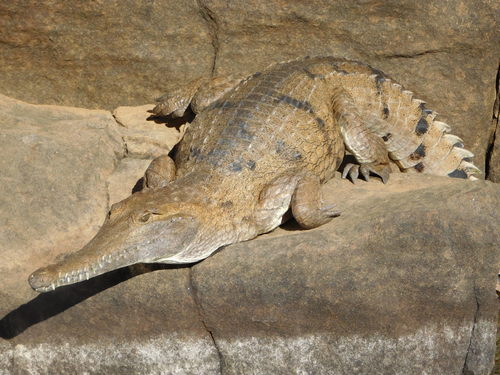
(c) Antoni Camozzato, some rights reserved (CC BY-NC), uploaded by Antoni Camozzato · cc-by-nc
Tomistoma
Sign in to saveTomistoma is a genus of gavialid crocodilians. They are noted for their long narrow snouts used to catch fish, similar to the gharial. Tomistoma contains one extant (living) member, the false gharial (Tomistoma schlegelii), as well as potentially several extinct species: T. cairense, T. lusitanicum and T. coppensi. Previously assigned extinct species known from fossils are reclassified as different genera such as Eogavialis, Toyotamaphimeia and Sutekhsuchus.
Species
Freshwater Crocodile
GENUS
- KingdomAnimalia
- PhylumChordata
- ClassCrocodylia
- FamilyCrocodylidae
via GBIF
Museum specimens
- Specimen records
- 31
- With media
- 10
- Family
- Crocodylidae
- Collections
- USNM, SDNHM, NHMUK, UCMP, MNHN, UMZC
- Recorded in
- United States, United Kingdom, Austria, France, Libye, Egypt, Malaysia, Malaysia?
Wikidata facts
- Instance of
- taxon
- Parent taxon
- Tomistominae
- Image
- Tomistoma schlegelii fg02.JPG
Show 4 more facts
- taxon name
- Tomistoma
- taxon rank
- genus
- topic's main category
- Category:Tomistoma
- Commons category
- Tomistoma
Sources (1)
via Wikidata · CC0
~2 min read
Encyclopedic overview
1 sectionsContents
- References
Tomistoma is a genus of gavialid crocodilians. They are noted for their long narrow snouts used to catch fish, similar to the gharial. Tomistoma contains one extant (living) member, the false gharial (Tomistoma schlegelii), as well as potentially several extinct species: T. cairense, T. lusitanicum and T. coppensi. Previously assigned extinct species known from fossils are reclassified as different genera such as Eogavialis, Toyotamaphimeia and Sutekhsuchus.
Unlike the gharial, the false gharial's snout broadens considerably towards the base and so is more similar to those of true crocodiles than the gharial, whose osteology indicated a distinct lineage from all other living crocodilians. However, although more morphologically similar to Crocodylidae based on skeletal features, recent molecular studies using DNA sequencing consistently indicate that the false gharial and by inference other related extinct forms traditionally viewed as belonging to the crocodylian subfamily Tomistominae actually belong to Gavialoidea and Gavialidae.
Excerpted from Wikipedia’s “Tomistoma” article, available under the CC BY-SA 4.0 licence.
Gallery (12)
Available in 10 languages
via Wikidata sitelinks · CC0