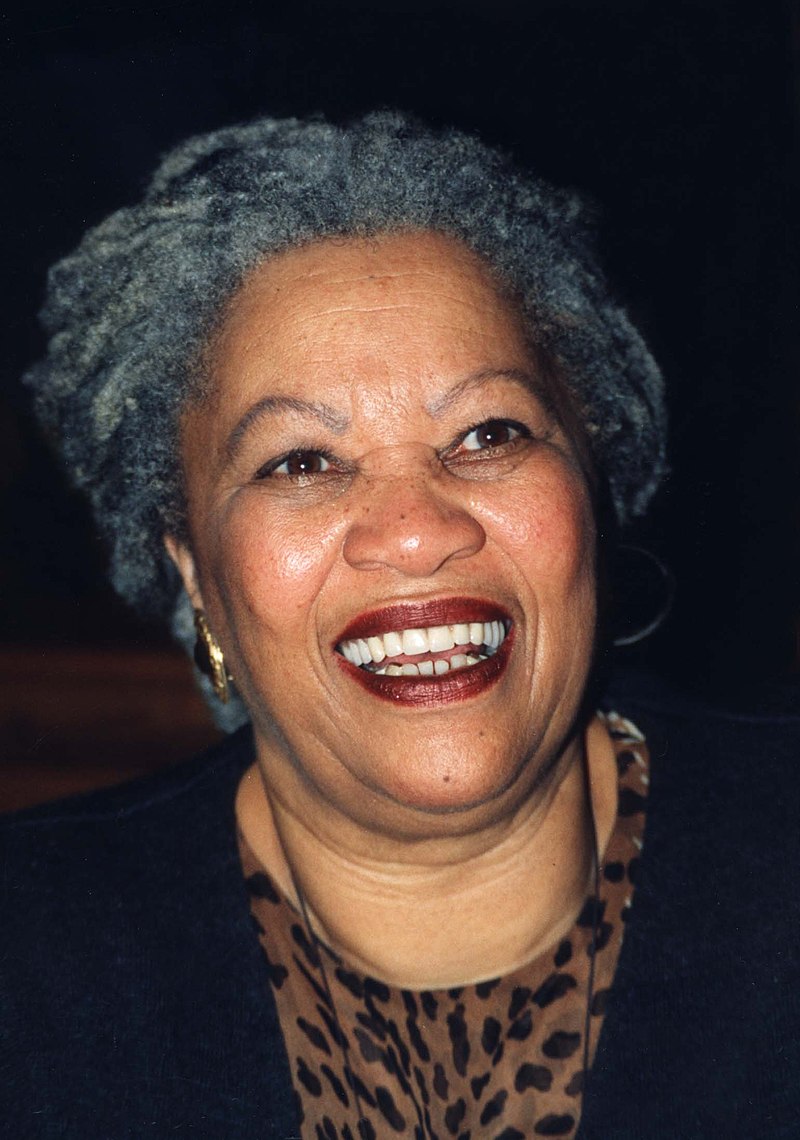
File:Toni_Morrison.jpg · Wikimedia Commons · See Wikimedia Commons
Toni Morrison
Sign in to saveAlso known as Chloe Ardelia Wofford, Chloe Anthony Wofford, Chloe Anthony Wofford Morrison, Chloe Anthony Wofford-Morrison
African American novelist, essayist, and academic (1931–2019)
OverviewAI-generated
Toni Morrison (1931–2019) was an author recognized in the American Academy Arts Sciences, Pulitzer Prize, and Nobel Literature collections. She received the Nobel Prize once. Her notable works include *Playing in the Dark*, *Desdemona*, and *God Help the Child*. She is also associated with *American Contemporaries* and *Miśḥaḳim ba-afelah*.
Morrison’s writing has been referenced by 2,346 other encyclopedia articles. Her official website is tonimorrisonsociety.org. She is described at womenshistory.org and biography.com. Her quotes include, "Here is the house. It is green and white. It has a red door. It is very pretty," and "There is really nothing more to say — except why. But since why is difficult to handle, one must take refuge in how."
Synthesized by Vinony from 32 facts across 10 sources: Wikidata, Last.fm, Firecrawl, Crossref, Wikiquote, MusicBrainz, Open Library, Nobel Prize, Vinony collections, Vinony graph. Generated from structured data (not the Wikipedia text) and checked against those facts — may still contain errors.
Nobel Prize
- The Nobel Prize in Literature1993
“who in novels characterized by visionary force and poetic import, gives life to an essential aspect of American reality”
Described at
Biography: Toni Morrison
Toni Morrison is one of the most celebrated authors in the world. Read more at womenshistory.org.
womenshistory.org →Toni Morrison is one of the most celebrated authors in the world. In addition to writing plays, and children’s books, her novels have earned her countless prestigious awards including the Pulitzer Prize and the Presidential Medal of Freedom from President Barack Obama. As the first African-American woman to win the Nobel Prize in Literature, Morrison’s work has inspired a generation of writers to follow in her footsteps. Toni Morrison was born on February 18, 1931 in Lorain, Ohio. The second of four children, Morrison’s birth name was Chloe Anthony Wofford. Although she grew up in a semi-integrated area, racial discrimination was a constant threat. When Morrison was two years old, the owner of her family’s apartment building set their home on fire while they were inside because they were unable to afford the rent. Morrison turned her attention to her studies and became an avid reader. She was able to use her intellect on the debate team, her school’s yearbook staff, and eventually as a secretary for the head librarian at the Lorain Public Library. When she was twelve years old, she converted to Catholicism and was baptized under the name Anthony after Saint Anthony of Padua. She later went by the nickname “Toni” after this saint. In 1949, Morrison decided to attend a historically black institution for her college education. She moved to Washington, D.C. to attend Howard University. While in college, Morrison experienced racial segregation in a new way. She joined the university’s theatrical group called the Howard University Players, and frequently toured the segregated south with the play. In addition, she witnessed how racial hierarchy divided people of color based on their skin tone. However, the community at Howard University also allowed her to make connections with other writers, artists, and activists that influenced her work. After graduating with a bachelor’s degree in English, Morrison attended Cornell University to earn the Master of Arts in English. When she graduated in 1955, she began teaching English at Texas Southern University but returned to Howard University as a professor. While back at the university, Morrison taught the young civil rights activist Stokely Carmichael, and met her husband Harold Morrison. The couple had two children, Harold and Slade. After teaching at Howard University for seven years, Morrison moved to Syracuse, New York to become an editor for the textbook division of Random House publishing. Within two years, she transferred to the New York City branch of the company and began to edit fiction and books by African-American authors. Although she worked for a publishing company, Morrison did not publish her first novel called The Bluest Eye until was she was 39 years old. Three years later, Morrison published her second novel called Sula , that was nominated for the National Book Award. By her third novel in 1977, Toni Morrison became a household name. Song of Solomon earned critical acclaim as well as the National Book Critics Circle Award. The success of her books encouraged Morrison to become a writer full time. She left publishing and continued to write novels, essays, and plays. In 1987, Morrison released her novel called Beloved , based on the true story of an African-American enslaved woman. This book was a Bestseller for 25 weeks and won countless awards including the Pulitzer Prize for Fiction. In 1993, Morrison became the first Black woman to win the Nobel Prize in Literature. Three years later, she was also chosen by the National Endowment for the Humanities to give the Jefferson Lecture, and was honored with the National Book Foundation’s Medal of Distinguished Contribution to American Letters. Morrison’s work continued to influence writers and artists through her focus on African American life and her commentary on race relations. In 1998, Oprah Winfrey co-produced and starred in the film adaptation of Morrison’s book, Beloved . The film also starred major Hollywood actors
Excerpt from a page describing this subject · 11,804 chars · not written by Vinony
Wikidata facts
- Instance of
- human
- Given name
- Chloe
- Named after
- Anthony of Padua
- Gender
- female
- Citizenship
- United States
- Place of birth
- Lorain
- Place of death
- New York City
- Occupation
- essayist
- Educated at
- Cornell University
- Employer
- Princeton University
- Languages spoken
- English language
- Religion
- Catholicism
- Academic degree
- Bachelor of Arts
- Field of work
- English studies
- Official website
- tonimorrisonsociety.org
- Image
- Toni Morrison.jpg
- Work location
- Princeton
- Residence
- Ohio
Show 13 more facts
- date of birth
- 1931-02-18
- archives at
- Princeton University Library
- Commons category
- Toni Morrison
- manner of death
- natural causes
- ethnic group
- African Americans
- influenced by
- Herman Melville
- name in native language
- Chloe Ardelia Wofford
- cause of death
- pneumonia
- birth name
- Chloe Ardelia Wofford
- date of death
- 2019-08-05
- relative
- Cecilia Rouse
- described at URL
- www.biography.com/authors-writers/toni-morrison
Sources (15)
via Wikidata · CC0
~40 min read
Encyclopedic overview
Chloe Anthony Wofford "Toni" Morrison (born Chloe Ardelia Wofford; February 18, 1931 – August 5, 2019) was an American novelist and editor. She was awarded the Nobel Prize in Literature in 1993. Her first novel, The Bluest Eye, was published in 1970. The critically acclaimed Song of Solomon (1977) brought her national attention and won the National Book Critics Circle Award. In 1988, Morrison won the Pulitzer Prize for Beloved (1987).
Born and raised in Lorain, Ohio, Morrison graduated from Howard University in 1953 with a B.A. in English. Morrison earned a master's degree in American Literature from Cornell University in 1955. In 1957 she returned to Howard University, was married, and had two children before divorcing in 1964. Morrison became the first Black female editor for fiction at Random House in New York City in the late 1960s. She developed her own reputation as an author in the 1970s and '80s. Her novel Beloved was made into a film in 1998. Morrison's works are praised for addressing the harsh consequences of racism in the United States and the Black American experience.
Excerpted from Wikipedia’s “Toni Morrison” article, available under the CC BY-SA 4.0 licence.
Gallery (8)
Available in 112 languages
- Español
- Français
- Deutsch
- 中文
- 日本語
- Русский
- Português
- Italiano
- العربية
- हिन्दी
- Afrikaans
- Albanian
- Amharic
- Aragonese
- Armenian
- Assamese
- Asturian
- azb
Show 93 more
- Azerbaijani
- Bahasa Indonesia
- Bangla
- Bashkir
- Basque
- be_x_old
- Belarusian
- Bikol
- Bosnian
- Breton
- Bulgarian
- Catalan
- Central Kurdish
- Croatian
- Czech
- Danish
- Egyptian Arabic
- Esperanto
- Estonian
- Faroese
- Fiji Hindi
- Finnish
- Galician
- Georgian
- Greek
- Haitian Creole
- Hakka Chinese
- Hausa
- Hebrew
- Hungarian
- Icelandic
- Ido
- Iloko
- Interlingua
- Irish
- Javanese
- Kazakh
- Kotava
- Kurdish
- Kyrgyz
- Latin
- Latvian
- Lithuanian
- Low German
- Luxembourgish
- Macedonian
- Malagasy
- Malay
- Malayalam
- Marathi
- Mazanderani
- Mingrelian
- Nederlands
- Norwegian
- Norwegian Nynorsk
- Occitan
- Odia
- Pashto
- Polski
- ppl
- Punjabi
- Quechua
- Romanian
- Scots
- Scottish Gaelic
- Serbian
- Serbian (Latin)
- simple
- Slovak
- Slovenian
- Southern Altai
- Svenska
- Swahili
- Tamil
- Tatar
- Tiếng Việt
- Türkçe
- Tuvinian
- Ukrainian
- Urdu
- Uzbek
- Waray
- Welsh
- Western Mari
- Western Panjabi
- Wu Chinese
- Xhosa
- Yoruba
- Zaza
- zh_yue
- فارسی
- ไทย
- 한국어
via Wikidata sitelinks · CC0