File:Torus_knot_2.stl · Wikimedia Commons · See Wikimedia Commons
topology
Sign in to saveAlso known as topologically
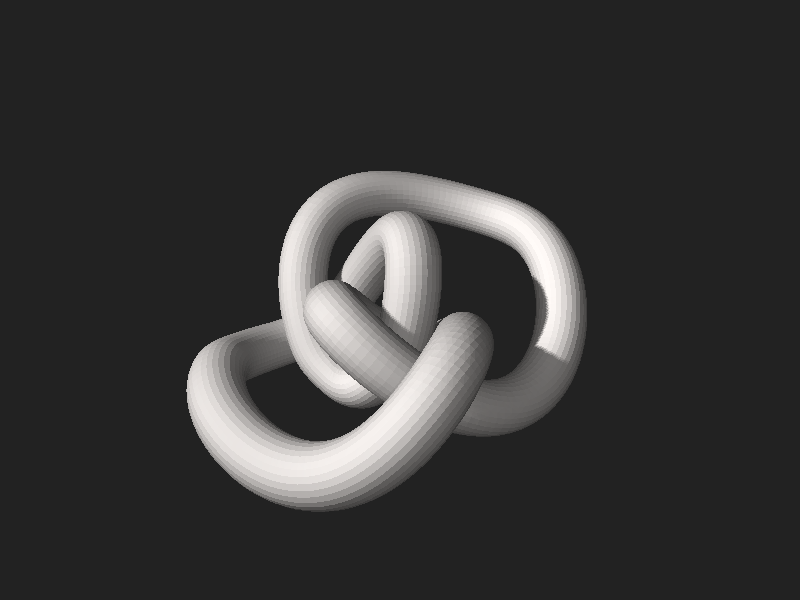
thumb|upright=1.5|A three-dimensional model of a Figure-eight knot (mathematics)|figure-eight knot. The figure-eight knot is a [[prime knot and has an Alexander–Briggs notation of 41.]]
Topology is a branch of mathematics that studies properties of objects and shapes that remain unchanged even when they are bent, stretched, or twisted without tearing or gluing. It matters because it helps mathematicians understand the fundamental characteristics of shapes and spaces in ways that go beyond traditional geometry.
AI-generated from the Wikipedia summary — may contain errors.
Wikidata facts
- Subclass of
- mathematics
- Part of
- mathematics
- Image
- Möbius strip.jpg
Show 11 more facts
- Commons category
- Topology
- topic's main category
- Category:Topology
- Commons gallery
- Topology
- Classification of Instructional Programs code
- 27.0105
- topic has template
- Template:Topology
- practiced by
- topologist
- is the study of
- topological space
- different from
- topography
- on focus list of Wikimedia project
- Wikipedia:Vital articles/Level/4
- Stack Exchange tag
- physics.stackexchange.com/tags/topology
- maintained by WikiProject
- WikiProject Mathematics
via Wikidata · CC0
~23 min read
Encyclopedic overview
28 sectionsContents
- Motivation
- History
- Concepts
- Topologies on sets
- Continuous functions and homeomorphisms
- Manifolds
- Subfields
- General topology
- Algebraic topology
- Differential topology
- Geometric topology
- Generalizations
- Applications
- Biology
- Computer science
- Physics
- Robotics
- Games and puzzles
- Fiber art
- Resources and research
- Major journals
- Major books
- See also
- References
- Citations
- Bibliography
- Further reading
- External links
thumb|upright=1.5|A three-dimensional model of a Figure-eight knot (mathematics)|figure-eight knot. The figure-eight knot is a [[prime knot and has an Alexander–Briggs notation of 41.]]
Topology (from the Greek words , and ) is the branch of mathematics concerned with the properties of a geometric object that are preserved under continuous deformations, such as stretching, twisting, crumpling, and bending; that is, without closing holes, opening holes, tearing, gluing, or passing through itself.
Excerpted from Wikipedia’s “topology” article, available under the CC BY-SA 4.0 licence.
Gallery (14)
Available in 109 languages
- Español
- Français
- Deutsch
- 中文
- 日本語
- Русский
- Português
- Italiano
- العربية
- हिन्दी
- Afrikaans
- Albanian
- Aragonese
- Armenian
- Asturian
- Azerbaijani
- Bahasa Indonesia
- Bangla
Show 90 more
- Bashkir
- Basque
- be_x_old
- Belarusian
- Bikol
- Bosnian
- Bulgarian
- Burmese
- Catalan
- Central Kurdish
- Chuvash
- Croatian
- Czech
- Danish
- Egyptian Arabic
- Esperanto
- Estonian
- Fijian
- Filipino
- Finnish
- Friulian
- Galician
- Gan Chinese
- gcr
- Georgian
- Greek
- Haitian Creole
- Hebrew
- Hungarian
- Icelandic
- Ido
- Interlingua
- Irish
- Jamaican Creole English
- Kalmyk
- Kannada
- Kara-Kalpak
- Kazakh
- Khmer
- Kyrgyz
- Latin
- Latvian
- Lezghian
- Lingua Franca Nova
- Lithuanian
- Luxembourgish
- Macedonian
- Madurese
- Malay
- Mari
- Mongolian
- Nederlands
- Northern Frisian
- Norwegian
- Norwegian Nynorsk
- Novial
- Occitan
- Piedmontese
- Polski
- Punjabi
- rki
- Romanian
- Serbian
- Serbian (Latin)
- Sicilian
- simple
- Sinhala
- Slovak
- Slovenian
- Svenska
- Swahili
- Tajik
- Tamil
- Tibetan
- Tiếng Việt
- Türkçe
- Turkmen
- Ukrainian
- Urdu
- Uzbek
- Waray
- Welsh
- Western Panjabi
- Wu Chinese
- Yiddish
- zh_classical
- zh_yue
- فارسی
- ไทย
- 한국어
via Wikidata sitelinks · CC0