File:Aquarium_total_internal_reflection.jpg · Wikimedia Commons · See Wikimedia Commons
Wikidata facts
- Instance of
- physical phenomenon
- Image
- Reflexión total.jpg
Show 2 more facts
- Commons category
- Total internal reflection
- Commons gallery
- Total internal reflection
Sources (3)
via Wikidata · CC0
~40 min read
Encyclopedic overview
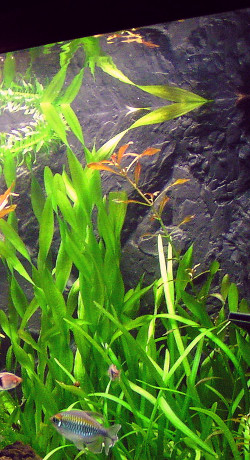
Fig. 1: Underwater plants in a fish tank, and their inverted images (top) formed by total internal reflection in the water–air surface
In physics, total internal reflection (TIR) is the phenomenon in which waves arriving at the interface (boundary) from one medium to another (e.g., from water to air) are not refracted into the second ("external") medium, but completely reflected back into the first ("internal") medium. It occurs when the second medium has a higher wave speed (i.e., lower refractive index) than the first, and the waves are incident at a sufficiently oblique angle on the interface. For example, the water-to-air surface in a typical fish tank, when viewed obliquely from below, reflects the underwater scene like a mirror with no loss of brightness (Fig. 1). A scenario opposite to TIR, referred to as total external reflection, occurs in the extreme ultraviolet and X-ray regimes.
Excerpted from Wikipedia’s “Total internal reflection” article, available under the CC BY-SA 4.0 licence.