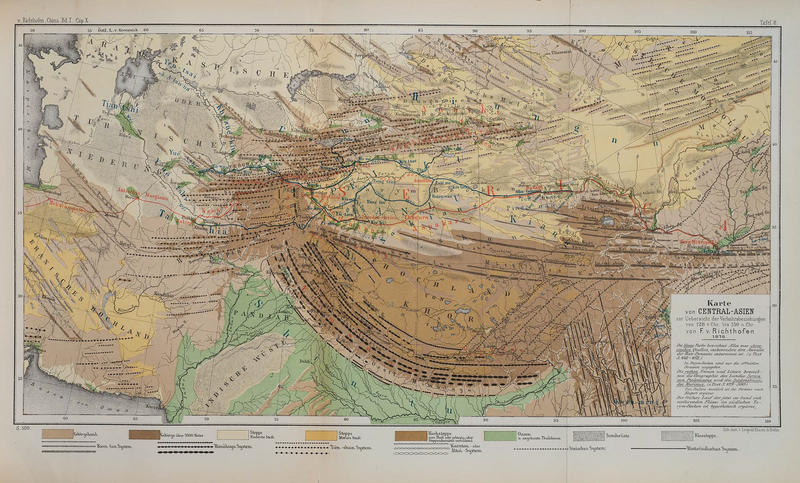
File:Map_of_Central_Asia_with_trade_routes_and_movements,_von_Richthofen.png · Wikimedia Commons · See Wikimedia Commons
trade route
Sign in to saveseries of roads, pathways and stoppages for commercial trade on land; excludes rail
In the Vinony graph
Vinony's link graph records 1,027 inbound references to trade route, and connects out to rail transport, water transport and Austronesian peoples.
It is catalogued under the topic Trade routes.
Vinony links it to 41 Wikipedia language editions.
Wikidata facts
Show 3 more facts
- topic's main category
- Category:Trade routes
- Commons category
- Trade routes
- topic has template
- Template:Trade route
Sources (1)
via Wikidata · CC0
~40 min read
Encyclopedic overview
Map of Central Asia with its trade routes and movements between 128 BCE to 150 CE
A trade route is a logistical network identified as a series of pathways and stoppages used for the commercial transport of cargo. Ancient trade routes were long-distance networks used in the ancient world to exchange goods, ideas, cultures, and technologies between civilizations. The term can also be used to refer to trade over land or water. Allowing goods to reach distant markets, a single trade route contains long-distance arteries, which may further be connected to smaller networks of commercial and noncommercial transportation routes. Among notable trade routes was the Amber Road, which served as a dependable network for long-distance trade. Maritime trade along the Spice Route became prominent during the Middle Ages, when nations resorted to military means for control of this influential route. During the Middle Ages, organizations such as the Hanseatic League, aimed at protecting interests of the merchants and trade became increasingly prominent.
Excerpted from Wikipedia’s “trade route” article, available under the CC BY-SA 4.0 licence.