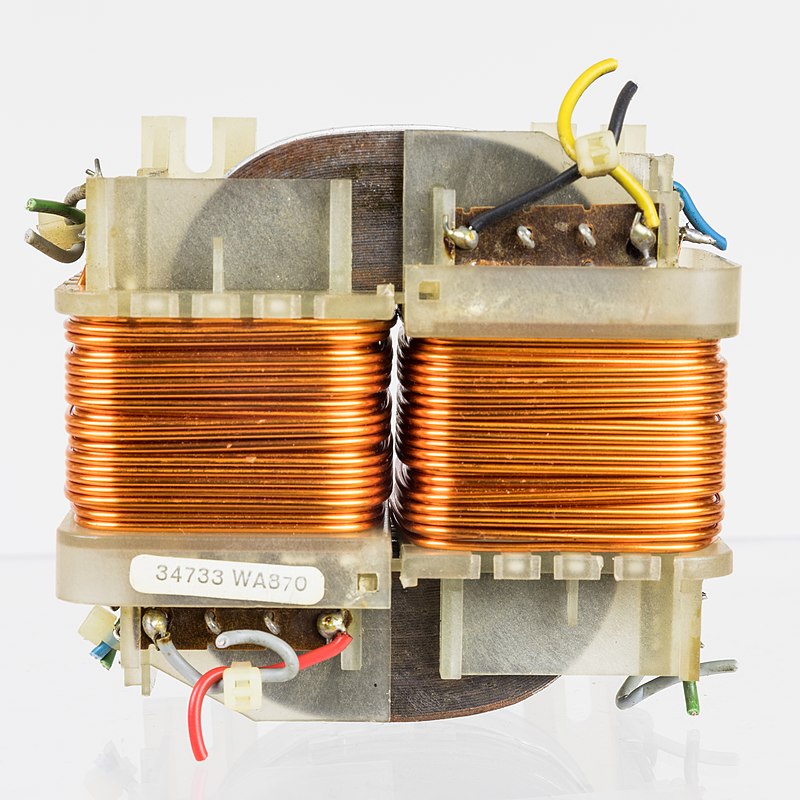
File:Philips_N4422_-_power_supply_transformer-2098.jpg · Wikimedia Commons · See Wikimedia Commons
transformer
Sign in to saveAlso known as electric transformer, trafo, electrical transformer
In electrical engineering, a transformer is a passive component that transfers electrical energy from one electrical circuit to another circuit, or multiple circuits. A varying current in any coil of the transformer produces a varying magnetic flux in the transformer's core, which induces a varying electromotive force (EMF) across any other coils wound around the same core. Electrical energy can be transferred between separate coils without a metallic (conductive) connection between the two circuits. Faraday's law of induction, discovered in 1831, describes the induced voltage effect in any co
A transformer is an electrical device that transfers energy between separate circuits using changing magnetic fields, without requiring a direct connection between them. Transformers matter because they enable efficient power distribution and allow voltage levels to be adjusted for different applications, making modern electrical systems practical.
AI-generated from the Wikipedia summary — may contain errors.
Key facts
- Electronic component.name
- Transformer
- Electronic component.image
- Philips_N4422_-_power_supply_transformer-2098.jpg
- Electronic component.image_size
- 200px
- Electronic component.caption
- An O-core transformer consisting of two coils of copper wire wrapped around a magnetic core
- Electronic component.type
- Passive
- Electronic component.working_principle
- Electromagnetic induction
- Electronic component.inventor
- Michael Faraday
- Electronic component.invention_Year
- 1831
- Electronic component.symbol
- 50px
via Wikipedia infobox
Wikidata facts
- Subclass of
- passive electronic component
- Has part
- coil
- Image
- Philips N4422 - power supply transformer-2098.jpg
- Has use
- voltage converter
Show 6 more facts
- topic's main category
- Category:Electric transformers
- Commons category
- Transformers
- on focus list of Wikimedia project
- Wikipedia:Vital articles/Level/4
- different from
- Transformer
- studied by
- canonical correlation analysis
- OpenStreetMap tag
- power=transformer
via Wikidata · CC0
~44 min read
Encyclopedic overview
35 sectionsContents
- Principles
- Ideal transformer
- Real transformer
- Deviations from ideal transformer
- Leakage flux
- Equivalent circuit
- Transformer EMF equation
- Polarity
- Effect of frequency
- Energy losses
- Construction
- Cores
- Laminated steel cores
- Solid cores
- Toroidal cores
- Air cores
- Windings
- Cooling
- Insulation
- Bushings
- Classification parameters
- Applications
- History
- Discovery of induction
- Induction coils
- First alternating current transformers
- Early series circuit transformer distribution
- Closed-core transformers and parallel power distribution
- Westinghouse improvements
- Other early transformer designs
- See also
- Notes
- References
- Bibliography
- External links
In electrical engineering, a transformer is a passive component that transfers electrical energy from one electrical circuit to another circuit, or multiple circuits. A varying current in any coil of the transformer produces a varying magnetic flux in the transformer's core, which induces a varying electromotive force (EMF) across any other coils wound around the same core. Electrical energy can be transferred between separate coils without a metallic (conductive) connection between the two circuits. Faraday's law of induction, discovered in 1831, describes the induced voltage effect in any coil due to a changing magnetic flux encircled by the coil.
Transformers are used to change AC voltage levels, such transformers being termed step-up or step-down type to increase or decrease voltage level, respectively. Transformers can also be used to provide galvanic isolation between circuits as well as to couple stages of signal-processing circuits. Since the invention of the first constant-potential transformer in 1885, transformers have become essential for the transmission, distribution, and utilization of alternating current electric power. A wide range of transformer designs is encountered in electronic and electric power applications. Transformers range in size from RF transformers less than a cubic centimeter in volume, to units weighing hundreds of tons used to interconnect the power grid.
Excerpted from Wikipedia’s “transformer” article, available under the CC BY-SA 4.0 licence.
Gallery (52)
Available in 117 languages
- Español
- Français
- Deutsch
- 中文
- 日本語
- Русский
- Português
- Italiano
- العربية
- हिन्दी
- Afrikaans
- Albanian
- Albanian
- Aragonese
- Armenian
- Assamese
- Asturian
- azb
Show 98 more
- Azerbaijani
- Bahasa Indonesia
- Bangla
- Bashkir
- Basque
- Bavarian
- be_x_old
- Belarusian
- Bosnian
- Breton
- Bulgarian
- Burmese
- Catalan
- Central Kurdish
- Chechen
- Corsican
- Croatian
- Czech
- Danish
- Esperanto
- Estonian
- Fiji Hindi
- Filipino
- Finnish
- Galician
- Georgian
- Greek
- Haitian Creole
- Hebrew
- Hungarian
- Icelandic
- Ido
- Interlingua
- Irish
- Javanese
- Kannada
- Kara-Kalpak
- Kazakh
- Kikuyu
- Kyrgyz
- Latin
- Latvian
- Lithuanian
- Lombard
- Low German
- Macedonian
- Malagasy
- Malay
- Malayalam
- Marathi
- Minangkabau
- Mongolian
- Nederlands
- Nepali
- Newari
- Northern Frisian
- Norwegian
- Norwegian Nynorsk
- Occitan
- Odia
- Piedmontese
- Polski
- Punjabi
- Romanian
- Rusyn
- Saterland Frisian
- Scots
- Serbian
- Serbian (Latin)
- simple
- Sindhi
- Slovak
- Slovenian
- Sundanese
- Svenska
- Swahili
- Tajik
- Tamil
- Tatar
- Telugu
- Tiếng Việt
- Türkçe
- Turkmen
- Ukrainian
- Urdu
- Uzbek
- Waray
- Welsh
- Western Panjabi
- Wolof
- Wu Chinese
- Yiddish
- zh_min_nan
- zh_yue
- Zulu
- فارسی
- ไทย
- 한국어
via Wikidata sitelinks · CC0