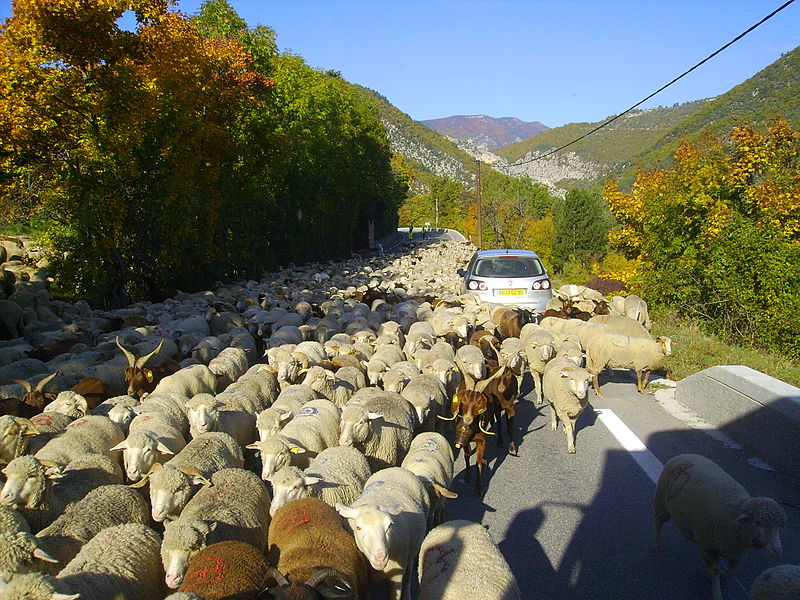
File:Mouton_sur_la_route_de_Entrevaux_a_Annot_0566.JPG · Wikimedia Commons · See Wikimedia Commons
transhumance
Sign in to savethumb|upright=1.2|Transhumance in Alpes-de-Haute-Provence, France
Wikidata facts
- Subclass of
- pastoralism
- Country
- Romania
- Image
- Transumanza nel Parc National des Ecrins.jpg
Show 6 more facts
- Commons category
- Transhumance
- topic's main category
- Category:Transhumance
- exact match
- www.eionet.europa.eu/gemet/concept/11199
- different from
- transhumanism
- OpenStreetMap tag
- route=transhumance
- intangible cultural heritage status
- Representative List of the Intangible Cultural Heritage of Humanity
via Wikidata · CC0
~39 min read
Encyclopedic overview
39 sectionsContents
- Etymology and definition
- In prehistory
- Europe
- Alps
- Balkans
- Poland
- Britain
- Wales
- Scotland
- England
- Ireland
- Italy
- Spain
- The Pyrenees
- Scandinavian Peninsula
- Caucasus and northern Anatolia
- Asia
- Afghanistan
- India
- Iran
- Lebanon
- Kyrgyzstan
- South and East Asia
- Oceania
- Australia
- Africa
- North Africa
- Horn of Africa
- East Africa
- Nigeria
- Angola
- Lesotho
- South Africa
- North America
- South America
- See also
- Sources
- References
- External links
thumb|upright=1.2|Transhumance in Alpes-de-Haute-Provence, France
Transhumance is a type of pastoralism or nomadism, a seasonal movement of livestock between fixed summer and winter pastures. In montane regions (vertical transhumance), it implies movement between higher pastures in summer and lower valleys in winter. Herders have a permanent home, typically in valleys. Generally only the herds travel, with a certain number of people necessary to tend them, while the main population stays at the base. In contrast, movement in plains or plateaus (horizontal transhumance) is more susceptible to disruption by climatic, economic, or political change.
Excerpted from Wikipedia’s “transhumance” article, available under the CC BY-SA 4.0 licence.