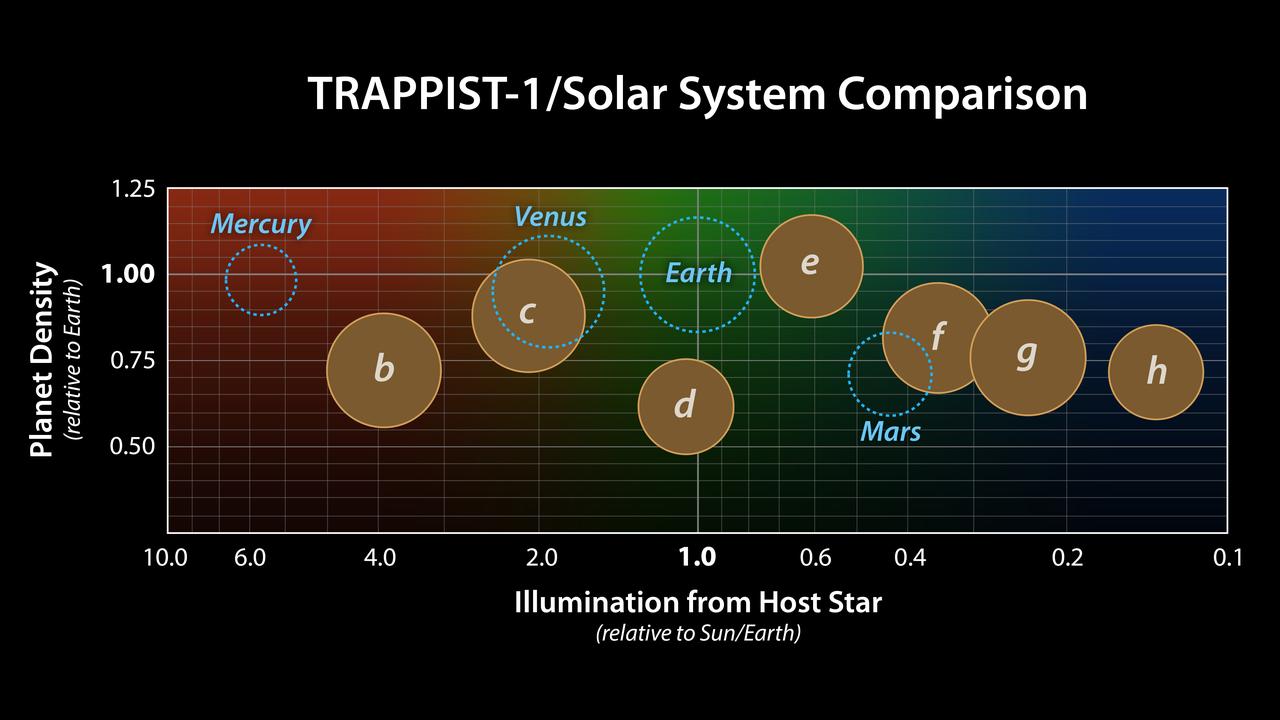
Comparing TRAPPIST-1 to the Solar System · NASA · NASA — public domain
TRAPPIST-1 b
Sign in to saveAlso known as TRAPPIST-1b
TRAPPIST-1b is a terrestrial, Earth-sized exoplanet orbiting around the ultra-cool dwarf star TRAPPIST-1, located away from Earth in the constellation of Aquarius. The planet was detected using the transit method, where a planet dims the host star's light as it passes in front of it. It was first announced on May 2, 2016, and later studies were able to refine its physical parameters.
Astronomical data · SIMBAD
- Object type
- Pl
- Distance
- 41 light-years
- Coordinates
- RA 346.6224° · Dec -5.0414°
via SIMBAD · CDS Strasbourg
Key facts
- Planet.name
- TRAPPIST-1b
- Planet.image
- TRAPPIST-1 b comparison.png
- Planet.caption
- Earth and TRAPPIST-1b compared
- Planet.discoverer
- Michaël Gillon et al.
- Planet.discovery_site
- TRAPPIST
- Planet.discovered
- May 2, 2016
- Planet.discovery_method
- Transit
- Planet.apsis
- astron
- Planet.eccentricity
- 0.00622
- Planet.star
- TRAPPIST-1
- Planet.surface_grav
- g
- Planet.albedo
- 0.020.19
- Planet.single_temperature
- (, equilibrium) (, surface at 12.8 μm) (, surface at 15 μm)
- Planet.atmosphere_composition
- None or extremely thin (uncertain)
via Wikipedia infobox
Exoplanet data
- Host star
- TRAPPIST-1
- Discovered
- 2016
- Discovered by
- La Silla Observatory
- Orbital period
- 1.51 days
- Radius
- 1.12 × Earth
- Mass
- 1.37 × Earth
- Equilibrium temp
- 397.60 K
- Distance
- 12.43 pc
via NASA Exoplanet Archive
Wikidata facts
- Constellation
- Aquarius
- Parent body
- TRAPPIST-1
- Radius
- 0.09689
- Mass
- 0.0027
- Orbital period
- 1.51087081
- Image
- Rocky exoplanet TRAPPIST-1 b (illustration) (weic2309a).tiff
Show 15 more facts
- time of discovery or invention
- 2016-05-00
- discovery method
- transit method
- semi-major axis of an orbit
- 0.01111
- orbital eccentricity
- 0
- orbital inclination
- 89.65
- right ascension
- 346.62236835536920
- declination
- -5.04139769179028
- epoch
- J2000.0
- catalog code
- TIC 278892590b
- temperature
- 400.1
- right ascension component of proper motion
- 930.879
- declination component of proper motion
- -479.403
- parallax
- 80.4512
- Commons category
- TRAPPIST-1 b
- argument of periapsis
- 336.86
via Wikidata · CC0
~8 min read
Encyclopedic overview
10 sectionsContents
- Physical characteristics
- Mass, radius, and temperature
- Orbit
- Host star
- Atmosphere
- Geology
- Gallery
- See also
- Notes
- References
TRAPPIST-1b is a terrestrial, Earth-sized exoplanet orbiting around the ultra-cool dwarf star TRAPPIST-1, located away from Earth in the constellation of Aquarius. The planet was detected using the transit method, where a planet dims the host star's light as it passes in front of it. It was first announced on May 2, 2016, and later studies were able to refine its physical parameters.
The planet is about 37% more massive than Earth and about 39% larger in volume; thus its density is very similar. It is the innermost of seven planets orbiting TRAPPIST-1, all of which are terrestrial, but is too close to its star to be in the habitable zone. Observations by the James Webb Space Telescope announced between 2023 and 2024 suggest that it is either airless or has a hazy -rich atmosphere. Its albedo is very low, making it dark in color.
Excerpted from Wikipedia’s “TRAPPIST-1 b” article, available under the CC BY-SA 4.0 licence.