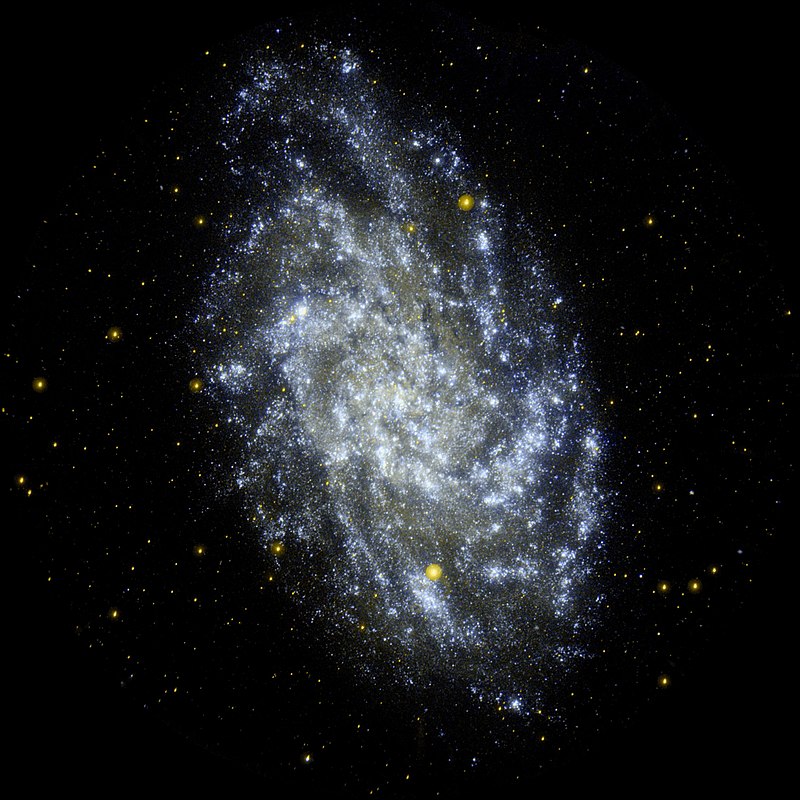
File:M33.jpg · Wikimedia Commons · See Wikimedia Commons
Triangulum Galaxy
Sign in to saveAlso known as Messier 33, M33
spiral galaxy in the constellation of Triangulum
The Triangulum Galaxy is a spiral galaxy located in the constellation Triangulum in our night sky. It is one of the closest major galaxies to Earth and is notable as a member of the Local Group of galaxies that includes our own Milky Way.
AI-generated from the Wikipedia summary — may contain errors.
Wikidata facts
- Instance of
- galaxy
- Has part
- Var 83
- Constellation
- Triangulum
- Parent body
- Andromeda Galaxy
- Child body
- Andromeda XXII
- Distance from Earth
- 0.8
- Radius
- 27500
- Image
- M33.jpg
Show 16 more facts
- discoverer or inventor
- William Parsons, 3rd Earl of Rosse
- catalog code
- Z 502-110
- Commons category
- Triangulum Galaxy
- topic's main category
- Category:Triangulum Galaxy
- time of discovery or invention
- 1654-00-00
- apparent magnitude
- 15.113876
- galaxy morphological type
- SA(s)cd
- redshift
- -0.000597
- Commons gallery
- Messier 33
- radial velocity
- -182
- epoch
- J2000.0
- on focus list of Wikimedia project
- Wikipedia:Vital articles/Level/4
- right ascension
- 23.46206906218
- declination
- 30.66017511198
- right ascension component of proper motion
- 0.707
- declination component of proper motion
- 0.827
via Wikidata · CC0
~18 min read
Encyclopedic overview
The Triangulum Galaxy is a spiral galaxy 2.878 million light-years (ly) from Earth in the constellation Triangulum. It is catalogued as Messier 33 or NGC 598. With the D25 isophotal diameter of 18.74 kiloparsecs (61,100 light-years), the Triangulum Galaxy is the third-largest member of the Local Group of galaxies, behind the Andromeda Galaxy and the Milky Way.
The galaxy is the second-smallest spiral galaxy in the Local Group after the Large Magellanic Cloud, which is a Magellanic-type spiral galaxy. It is believed to be a satellite of the Andromeda Galaxy or on its rebound into the latter due to their interactions, velocities, and proximity to one another in the night sky. It also has an H II nucleus.
Excerpted from Wikipedia’s “Triangulum Galaxy” article, available under the CC BY-SA 4.0 licence.
Gallery (9)
Available in 73 languages
- Español
- Français
- Deutsch
- 中文
- 日本語
- Русский
- Português
- Italiano
- العربية
- हिन्दी
- Afrikaans
- Armenian
- Asturian
- Azerbaijani
- Bahasa Indonesia
- Bangla
- Bashkir
- Basque
Show 54 more
- be_x_old
- Belarusian
- Bosnian
- Breton
- Bulgarian
- Burmese
- Catalan
- Chechen
- Corsican
- Croatian
- Czech
- Danish
- Esperanto
- Estonian
- Finnish
- Greek
- Hebrew
- Hungarian
- Latin
- Latvian
- Lithuanian
- Luxembourgish
- Macedonian
- Malagasy
- Malay
- Malayalam
- Mazanderani
- Nederlands
- Norwegian
- Norwegian Nynorsk
- Occitan
- Polski
- Romanian
- Serbian
- Serbian (Latin)
- simple
- Slovak
- Slovenian
- Svenska
- Tajik
- Tatar
- Tiếng Việt
- Türkçe
- Ukrainian
- Urdu
- Waray
- Welsh
- Wu Chinese
- Zaza
- zh_min_nan
- zh_yue
- فارسی
- ไทย
- 한국어
via Wikidata sitelinks · CC0