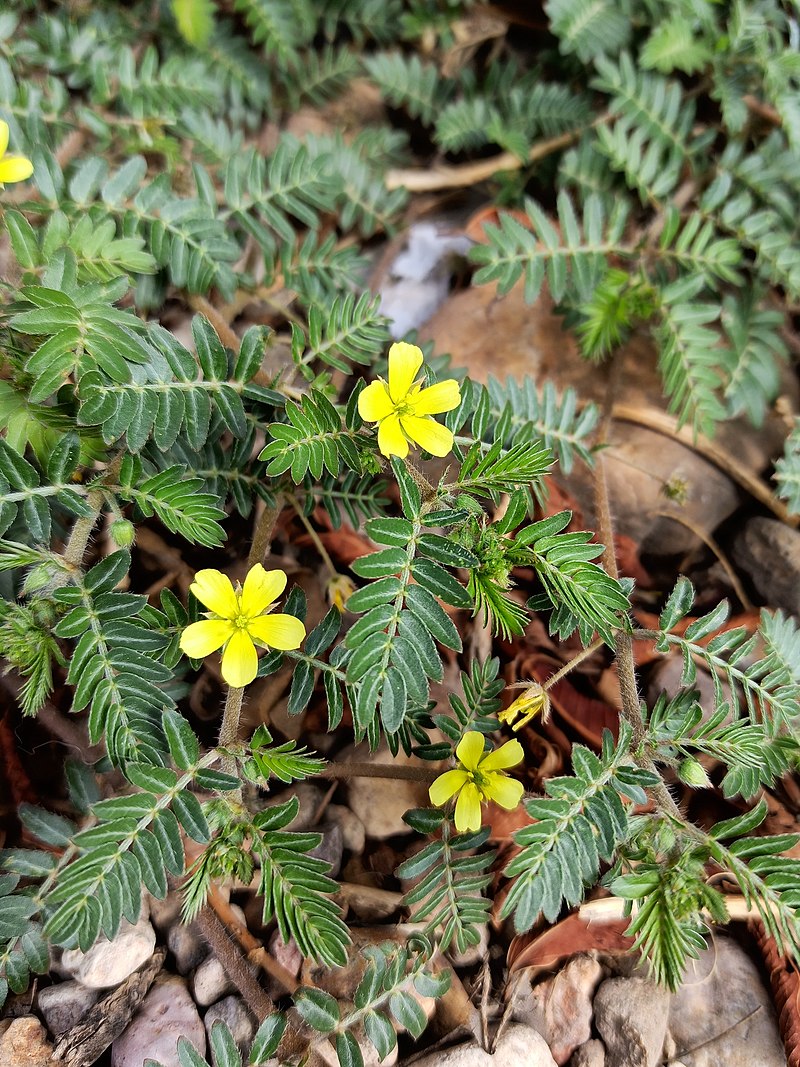
File:Tribulus_terrestris_(Family_Zygophyllaceae).jpg · Wikimedia Commons · See Wikimedia Commons
Tribulus terrestris
Sign in to saveAlso known as devil's thorn, goathead, goat's head, goat head, puncturevine, tackweed, Mexican sandbur, Texas sandbur
species of plant
OverviewAI-generated
*Tribulus terrestris*, commonly known as puncturevine or Devil's thorn, is a species of annual, herbaceous plant in the family Zygophyllaceae. Classified within the order Zygophyllales and class Magnoliopsida, this taxon was described by L. The plant produces yellow flowers and fruits of the nucule type. Its scientific name is derived from the words for caltrop and head.
The species has a wide distribution, with native records in locations including Afghanistan, Albania, Algeria, Angola, Assam, Austria, Baleares, Bangladesh, Benin, Botswana, and Bulgaria. It is also documented in Beijing, China, the Caatinga, and Shanghai. In Mexico, specimen records are held by institutions such as FC-UNAM, ENCB-IPN, CIBNOR, INECOL, and UAZ.
*Tribulus terrestris* is listed as Least Concern on the IUCN Red List, a status assigned in 2020. The plant reaches a height of 15–30 cm. It has various uses, including as a medicinal plant, veterinary drug, fodder, and insecticide.
Synthesized by Vinony from 48 facts across 9 sources: Wikidata, GBIF, iNaturalist, Gbif Occ, IUCN Red List, Encyclopedia of Life, Plants of the World, iDigBio, Vinony graph. Generated from structured data (not the Wikipedia text) and checked against those facts — may still contain errors.
Species
Least Concernpuncture vine
Tribulus terrestris
SPECIES
- KingdomPlantae
- PhylumTracheophyta
- ClassMagnoliopsida
- OrderZygophyllales
- FamilyZygophyllaceae
Height: 15-30 cm.
via GBIF · IUCN · Kew POWO
Museum specimens
- Specimen records
- 8,115
- With media
- 6,176
- Family
- Zygophyllaceae
- Collections
- FC-UNAM, ENCB-IPN, CIBNOR, INECOL, UAZ, FZ-UACH
- Recorded in
- Mexico
Wikidata facts
- Instance of
- taxon
- Subclass of
- herbaceous plant
- Parent taxon
- Tribulus
- Named after
- head
- Image
- COI00105868 - Tribulus orientalis - Woloszczak, Eustach - s.n..jpg
- Has use
- medicinal plant
Show 13 more facts
- taxon rank
- species
- taxon name
- Tribulus terrestris
- Commons category
- Tribulus terrestris
- Commons gallery
- Tribulus terrestris
- taxon common name
- Erdsternchen
- has fruit type
- nucule
- described by source
- Gujin Tushu Jicheng
- IUCN conservation status
- Least Concern
- taxon range
- Zhoushan Archipelago
- flower color
- yellow
- short name
- T. terrestris
- taxon author citation
- L.
Sources (8)
via Wikidata · CC0
~11 min read
Encyclopedic overview
Tribulus terrestris is an annual plant in the caltrop family (Zygophyllaceae) widely distributed around the world. It is adapted to thrive in dry climate locations in which few other plants can survive, and is a highly invasive species.
Native to warm temperate and tropical regions in southern Eurasia and Africa, it has been unintentionally introduced to North America and Australia. T. terrestris is widely known as a noxious weed because of its small woody fruit – the bur – having long sharp and strong spines which easily penetrate surfaces, such as bare feet or thin shoes of crop workers and other pedestrians, the rubber of bicycle tires, and the mouths and skin of grazing animals.
Excerpted from Wikipedia’s “Tribulus terrestris” article, available under the CC BY-SA 4.0 licence.
Gallery (13)
Available in 69 languages
- Español
- Français
- Deutsch
- 中文
- 日本語
- Русский
- Português
- Italiano
- العربية
- हिन्दी
- Afrikaans
- Aragonese
- Armenian
- Asturian
- azb
- Azerbaijani
- Bahasa Indonesia
- Balinese
Show 50 more
- Bangla
- Bulgarian
- Catalan
- Cebuano
- Corsican
- Croatian
- Czech
- Divehi
- Egyptian Arabic
- Esperanto
- Finnish
- Galician
- Georgian
- Gujarati
- Hebrew
- Hungarian
- Kabyle
- kai
- Kannada
- Kinyarwanda
- Latin
- Lithuanian
- Malagasy
- Malayalam
- Marathi
- Navajo
- Nederlands
- Norwegian
- Polski
- Punjabi
- Romanian
- Sanskrit
- Serbian
- Shona
- Sinhala
- Slovak
- Svenska
- Swahili
- Tajik
- Tamil
- Tiếng Việt
- Türkçe
- Ukrainian
- Waray
- Western Panjabi
- Wu Chinese
- zh_yue
- فارسی
- ไทย
- 한국어
via Wikidata sitelinks · CC0