File:Triody_var.jpg · Wikimedia Commons · See Wikimedia Commons
triode
Sign in to saveA triode is an electronic amplifying vacuum tube (or thermionic valve in British English) consisting of three electrodes inside an evacuated glass envelope: a heated filament or cathode, a grid, and a plate (anode).
Key facts
- Electronic component.name
- Triode
- Electronic component.image
- Triody var.jpg
- Electronic component.caption
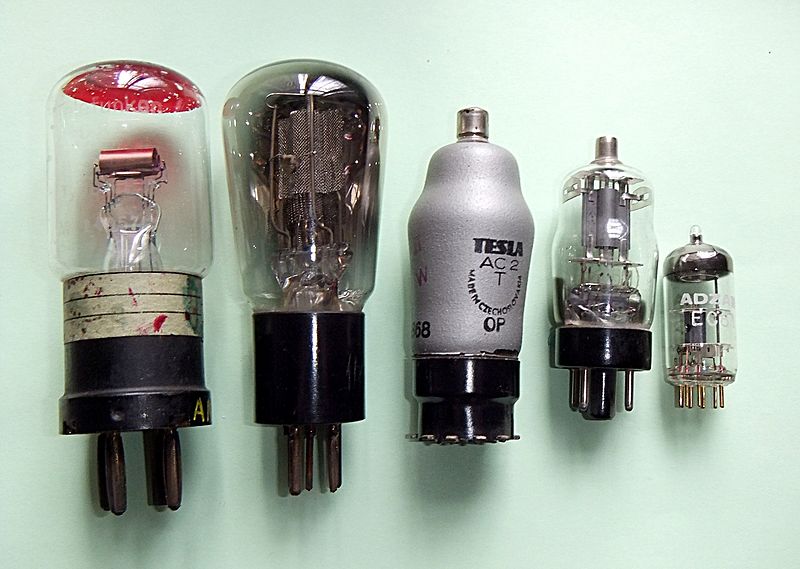
- Examples of low power triodes from 1918 (left) to miniature tubes of the 1960s (right)
- Electronic component.type
- Active
- Electronic component.working_principle
- Thermionic emission
- Electronic component.inventor
- Lee de Forest
- Electronic component.invention_Year
- 1908
- Electronic component.pins
- Plate, grid, and cathode
- Electronic component.symbol
- 80px
via Wikipedia infobox
Wikidata facts
- Subclass of
- electronic component
- Has part
- envelope
- Image
- Triody var.jpg
Show 4 more facts
- Commons category
- Vacuum triodes
- discoverer or inventor
- Robert von Lieben
- time of discovery or invention
- 1906-00-00
Sources (3)
via Wikidata · CC0
~26 min read
Encyclopedic overview
19 sectionsContents
- Name
- History
- Precursor devices
- Invention
- Wider adoption
- Construction
- Low power triodes
- High-power triodes
- Lighthouse tubes
- Operation
- Comparison of ECC81, ECC82, and ECC83
- Plate characteristics
- Dependence of amplification factor on structure
- Applications
- Characteristics and load lines
- Use in guitar amplifiers
- See also
- References
- External links
A triode is an electronic amplifying vacuum tube (or thermionic valve in British English) consisting of three electrodes inside an evacuated glass envelope: a heated filament or cathode, a grid, and a plate (anode).
Developed from Lee De Forest's 1906 Audion, a partial vacuum tube that added a grid electrode to the thermionic diode (Fleming valve), the triode was the first practical electronic amplifier and the ancestor of other types of vacuum tubes such as the tetrode and pentode. Its invention helped make amplified radio technology and long-distance telephony possible. Triodes were widely used in consumer electronics devices such as radios and televisions until the 1970s, when transistors replaced them. Today, their main remaining use is in high-power RF amplifiers in radio transmitters and industrial RF heating devices. In recent years there has been a resurgence in demand for low power triodes due to renewed interest in tube-type audio equipment by audiophiles who prefer the sound of tube-based electronics.
Excerpted from Wikipedia’s “triode” article, available under the CC BY-SA 4.0 licence.