File:Phase-diag2.svg · Wikimedia Commons · See Wikimedia Commons
triple point
Sign in to savethermodynamic point where three matter phases exist
The triple point is the specific temperature and pressure at which all three states of matter—solid, liquid, and gas—can exist together in perfect balance. This point is scientifically important because it's used as a precise reference standard for measuring temperature and defining the scale we use on thermometers.
AI-generated from the Wikipedia summary — may contain errors.
Wikidata facts
- Subclass of
- phase change
- Has part
- pressure
Show 4 more facts
- studied by
- thermodynamics
- Commons category
- Triple point
- on focus list of Wikimedia project
- Wikipedia:Vital articles/Level/4
- has characteristic
- possibility
Sources (3)
via Wikidata · CC0
~6 min read
Encyclopedic overview
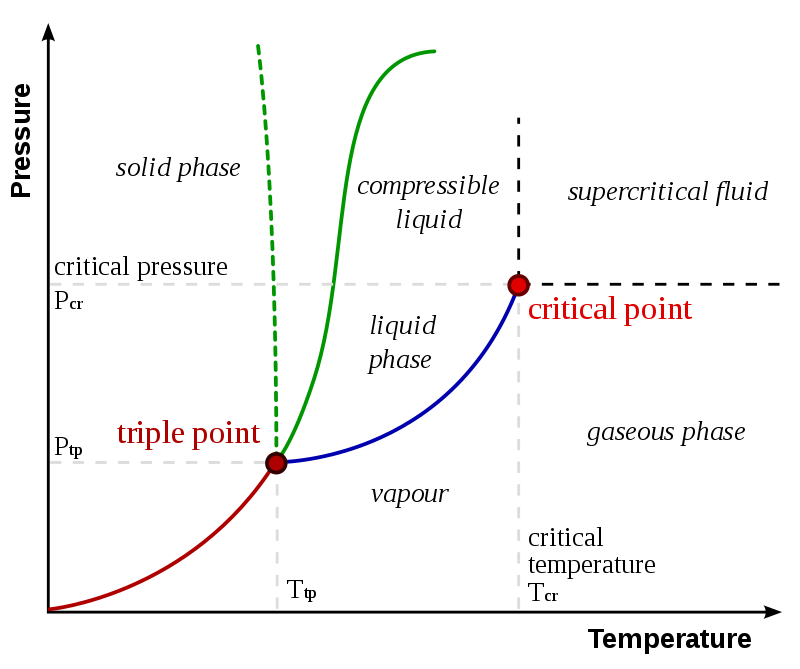
A typical phase diagram. The solid green line applies to most substances; the dashed green line gives the anomalous behavior of water
In thermodynamics, the triple point of a substance is the temperature and pressure at which the three phases (gas, liquid, and solid) of that substance coexist in thermodynamic equilibrium. It is that temperature and pressure at which the sublimation, fusion, and vapourisation curves meet. For example, the triple point of mercury occurs at a temperature of −38.8 °C (−37.8 °F) and a pressure of 0.165 mPa.
Excerpted from Wikipedia’s “triple point” article, available under the CC BY-SA 4.0 licence.
Gallery (3)
Available in 69 languages
- Español
- Français
- Deutsch
- 中文
- 日本語
- Русский
- Português
- Italiano
- العربية
- हिन्दी
- Afrikaans
- Aragonese
- Armenian
- Asturian
- Bahasa Indonesia
- Bangla
- Basque
- Belarusian
Show 50 more
- Bosnian
- Breton
- Bulgarian
- Catalan
- Chuvash
- Croatian
- Czech
- Danish
- Esperanto
- Estonian
- Finnish
- Galician
- Hebrew
- Hungarian
- Icelandic
- Interlingua
- Kazakh
- Latin
- Latvian
- Low German
- Macedonian
- Malayalam
- Mongolian
- Nederlands
- Norwegian
- Norwegian Nynorsk
- Occitan
- Piedmontese
- Polski
- Romanian
- Serbian
- Serbian (Latin)
- simple
- Sinhala
- Slovak
- Slovenian
- Svenska
- Swahili
- Tamil
- Tiếng Việt
- Türkçe
- Ukrainian
- Urdu
- Western Panjabi
- Wu Chinese
- zh_min_nan
- zh_yue
- فارسی
- ไทย
- 한국어
via Wikidata sitelinks · CC0