File:Wikipedia_vandalism.svg · Wikimedia Commons · See Wikimedia Commons
troll
Sign in to saveAlso known as internet troll, online troll
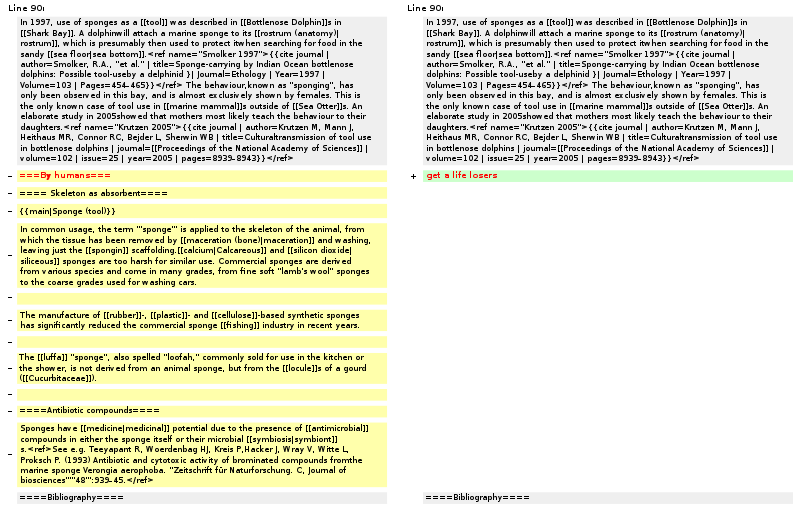
thumb|upright=1.2|A revision of a Wikipedia article shows a troll Vandalism on Wikipedia|vandalizing by replacing content with an insult.|alt= In slang, trolling is when a person posts deliberately offensive or provocative messages online (such as in social media, a forum, a chat room, an online video game) or performs similar behaviors in real life. The methods and motivations of trolls can range from benign to sadistic. These messages can be inflammatory, insincere, digressive, extraneous, or off-topic, and may have the intent of provoking others into displaying emotional responses, or manip
A troll is someone who posts deliberately offensive or provocative messages online (or behaves similarly in person) with the goal of provoking emotional reactions from others. Trolling matters because it can disrupt online communities, spread misinformation, and negatively affect the people targeted, ranging from minor annoyances to more serious harassment.
AI-generated from the Wikipedia summary — may contain errors.
Wikidata facts
- Instance of
- occupation
- Named after
- troll
- Image
- Internet Troll velu ill artlibre jnl.jpg
- Field of occupation
- trolling
Show 8 more facts
- Commons category
- Internet trolling
- Commons gallery
- Troll (Internet)
- topic's main category
- Category:Internet trolling
- male form of label
- متصيد
- female form of label
- trolka
- WordLift URL
- data.thenextweb.com/tnw/entity/troll
- different from
- troll
- hashtag
- troll
Sources (3)
via Wikidata · CC0
~37 min read
Encyclopedic overview
23 sectionsContents
- Usage
- Responses
- Origin and etymology
- In other languages
- Trolling, identity, and anonymity
- Corporate, political, and special-interest sponsored trolls
- Psychological characteristics
- Concern troll
- Troll sites
- Media coverage and controversy
- Australia
- India
- Japan
- United Kingdom
- United States
- Examples
- See also
- References
- Further reading
- External links
- Trolling advocacy and safety
- Background and definitions
- Academic and debate
thumb|upright=1.2|A revision of a Wikipedia article shows a troll Vandalism on Wikipedia|vandalizing by replacing content with an insult.|alt= In slang, trolling is when a person posts deliberately offensive or provocative messages online (such as in social media, a forum, a chat room, an online video game) or performs similar behaviors in real life. The methods and motivations of trolls can range from benign to sadistic. These messages can be inflammatory, insincere, digressive, extraneous, or off-topic, and may have the intent of provoking others into displaying emotional responses, or manipulating others' perceptions, thus acting as a bully or a provocateur. The behavior is typically for the troll's amusement, or to achieve a specific result such as disrupting a rival's online activities or purposefully causing confusion or harm to other people. Trolling behaviors involve tactical aggression to incite emotional responses, which can adversely affect the target's well-being.
In this context, the noun and the verb forms of "troll" are frequently associated with Internet discourse. Since at least the 2010s, media attention has equated trolling with online harassment. The Courier-Mail and The Today Show have used "troll" to mean "a person who defaces Internet tribute sites with the aim of causing grief to families". In addition, depictions of trolling have been included in popular fictional works, such as the HBO television program The Newsroom, in which a main character encounters harassing persons online and tries to infiltrate their circles by posting negative sexual comments.
Excerpted from Wikipedia’s “troll” article, available under the CC BY-SA 4.0 licence.
Gallery (9)
Available in 72 languages
- Español
- Français
- Deutsch
- 中文
- 日本語
- Русский
- Português
- Italiano
- العربية
- हिन्दी
- Albanian
- Aragonese
- Armenian
- Bahasa Indonesia
- Bangla
- Basque
- Bavarian
- Bhojpuri
Show 53 more
- Bosnian
- Breton
- Bulgarian
- Catalan
- Central Kurdish
- Croatian
- Czech
- Danish
- Egyptian Arabic
- Esperanto
- Estonian
- Finnish
- Friulian
- Galician
- Georgian
- Gilaki
- Greek
- Hebrew
- Hungarian
- Icelandic
- Interlingua
- Lao
- Latvian
- Limburgish
- Lithuanian
- Macedonian
- Malayalam
- Mazanderani
- Mirandese
- Nederlands
- Norwegian Nynorsk
- Polski
- Punjabi
- Romanian
- Sardinian
- Serbian
- Serbian (Latin)
- Sicilian
- simple
- Svenska
- Swahili
- Tiếng Việt
- Türkçe
- Ukrainian
- Urdu
- Welsh
- Wu Chinese
- Yiddish
- zh_min_nan
- zh_yue
- فارسی
- ไทย
- 한국어
via Wikidata sitelinks · CC0