File:Jumo_004.jpg · Wikimedia Commons · See Wikimedia Commons
turbojet
Sign in to saveAlso known as jet engine, turbojet engine
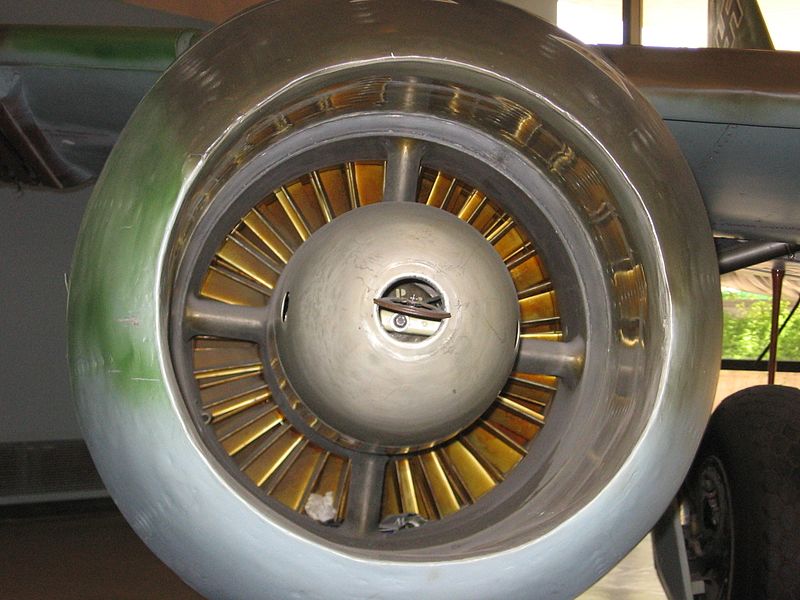
thumb|Junkers Jumo 004, the first production turbojet in operational use, showing the starter pull-start handle housed in the center of the intake nose bullet. thumb|Diagram of a typical gas turbine jet engine thumb|Frank Whittle thumb|Hans von Ohain The turbojet is an airbreathing jet engine which is typically used in aircraft. It consists of a gas turbine with a propelling nozzle. The gas turbine has an air inlet which includes inlet guide vanes, a compressor, a combustion chamber, and a turbine (that drives the compressor). The compressed air from the compressor is heated by burning fuel in
Wikidata facts
- Subclass of
- airbreathing jet engine
- Image
- Jet engine.svg
- Has parts of class
- turboprop
Show 3 more facts
- discoverer or inventor
- Hans von Ohain
- inception
- 1930-00-00
- Commons category
- Turbojet engines
Sources (2)
via Wikidata · CC0
~20 min read
Encyclopedic overview
18 sectionsContents
- History
- Early designs
- Components
- Nose bullet
- Air intake
- Compressor
- Combustion chamber
- Turbine
- Nozzle
- Afterburner
- Thrust
- Thrust augmentation
- Net thrust
- Cycle improvements
- See also
- References
- Further reading
- External links
thumb|Junkers Jumo 004, the first production turbojet in operational use, showing the starter pull-start handle housed in the center of the intake nose bullet. thumb|Diagram of a typical gas turbine jet engine thumb|Frank Whittle thumb|Hans von Ohain The turbojet is an airbreathing jet engine which is typically used in aircraft. It consists of a gas turbine with a propelling nozzle. The gas turbine has an air inlet which includes inlet guide vanes, a compressor, a combustion chamber, and a turbine (that drives the compressor). The compressed air from the compressor is heated by burning fuel in the combustion chamber and then allowed to expand through the turbine. The turbine exhaust is then expanded in the propelling nozzle where it is accelerated to high speed to provide thrust. Two engineers, Frank Whittle in the United Kingdom and Hans von Ohain in Germany, developed the concept independently into practical engines during the late 1930s.
Turbojets have poor efficiency at low vehicle speeds, which limits their usefulness in vehicles other than aircraft. Turbojet engines have been used in isolated cases to power vehicles other than aircraft, typically for attempts on land speed records. Where vehicles are "turbine-powered", this is more commonly by use of a turboshaft engine, a development of the gas turbine engine where an additional turbine is used to drive a rotating output shaft. These are common in helicopters and hovercraft.
Excerpted from Wikipedia’s “turbojet” article, available under the CC BY-SA 4.0 licence.