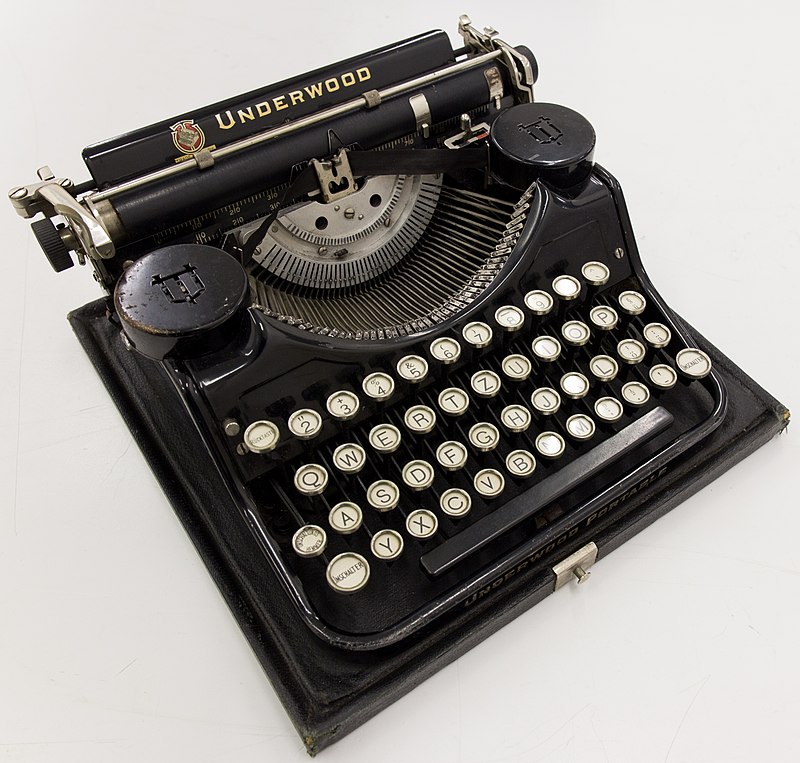
File:MEK_II-371.jpg · Wikimedia Commons · See Wikimedia Commons
typewriter
Sign in to saveAlso known as Typewriters
thumb|Mechanical typewriters, such as this 1930s Underwood Typewriter Company|Underwood, were long-time standards in government agencies, newsrooms, and offices. thumb|This late 1960s Olivetti Valentine typewriter designed by [[Ettore Sottsass became a pop-culture icon.]] A typewriter is a mechanical or electromechanical machine for typing characters. Typically, a typewriter has an array of keys, and each one causes a different single character to be produced on paper by striking an inked ribbon selectively against the paper with a type element. Thereby, the machine produces a legible written
A typewriter is a mechanical or electromechanical machine with an array of keys that produce typed characters on paper by striking an inked ribbon with a type element. Typewriters were long-time standards in government agencies, newsrooms, and offices, and some models became cultural icons.
AI-generated from the Wikipedia summary — may contain errors.
Wikidata facts
- Subclass of
- machine
- Image
- Olivetti Lettera 22 by LjL.jpeg
Show 7 more facts
- Commons category
- Typewriters
- topic's main category
- Category:Typewriters
- Commons gallery
- Typewriter
- 2022 Harmonized System Code
- 8469
- has characteristic
- keyboard layout
- P8168
- Aleksandrovskaya
- on focus list of Wikimedia project
- Wikipedia:Vital articles/Level/4
Sources (2)
via Wikidata · CC0
~67 min read
Encyclopedic overview
51 sectionsContents
- History
- Hansen Writing Ball
- Sholes and Glidden typewriter
- Index typewriter
- Other typewriters
- Standardization
- Frontstriking
- Four-bank keyboard
- Shift key
- Three-bank typewriters
- Tab key
- Dead keys
- Character sizes
- Color
- "Noiseless" designs
- Electric designs
- Early electric models
- IBM Selectric
- Later electric models
- Electronic typewriters
- Decline
- Correction technologies
- Typewriter erasers
- Erasing shield
- Erasable bond
- Correction fluid
- Legacy
- Keyboard layouts
- QWERTY
- Other layouts for English
- Keyboards for other languages
- Typewriter conventions
- Terminology repurposed for the computer age <span class="anchor" id="Terminology"></span>
- Social effects
- Writers with notable associations with typewriters
- Early adopters
- Others
- Late users
- Typewriters in popular culture
- In music
- Other
- Forensic examination
- Collections
- Gallery
- See also
- Notes
- References
- Patents
- Further reading
- External links
- Revival
thumb|Mechanical typewriters, such as this 1930s Underwood Typewriter Company|Underwood, were long-time standards in government agencies, newsrooms, and offices. thumb|This late 1960s Olivetti Valentine typewriter designed by [[Ettore Sottsass became a pop-culture icon.]] A typewriter is a mechanical or electromechanical machine for typing characters. Typically, a typewriter has an array of keys, and each one causes a different single character to be produced on paper by striking an inked ribbon selectively against the paper with a type element. Thereby, the machine produces a legible written document composed of ink and paper. By the end of the 19th century, a person who used such a device was also referred to as a typewriter.
The first commercial typewriters were introduced in 1874, but did not become common in offices in the United States until after the mid-1880s. The typewriter quickly became an indispensable tool for practically all writing other than personal handwritten correspondence. It was widely used by professional writers, in offices, in business correspondence in private homes, and by students preparing written assignments.
Excerpted from Wikipedia’s “typewriter” article, available under the CC BY-SA 4.0 licence.
Gallery (52)
Available in 99 languages
- Español
- Français
- Deutsch
- 中文
- 日本語
- Русский
- Português
- Italiano
- العربية
- हिन्दी
- Afrikaans
- Albanian
- Armenian
- Asturian
- Azerbaijani
- Bahasa Indonesia
- Bangla
- Bashkir
Show 80 more
- Basque
- be_x_old
- Belarusian
- Bhojpuri
- Bikol
- Bosnian
- Bulgarian
- Burmese
- Catalan
- Chuvash
- Croatian
- Czech
- Danish
- Egyptian Arabic
- Esperanto
- Estonian
- Finnish
- Galician
- Gan Chinese
- Georgian
- Greek
- Hebrew
- Hungarian
- Icelandic
- Ido
- Inupiaq
- Irish
- Jamaican Creole English
- Javanese
- Kannada
- Kazakh
- Latin
- Latvian
- Lombard
- Luxembourgish
- Malagasy
- Malay
- Malayalam
- Marathi
- Nederlands
- Norwegian
- Norwegian Nynorsk
- nup
- Odia
- Polski
- Punjabi
- Romanian
- Sanskrit
- Serbian
- Serbian (Latin)
- simple
- Sindhi
- Sinhala
- Slovak
- Slovenian
- Sundanese
- Svenska
- Swahili
- Tamil
- Telugu
- Tiếng Việt
- Türkçe
- Tyap
- Ukrainian
- Urdu
- Uzbek
- Venetian
- Waray
- Wayuu
- Welsh
- Western Frisian
- Western Panjabi
- Wu Chinese
- Yiddish
- Zaza
- zh_min_nan
- zh_yue
- فارسی
- ไทย
- 한국어
via Wikidata sitelinks · CC0