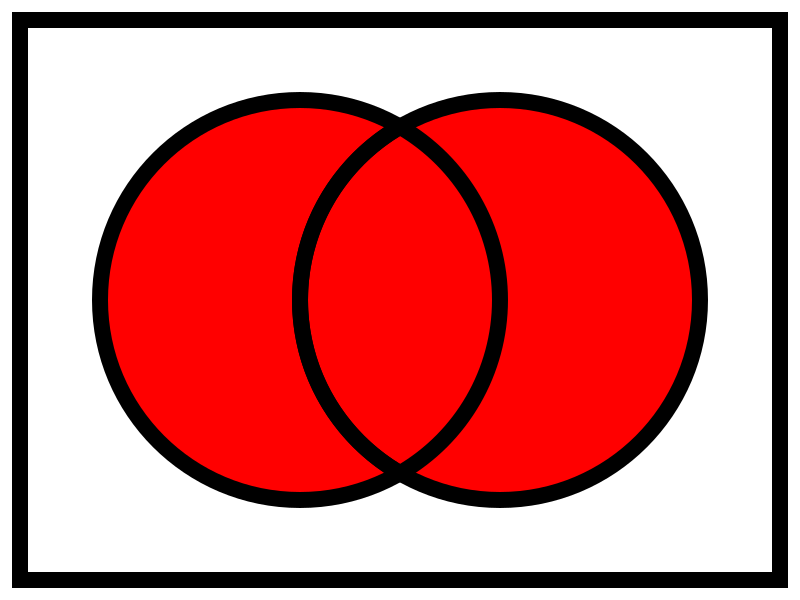
File:Venn0111.svg · Wikimedia Commons · See Wikimedia Commons
اتحاد
Sign in to saveAlso known as set union, union of two sets, union of sets, ∪
عملية على مجموعتين تنتج مجموعة جديدة فيها عناصر المجموعاتين كلهما مع إزالة التكرار، إن وجد.
A union is a mathematical operation (shown by the symbol "∪") that combines two sets into a single set containing all the distinct elements from both. It matters because it's a fundamental tool for organizing and comparing groups of items in mathematics, logic, and computer science.
AI-generated from the Wikipedia summary — may contain errors.
Wikidata facts
- Subclass of
- connection
- Image
- Venn0111.svg
Show 6 more facts
- Commons category
- Union (set theory)
- TeX string
- \cup
- different from
- Union
- maintained by WikiProject
- WikiProject Mathematics
- opposite of
- intersection
- has characteristic
- associativity
Sources (1)
via Wikidata · CC0
Article · العربية
في نظرية المجموعات، يشير مصطلح الاجتماع أو الاتحاد إلى العملية على المجموعات التي تستخدم في دمج مجموعتين للحصول على مجموعة جديدة تحوي عناصر كلا المجموعتين. كمثال بسيط على هذه العملية، إن اجتماع مجموعتين منفصلتين لا تشتركان بأي عنصر هو المجموعتان ذاتهما.
Abstract from DBpedia / Wikipedia · CC BY-SA
Gallery (3)
Available in 63 languages
- Español
- Français
- Deutsch
- 中文
- 日本語
- Русский
- Português
- Italiano
- العربية
- हिन्दी
- Albanian
- Amharic
- Armenian
- Bahasa Indonesia
- Basque
- be_x_old
- Belarusian
- Bulgarian
Show 44 more
- Catalan
- Chuvash
- Croatian
- Czech
- Esperanto
- Estonian
- Filipino
- Finnish
- fiu_vro
- Galician
- Greek
- Hebrew
- Hungarian
- Icelandic
- Ido
- Interlingua
- Irish
- Kalmyk
- Kazakh
- Lombard
- Macedonian
- nah
- Nederlands
- Norwegian
- Norwegian Nynorsk
- Oromo
- Piedmontese
- Polski
- Romanian
- Serbian
- Slovak
- Slovenian
- Svenska
- Tamil
- Tiếng Việt
- Türkçe
- Ukrainian
- Welsh
- Wu Chinese
- zh_classical
- zh_yue
- فارسی
- ไทย
- 한국어
via Wikidata sitelinks · CC0